For my first blog I thought it might be a good idea to write on the pressing matter of climate change. More specifically I will be discussing the findings from a paper talking about the impacts of climate change on Wetlands, by Michener et al, which was written in 1997. The article concludes that the changes associated with climate change will drastically impact wetlands. These changes to wetlands will mainly because of hurricanes and other tropical storms. These factors will impact biodiversity number of extinctions in wetlands, and primary production. A few changes to wetland areas that I found alarming were that this study showed that salinization caused by climate change effects will make marshes in low lying forested areas more common, wetlands near coasts will move inland as seas rise, and there have been cases of mangroves turning into open water areas.
If one goes through the article, it is clear that climate change is changing habitats. These changes, as we have learned in many of our courses, usually happen over a long period of time, but because of climate change they are occurring much faster. The article also talks about how human disturbance is adding toxic chemicals into these wetlands as well. There are also permafrost wetlands, according to the study that are at risk of melting further north. This means that if we wish to stop further global warming, we need to do more to protect wetlands.
Imagine you’re a plant biologist on an isolated island conducting research and you just sequenced a novel plant species, never before seen, that produces diamonds as seeds. This is amazing and your discovery has to be shared with everyone, but how? How does a knowledge-creating sector share this knowledge? Well, there are many tiers to the knowledge sharing pyramid and I like to think of it also as how information flows and is suited based on a particular audience. There are 3 types of literature: peer-reviewed primary, secondary, and tertiary.
Image from wikimedia commons by Ruta Badina
Peer-reviewed primary literature.
These are written by academics, editing and reviewed by other academics in the field, and published for other academics to read in scholarly journals like Science, the Journal of Plant Ecology, Frontiers in Plant Science, or Perspectives in Plant Ecology,Evolution, and Systematics. These articles may sometimes be hidden behind a paywall (unless it is available by open access) or may be accessible through the academic institution’s library database. Using the same plant biologist example, the purpose of you writing this article is to inform others in your field globally of this new discover. Its purpose is to advance knowledge. The writing style of the article would be highly specialized to the field because assumes other plant biologist would be reading it. It would also include sections for methodology and a detailed bibliography
Zhu, Y. H., Weiner, J., Yu, M. X., & Li, F. M. (2018). Evolutionary agroecology: Trends in root architecture during wheat breeding. Evolutionary applications, 12(4), 733–743. doi:10.1111/eva.12749
Peer Reviewed Secondary Literature
Imagine a few years later, other ecologists did more research on this same plant and later found it was a part of a family of plants that had a diverted ancestry because they were on this small isolated island. A group of researchers now decide to publish a summary of all the research done on this over the past few years. This would be secondary literature. It discusses information that was previously published. These would also have a detailed bibliography but no methodology section. The article would focus heavily on analysis and interpretation of data or information from a multitude of primary sources. These would also be published in scholarly academic journals, but would they often have “review of…” somewhere in the title or “review article” on the above the abstract. These also are written for other academics by academics and are subject to the same peer review process. There may not be as specialized, field specific jargon being used. University students often find this type of source most helpful to begin with because it summarizes the major concepts relating to a particular topic
Garnier, E., Navas, M. (2012) A trait-based approach to comparative functional plant ecology: concepts, methods and applications for agroecology. A review. Agron. Sustain. Dev. 32, 365–399. https://doi.org/10.1007/s13593-011-0036-y
Tertiary Literature
Tertiary research is meant to have the widest audience scope of all of the above-mentioned categories. The information is consolidated into a concise summary and a simplified explanation. A common example of this is textbooks. Theses typically are not cited in academic research and use the least technical jargon (some basic foundational background knowledge may be needed to understand the work). It is meant to be read by individuals who don’t necessarily have the scientific background or expertise. Tertiary literature may also include dictionary, encyclopedias, almanacs, manuals, or Wikipedia.
When I was searching for documentaries for the Applied Plant Ecology Film Festival, I struggled between two films which I thought best provided information and cleared up misconceptions about plant. I ended up choosing an episode from Battleground Everglades about invasive species, but a close second was “A Fragile World.”
With a duration of 51 minutes and 40 seconds, this documentary immediately begins by establishing the interconnectivity of different living systems on Earth and how important it is to the survival of life to maintain this delicate balance between living organism in an ecosystem. Human influence is directly identified as the culprit in causing massive extinctions we are currently facing by altering our environments to suit our needs. As a result of this human influence entire ecosystems have disappeared. This is significant to establish right away the human impact is the cause of all the loss of biodiversity and climate change as there is sometimes to false conception that climate change is simply a part of the natural cycle of the Earth’s temperature cycle. In countries where they depend on land to grow their food and provide their livelihood; these areas also high biodiversity areas. The during of the land to clear it leads to the loss of ecosystems and biodiversity. Tropical rainforests are homed to half the species of man but only cover 6% of the earth’s surface. This is the most sensitive area for the conservation of biodiversity conservation. Human impact has resulted in the loss of 60% of the temperate forests and 30% of the coniferous forest. 45% of rainforest is wasteland and 70% of dry tropical forest have been cut down. The rainforests impacts are wide reaching (e.g. the equatorial rains) and its lost impacts life outside of itself as well, influencing the water and atmosphere.
One of the case study areas the documentary chooses to focus on is Madagascar, an island of independent evolution. The species that live here are isolated and independent from the rest of the world. The species were not subject to the same selective pressures as the rest of the world. The isolation has given rise the plants which are distinct from those around the planet and the biodiversity here is high. However, due to its unique ecosystems, it’s also an extremely fragile existence which must be protected. Species living on Madagascar may not exist anywhere else in the world. Any external influences that alter the fragile niches here may result in the loss of the species forever. This had the biggest impact on me because I had no idea that such uniqueness still existed in the world today. I thought that many of the organisms living on Madagascar would have some differences to those on continental Africa. I had not anticipated the differences would be such that this may the only habitat of some organisms. The theme of species interdependency arises here again and stresses the importance and vitality of each organism to the survival of the entire ecosystem. Unfortunately, man’s impact as stretched here as well and half of the Madagascan jungles are been destroyed.
Image of Madagascar abstained from Wikimedia Commons.
What binds all human societies is the need for survival and supplying our most basic needs, food for survival. From the richest to the poorest, food security is an issue of great importance to us all. The agricultural industry has a net worth 2.4 TRILLION globally (according to croplife.com as of 2015). Additionally, the agricultural industry is a large contributor to global warming and climate change. You would think that the industry is pumping out a large variety of many different crops, but in reality, only a few plants actually make up our main food supply. The major crops that feed us are wheat, rice, maize, a soybean. The issue is that these are usually grown in large monocultures. By cultivating a single crop using one specific type of method, that entire supply is vulnerable to disease or insects which could jeopardize the 2.4 trillion-dollar industry and our food supply.
We have seen monocrop supplies get wiped out in the past like potato blight and the Irish famine in the 1840s which lead to many deaths, rice blight in the 1960s which lead to 80% yield loss in certain areas of South East Asia, and the southern corn leaf blight epidemic in the 1970s and the Gros Michel banana and Panama Disease.
The banana situation serves as a warning that our old methods must be changes. When Panama Disease wiped out the Gros Michel bananas, there were billions of dollars lost. The industry switched to the Cavendish Banana which was resistant to the disease. This worked for a while but the variant strain of the Panama disease as re-emerged and the Cavendish is no longer resistant. Finding another resistant plant and growing it as a monoculture is not feasible for the future.
Sustainable farming
Sustainable farming is a complex concept that can be simplified by thinking of the future. This involves employing practices that will ensure there are resources remaining for future use.
Permaculture: aims to promote biodiversity by implementing a diverse range of crops, keeping the ecosystem strong and well protected.
Rotating crops and embracing diversity
Applying integrated pest management
Building and maintaining healthy soil
Following the theme of sustainable agriculture, a new research field has developed, agroecology. This is the study of ecological processes as it applies to agricultural production systems. This ideology supports farms that are small and have low level of input to find a balance between economically profitable production and sustainability of the natural resources. According to the Report of the Regional Meeting on Agroecology in Sub-Saharan Africa, the employment of agroecological practices increased agricultural yields without any negative impacts on the environment
When you do a google search for “ecologist,” the first few images that pop up are women. Of the top 10 images, 7 of them show women in the field. This is vastly different from the face of science many years ago. While many women have been influential and contributed to the field their impacts are often hidden. In my undergrad experience, of the countless course I’ve taken, I’ve only had 5 female science professors. This is not representative of women’s contributions to scientific academia at all.
Her research focusses on managing ecosystem services, agricultural production and water quality, human influence on phosphorous cycles through farming, and high levels of phosphorus in lakes leading to increased algae and aquatic plant growth. Bennett has made over 100 publications and been cited over 45,242 times (according to google scholar), earning her an H-index of 51. She already has 3 publications this year according to the Bennett Lab website. She is also a member of the Quebec Centre for Biodiversity Science. Bennett began her academic journey at Oberlin College where she majored in Biology and Environmental Studies (graduated cum laude). She then moved on to earn her MSc. in 1999 at the University of Wisconsin in Land Resources. A few years later, in 2002, she received her PhD in Limnology and Marine Sciences. Her PhD thesis is available online in open access. Her post-doctoral research took place at the University of Wisconsin where she worked on the Scenarios Working Group of the Millennium Ecosystem Assessment. She has supervised over 60 undergraduates, graduate, and post graduate students.
In 2012, Bennett received the Leopold Leadership Fellow. In 2017, she was inducted in the Royal Society of Canada’s College of New Scholars, Artists, and Scientists. Bennett co-chairs the Scientific Committee of ecoServices, which investigates the impact of biodiversity alteration on the ecosystem services.
Elena Bennet is one of the many women in ecology who are consistently working to encourage conversations surrounding the interactions with ecosystem services and humans as in the Monteregie Connection. This project involves studying the relationship between human lifestyle landscape structure and biodiversity to develop a tool that can be used in planning (by people who may not have scientific background) to achieve a balance between maintaining the biodiversity of the ecosystem and meeting human needs.
Over the 4 years I have spent at York University, if I went to the library it was definitely Staecie Science library. The only time I would venture into Scott library is if I was meeting with a group to study, but that was not very common. As I began doing research practicums with Dr. Bazely she often used the terms “super librarians” and emphasized the importance of librarians more than any professor I had ever seen. Her lessons emphasized the importance of library services and how utilizing them can help your research skills immensely increase.
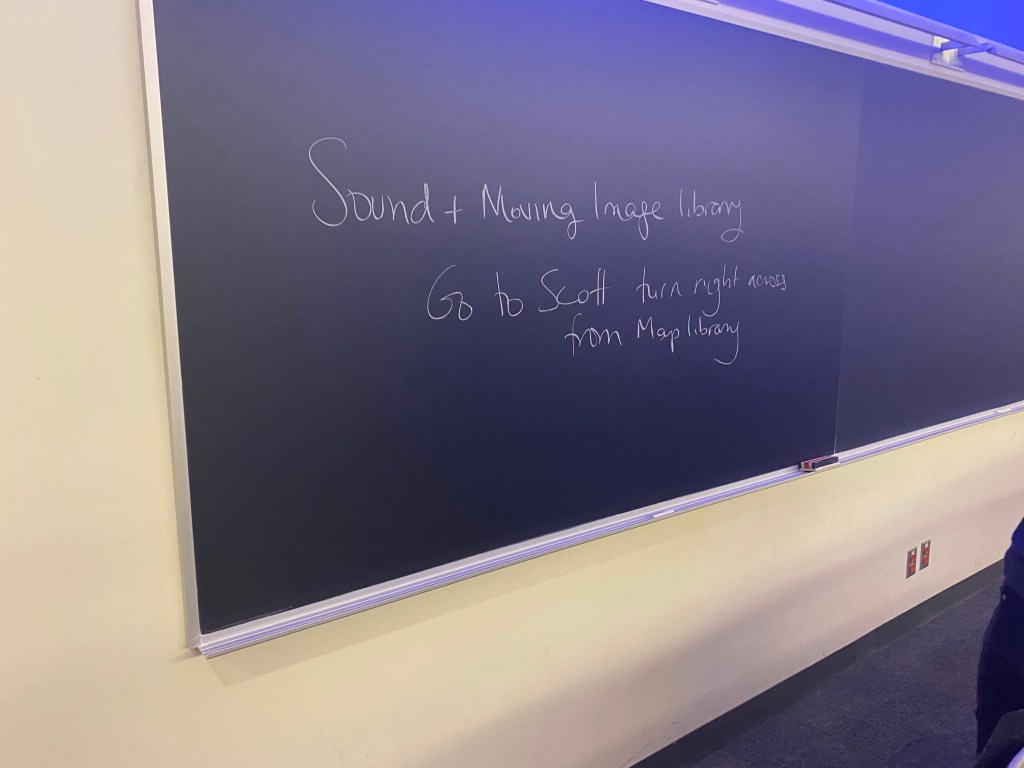
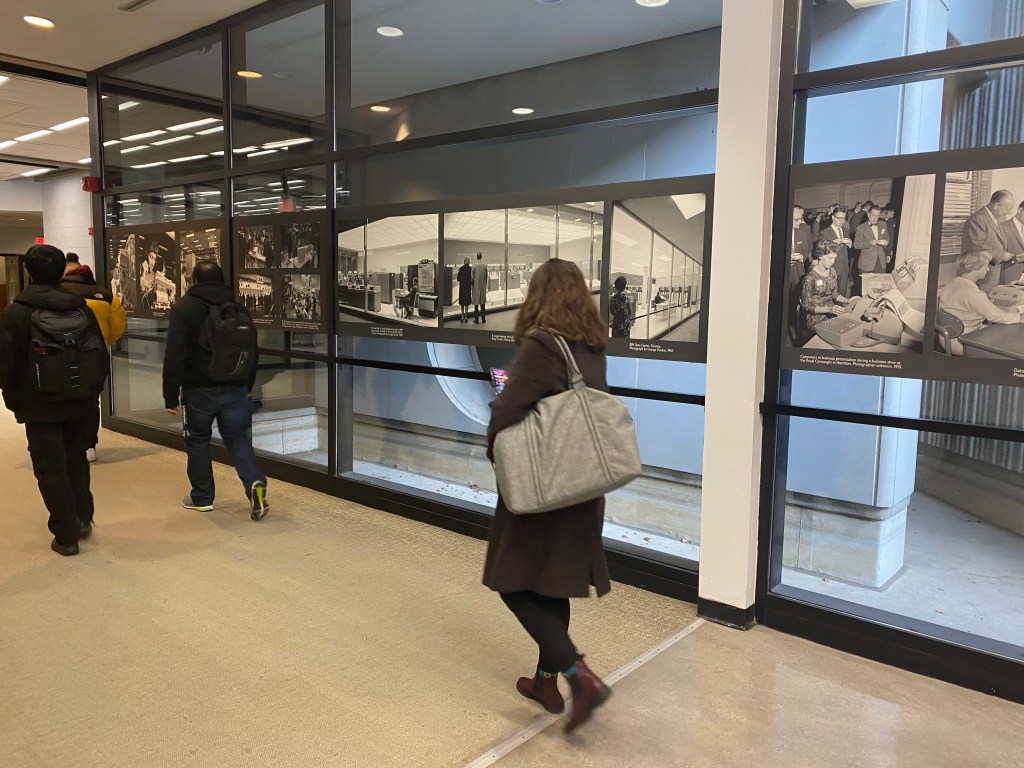
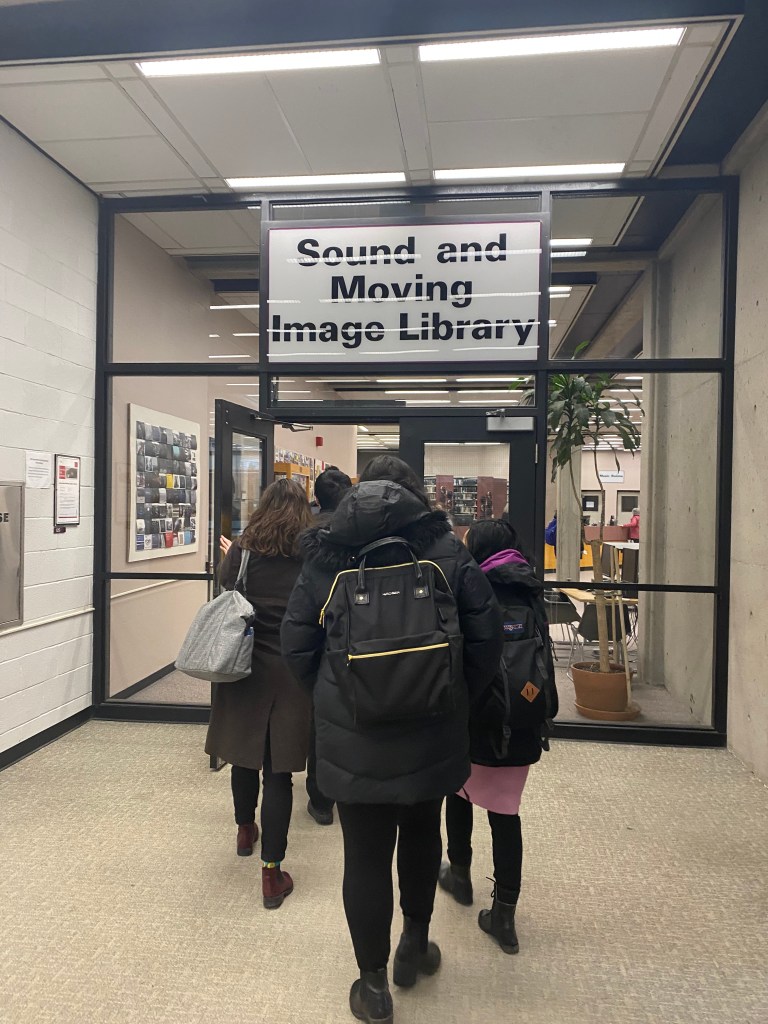
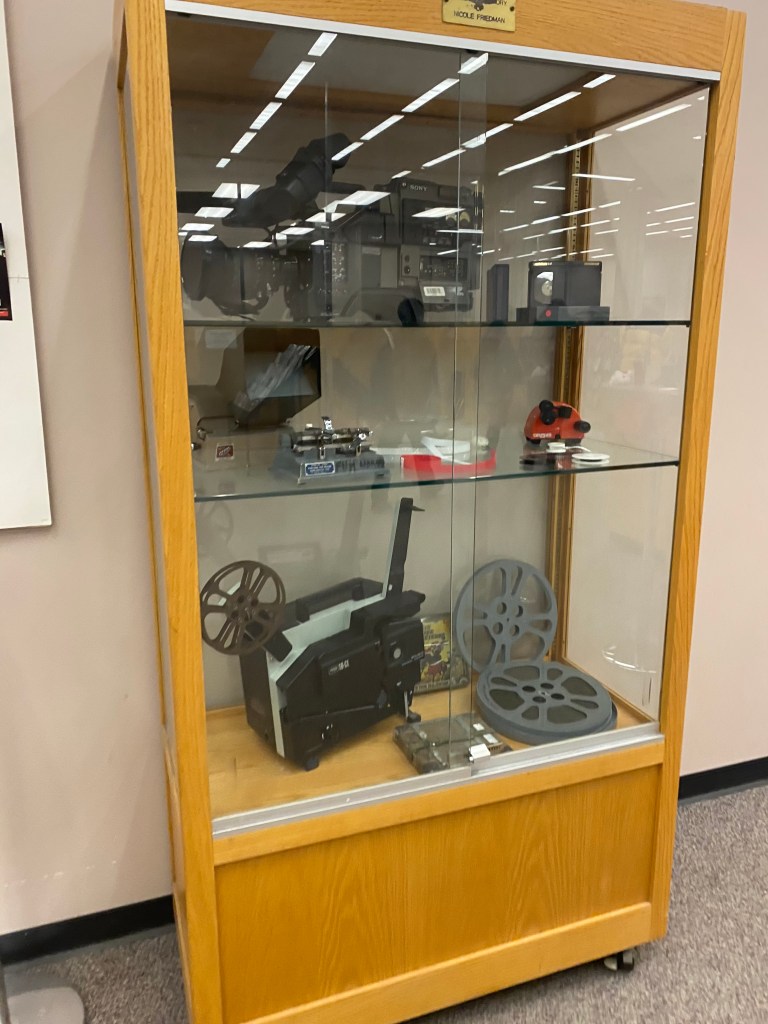
I had vaguely heard of the Sound and Moving Image Library (SMIL) but, I was unsure of where it actually was or what is actually does. Cut to Feb 3rd, 2020, the BIOL4095 class took a visit to the SMIL. As you enter Scott Library, most people head straight for the escalators to go upstairs to the collaboratorium or quiet study rooms. Just to the right of the escalator is a whole other section of the library that is rarely explored by science majors. Walking past the escalator, to the right is a wall full of images from the past, like the IBM Data Center in Toronto during 1965. Following this route, you see the Map Library to your left and then finally the sign that says, “Sound and Moving Image Library.” What immediately caught my eye was the display cabinet with video reels, a video reel recorder, and an “old school” video camera that looked way too heavy for one person to hold.
Dr. Bazely’s directions to the SMIL
I was also surprised to see that the DVD display had many modern/current selections, like ” A Wrinkle in Time”. I was expecting to only see documentaries there.The SMIL houses media formats including DVD, CD, LP, VHS, CD-ROM, audiocassette, and audio reel. They have various audio and visual equipment to plat the media (cassette decks, turntables, VHS players, etc). You can search for items in SMIL using the same OMNI library system used by Scott and Staecie, simply limit the search parameters to audio or video. Even if the SMIL doesn’t have the exact selection you are looking for you can put in a request for it. Specialized collections like the Clara Thomas Archives are located here. This archive houses manuscripts and rare books in the subject area of Canadian history, environmental history, fine arts, and sexual diversity. One of the things that I found most surprising, which in retrospect is something that should not have been surprising, is that there are specialized areas in the librarian field. Rob van der Bliek is a music librarian and Mary Kandiuk is a Visual Art, Design, Theatre, and Dance Librarian.
The second time I visited the SMIL, I went to attend one of the learning skills workshops for mastering group work. Learning Skills Services host most of their workshops in room 124 (the screening room). After the workshop I looked around the main area of the SMIL and I noticed that, unlike the cubicles in Scott library that just have an electrical plug, these also have devices for watching movies or documentaries. The vast majority of students sitting at these desks weren’t actually watching something It looked like they were just studying, so it seems that the SMIL is also a great study area with lots of seating since most people don’t know about it.
Walking towards the entrance of the SMIL the walls are lined with images from the pastThe entrance the the Sound and Moving Image Library at York University
The second time I visited the SMIL on my own, I went to attend one of the learning skills workshops for mastering group work. Learning skills services host most of their workshops in room 124 (the screening room). After the workshop I looked around the main area of the SMIL and I noticed that, unlike the cubicles in Scott library that just have an electrical plug, these also have devices for watching movies or documentaries. The vast majority of students sitting at these desks weren’t actually watching something It looked like they were just studying, so it seems that the SMIL is also a great study area with lots of seating since most people don’t know about it.
There’s a difference between primary, secondary and tertiary literature. Most people don’t even know the differences between all three yet they use them constantly — especially tertiary literature. Primary literature is new data and new information that hasn’t yet been published or recorded in the scientific community, or a first person account of whatever events that might have occurred in any other community. Most sources of primary literature in science come from lab reports, autobiography, photos and conferences. Secondary sources are a second hand account of an event. An example would be scientific journal articles. This is the one academics use most often for research purposes and gathering information for their research papers. University students have a love/hate relationship with these secondary sources; they either love or hate them — there is no in between.
Tertiary sources are third person accounts of an event that has transpired. It is a compilation of the first and secondary sources into an easily digestible summary article that gives the main points of the primary/secondary data but makes it easier to understand for the everyday person. Wikipedia is an example of a tertiary source. It is often open access and allows anyone, regardless of intelligence, to edit it. This is why tertiary sources are a good starting point for research and allows anyone to get a quick grasp of their topic in question but isn’t able to be used as a reference or a citation since anyone could edit it and the information you gain from Wikipedia isn’t peer reviewed.
An example of a primary, secondary and tertiary sources are as follows for a Drosera (sundew) plant.
Primary:
A photo that I myself took of a Drosera capensis plant.
Secondary: Scientific article that has been peer reviewed and published –
(Pavlovič, A., Krausko, M., Libiaková, M., & Adamec, L. (2013). Feeding on prey increases photosynthetic efficiency in the carnivorous sundew Drosera capensis. Annals of Botany, 113(1), 69–78. doi: 10.1093/aob/mct254 https://academic.oup.com/aob/article/113/1/69/171473
Agriculture — a pivotal point in human evolution. Where small tribes of gatherer hunters transitioned into farming and producing livestock which allowed larger congregations of humans to occur. This eventually became the building blocks for cities and large aggregation of humans in a set space. However, with these large population, came a lot of mouths to feed. This is where sustainable agriculture came into place. Or rather, unsustainable agriculture that led us to the current day and working towards a future where sustainable agriculture is ideal.
Currently, the model of food production is Monocultures — vast fields/acres of one single crop. While it might be easy and cheap to cultivate at first, the expenses pile up over time. The soil gets depleted of nutrients and turnover time is slow. The march towards climate change has shifted growing ranges so some acres of land might not be ideal for a certain monoculture anymore.
But the most important and deadly thing about monocultures is their lack of genetic diversity and susceptibility to disease and pests. If a specialized pest/disease (Panama Disease) that targeted a specific monoculture (bananas) and is incredibly efficient, the entire monoculture could go extinct which can cause detrimental socioeconomic impacts. Not to mention, the diseases/ pests could undergo evolution via natural selection to evolve traits that make them more resistant against chemical defenses and biological defenses from humans protecting their crops. Humans would have to develop more and more defense strategies to combat against the pest/diseases and it would cost millions, if not billions of dollars.
If the banana monoculture were to go extinct in the present (it already has once in the past with another, tastier species of banana but apparently humans don’t learn from the past), it would cause the concern of food security to shoot up among the public. However, the people in charge wouldn’t do jack squat about it. After all, an extinction event of the previous banana cultivar has already occurred where the same fungal pathogen that’s currently threatening our banana crops, decimated the previous one to the point where it wasn’t sustainable to grow them commercially anymore. But even after that, nothing has changed in terms of how humans are managing the monoculture.
Charles Darwin, the founder of evolution and probably the most well known name in the history of science. He is credited for his research on the Galápagos Islands, regarding a type of finch and beak size. On each of the different islands, he noticed that the finches had different beak characteristics depending on their diet which varied from seeds to insects. In the end, he hypothesized that all of the birds had come from one bird that came from South America and through adaptation and natural selection, the one bird eventually diversified into multiple birds. He’s the person who came up with the theory of evolution via natural selection — the most widely applied and accepted theory even in the modern day.
Darwin was also credited for saying one hilarious quote. In a letter he wrote, he said “I care more about Drosera than the origin of all the species in the world” which, for those who don’t know, Drosera is a genus of carnivorous plants that look like a feather duster that said, “Screw the feathers, give me some mucilage that traps and digests insects in one go!” The mucilage is a sticky secretion by the plant that looks like dew and attracts insects by giving off a fruity, floral scent. It is also, surprisingly sweet in some species.
Darwin took a long sea voyage on the HMS Beagle that allowed him to sail along the coasts of various continents and disembark on said continents to explore. After journeying and coming up with the theory of evolution, Darwin compiled a book titled “The Origin of Species” which is a fascinating read and still relevant to the current day. His work was banned in various universities of the time and Tennessee had banned anyone teaching evolution until 1967. Way to go America.
Wikipedia is a useful tertiary resource; great for getting general idea of how/what to write and coming up with ideas. However, as a person who edited their first Wikipedia post, I’ve gained a new sort of appreciation for the people who edit it as well as increased blood pressure. The interface is difficult to work with and not very intuitive. I literally had to google ‘how to edit Wikipedia’ – only to be directed to a page on Wikipedia on how to edit Wikipedia articles. Meta, yes. Helpful, no.
There was a lot of research that had to be done for the editing of the Wikipedia page. My topic was Carnivorous plants, more specifically, the page on Sundews – the plants that look like a feather duster with water droplets on the end. It was a relatively empty page when I first started writing but I had to read article after article of scientific papers in order to collect enough information with enough references and peer reviewed journals to back up my claims. It was very tedious trying to gather up all the information needed as well as linking up the references to my claims in the references section. The citations were a real pain in the butt to accomplish.
But aside from all my bellyaching about editing Wikipedia, it was still a good experience. Not an experience I would like to repeat as I don’t have the time nor effort to continue editing Wikipedia pages – money doesn’t grow on trees and student debt isn’t fun – but it still taught me something. I learned some new stuff about sundews and how any idiot with a computer and internet access could edit a Wikipedia article. That thought alone is terrifying.



 Applied Plant Ecology Winter 2020
