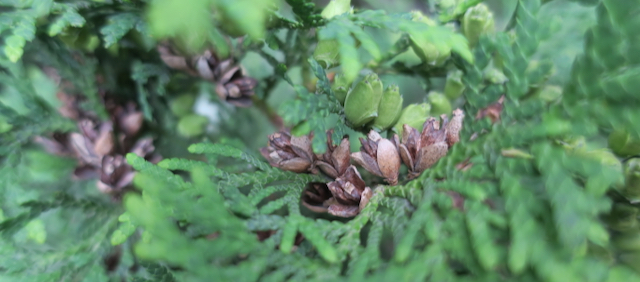
While editing a Wikipedia page that talked about thyme, I was looking for definitions and methods how seeds are planted. After a couple of hours about dwelling in modern techniques and the history of irrigation and farming at the old civilization, I realized just how little I know about farming! The history and the way farming developed and spread along the continents is purely amazing. The earliest known irrigation system occurred in the year 6000 BC in Mesopotamia and Egypt where they manipulated the river drainage and paths in order to water plants and they did that in fabulous ways. Later, this practice spread through the world. It was also very interesting to know the huge sector that involves farming equipments and machines! Farming nowadays in run by rather expensive and automated machines to produce enormous amounts of crops in order to feed the 7 billion humans in the world. This all relates to economy, workers, low-wages, human-trafficking and so much more. After surfing the internet for two hours, I realized that farming is multi-disciplinary in the sense that it connects all sort of fields because it involves money, humans, machines and food (the basic need for humans). It also relates to climate change and how that is affecting crops and thus human workers and thus the economy and thus decision-makers, so it creates a big domino effect in the real world. I learned so much information when I was just going to look for more information about cultivation of thyme. It is fascinating how much one can learn and explore interests with the help of the internet but it is also sad that I have not taken one course in my university years that involves this.
Improvement of Kenya’s Mtwaba Creek through Green Technology
Mtwaba bridge which straddles Mtwaba Creek in Mombasa, Kenya. Shimo la Tewa, is a prison located near the creek, with an immense population that is overwhelming the septic drainage system. The prison has been dumping raw sewage into the area for a very long time. With other sides dumping excess substances into the Creek, it has resulted in pollution.
The pollution threatens the ecosystem of the coral reefs, the biodiversity of fish species and carb species in location nearby and has forced evacuation of humans from certain buildings of the prison due to the inhabitable conditions and the stench.
To address this issue, Kenya Marine and Fisheries Research Institute, Shimo la Tewa prison, the National Environment Management Authority and GreenWater has decided to use constructed wetlands to try and mitigate the effects of pollution. Constructed wetlands is an engineered system or a green infrastructure involving using water bodies to filter water naturally. The authorities have decided to diverge the prison’s sewage into the constructed wetland, which will have a system of plants and gravel or sand to mimic the nature’s processes and lessen the amount of harmful pollutants.
When the water has been filtered from the pollutants, the authorities are planning to use that treated water into growing food crops at the prison’s farm and it will be used to manage, construct and stock fish ponds at the prison as well, this will improve food security and nutrition of prisoners and workers there.
National Environment Management Authority officials said that if the project of constructed wetlands was proven to be successful at the Mtwaba Creek and the prison, this method could be adopted to save other habitats or be installed at other location in Kenya that has wastewater management issue like local hotels.
Metadata, Open access and CCL
In my opinion, a great way to indulge the human beings in the current issues, for example, climate change is through educating people, this is beautifully accomplished by databases such as open access. Open access is where you can have access to read and be informed about the current research outputs online, usually free of cost and with reduced copyrights. This doesn’t only allow, for mass education (and perhaps mass number of advocates) but also promotes editing of research articles, it allows data to be built on, added, modified, speculated and thus improved.
Metadata is data that gives us information about data, it is the data of data. The profound need for metadata comes from the fact that it makes connections, relations and show us variations among all data presented, providing us with an easier escape into appointing meaningful findings about data we want. Metadata encompasses many different disciplines and can be formed manually or through automated information processing. The difference between the two methods of creation is that automated metadata tends to be more elementary, having basic information. On the other hand, manually formed metadata is stronger in terms of accuracy because it ables us to modify relevant information thus limiting error.
Creative common license is a way that enables the public to use copyrighted work and modify it through building on it, using it or share it. This license is used by an author when he allows his work to be used under certain rules that different licenses provide. Some authors may allow only non-commercial uses or whatever license form that will protect their work but also provide the information to the public. This flexibility in choosing what license type an author gets to choose is established by the four license types CC offers.
Genetic and Epigenetic Understanding of the Seasonal Timing of Flowering is a peer-reviewed paper that can be accessed by the public through Plant Communication journal in Elsevier website.
Food and Sustainability
The World Food Programme has posted a recent article in which it estimates that the risk of hunger and malnutrition could increase by up to 20% by 2050. The percentage is huge and shocking and will definitely be disastrous on rural areas who don’t have a stable access to food. Climate change, along with other contributors, are causing a sharp risk of food insecurity. Climate change for people in Africa, Asia and Latin America means more frequent floods, greater catastrophes that will most probably distract the food system in these areas and therefore a greater food and nutrition crises. In response to this, WFP has developed The Food Insecurity and Climate Change Vulnerability Map, which helps to identify which regions are susceptible to fluctuations in food security, this map aims to guide public policy and decision makers to develop programs that build profound assistance strategies against hunger.
Most of these solutions are necessary but they can be short-term and are only put there for emergency situations. If we produce sustainable, locally grown foods that can be easily grown and taken care of by the people of a community then we are on a better level in the journey of food security. When planting locally, rural areas and areas that can’t be frequently and easily accessed can form a sort of self-independency. Transportation of food will not be as crucial, and people will be less dependent on the availability of transportation for their daily food intake. The idea of local food can be applied to anywhere in the world, making our own vegetables and fruits will be a very pleasant way to sustain our own environments.
Land, land-use change and forestry
My first blog would post would be on the UN article, land use, and land-use change and forestry. Lands and forests are an important aspect of the global carbon cycle. They contain a large amount of stored carbon and act as carbon stocks. It is estimated that the global forest vegetation stores 283 Gt of carbon in its biomass, 38 Gt in deadwood and 317 Gt in soils and litter. Altogether, it is estimated the total amount of carbon in forest ecosystems is 638 Gt which is higher than the total carbon in the atmosphere. This shows the importance of protecting these forest ecosystems from exploitation. Forests such as the Amazon are important carbon sink and oxygen producers. Lots of carbon is stored in above-ground biomass (leaves) and below-ground biomass ( roots).
Human interference and degradation of forest change this delicate carbon cycle. For example in the 1990s, deforestation in the tropics and forest re-growth in temperate and boreal zones remained the major factors contributing to emissions and removals of greenhouse gases. Carbon dioxide emission due to land-use changes was estimated at about 2 gt per year globally. This as a result of the conversion of forest lands by humans for urban development. However, on the brighter side, these emissions are reversible and not permanent. Carbon emissions can be reduced through the reduction and control of deforestation globally. Better and more environmentally friendly agricultural practices could also be adopted such as improved agronomic practices, nutrient use, tillage, residue management and restoration of damaged organic soils.
The missing pieces of Tansley’s 1917 paper
Tansley’s 1917 paper is a good paper for it’s time. It explains the steps and approaches in his experimental methodology, but not as detailed as the current standards. To cover what’s missing, first we must cover what is present in the paper:
Tansley, A. (1917). On Competition Between Galium Saxatile L. (G. Hercynicum Weig.) and Galium Sylvestre Poll. (G. Asperum Schreb.) On Different Types of Soil. Journal of Ecology,5(3/4), 173-179. doi:10.2307/2255655
Tansley’s interest in this paper is around the competition between closely related species and how that relationship plays into effect when put against different soils. His inspiration arose from the relationship represented by Achillea moschata and A. atrata, as he investigates a possibly similar phenomenon between Galium saxatile and G. sylvestre. These species were grown on different soils and displayed the following growth:
- G. sylvestre grew most freely on calcareous soil and least on acid peat.
- G. saxatile grew most on acid peat and least on calcareous soil.
- When grown in sandy loam G. saxatile grew more than G. sylvestre.
- Both species failed to grow in the original experiment on sandy loam.
Tansley concluded that competition worked through suppression of the shoots, done by the out-competitor. The paper does a great job of explaining the logical thinking behind the conclusions made, but when presenting the numerical data, it is a bit disappointing. Data in terms of recorded growth was not represented in the detail manner that would be expected by today’s standards. This critical missing piece could be attributed to statistics, which plays a large part of today’s research. Granted statistics was invented past Tansley’s time, it is the most apparent missing piece to this otherwise easy to follow paper. Though, I would like to point out that the level of transparency and detail in the methods portion is also not up to today’s standards, that would allow for an accurate duplication of the experiment. It’s also important to note that the writing style of this older paper lacks the rigid empirical structure that is expected of scientific articles today. But personally, I believe this lack of structure is what contributed to it’s easy-to-read nature.
Becoming a Wikipedian 2.0
Wikipedia is an open access online encyclopedia that anyone can read and edit. This is why teachers don’t like students using it as a citation! However, it is an excellent starting point in research and can help you gain an appreciable understanding of a subject relatively quickly. I have personally used it countless times throughout my time as a student in order to begin my research on topics that I am unfamiliar with.
Despite using it so frequently, I had never edited, nor thought about editing a Wikipedia page before because I thought it would be too complicated, but it turns out that it is quite simple. Once I created my account (which was easy) I could already begin editing. However, finding a page to edit was not easy because Wikipedia has so many pages already, and many of them are already filled with a lot of information already thanks to the many Wikipedia contributors. This was really the only challenging part though, and after a few hours of searching, I found a page in need of information – Carolinian Forests. I did some research and then wrote most of the “Carolinian Canada” section and sub-sections which discusses the climate and uniqueness of the region, and how it is under threat due to habitat loss and fragmentation caused by deforestation and urban development.
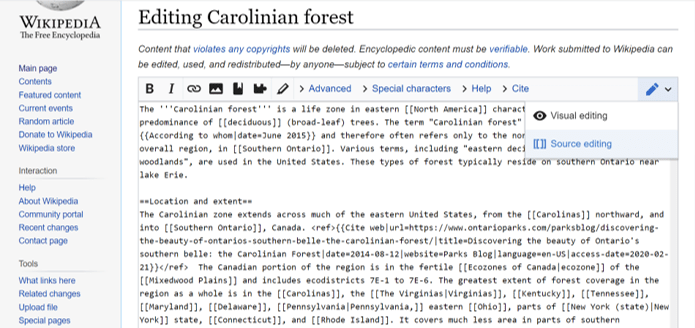
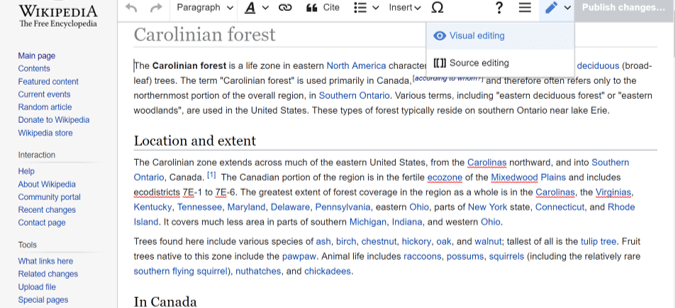
This part was not too difficult, but the editing view that Wikipedia sets as the default, “source editing”, is very confusing and non-intuitive (Figure 1). As a result, I switched the editing view to “visual editing” which is very similar to editing a word document (Figure 2). After I did this, editing was a breeze!
Overall, becoming a Wikipedian was a relatively simple and fun experience once I found the page I wanted to edit. I might even go as far as saying that it was kind of rewarding knowing that I contributed something to the community which I have benefited from so many times before!
UPDATE (04/15/2020)
For the final exam in #BIOL4095, one of our tasks was to go back to Wikipedia and complete the training modules and exercises through Wikipedia Edu and its associated dashboard. Registering was easy and the modules and exercises were easy to find and access. They walk you through the process of becoming a Wikipedian step-by-step and make sure you do things the right way. Although I did not significantly struggle figuring out how to edit on my own, these modules would have been extremely useful to have completed beforehand and surprisingly taught me many things I did not know previously.
For instance, they provide you with tips on how to find and choose a good article to edit which is the one part I struggled with initially. The Evaluation exercise I also found very useful as it taught me how to identify what Wikipedia considers reliable sources, which is a major component of a good Wikipedia article, alongside organization, neutrality, balance, and it being easy for any audience to understand, etc. These enabled me to critique and evaluate the Carolinian forest article I had already worked on previously which helped me determine areas which needed to be improved.
The lead paragraph, for example, had a few statements which were not backed up by a source and were slightly confusing. I was able to locate reliable sources and greatly improve the paragraph. I also added free-to-use images as well as links to other Wikipedia articles and websites to the article I edited which improved it. Additionally, I removed words that could have been interpreted as bias and also learned how to add and how to re-use a reference that was already cited. Finally, I added a second paragraph to the conservation section which included academic journal articles which is something I felt was missing from the page.
Overall, this assignment was very different than any other I had ever done, but the process of becoming a Wikipedian was rewarding because I was able to improve the article to a level I am quite proud of and I know it will help people who need to get a quick understanding of Carolinian forests. I think all the work and research Wikipedians do behind the scenes is important to the field of science as it can expand public awareness or understanding of a topic because the material is presented in a much more digestible way than most journal articles.
Invasive plants
Invasive species are a major threat to biological diversity all over the world. Pest plants usually pose a huge problem and especially because they usually go undetected for a very long time and hence ends up causing huge ecological damage. The worst invasive pests are normally due to intercontinental introductions and especially due to the release from natural control factors. The main aim of this research paper is to discuss the issues that are involved in assessing the risk involved when there is the introduction of invasive pest plants. The study further goes ahead to propose policy recommendations for botanical gardens to act as models for policies on plant introduction and distribution.
The research proposes two policy alternatives for botanical gardens which include the Strict Conservation Garden and Conservation Aware Garden policy. The Strict Conservation Garden policy circumvents the problem through the prohibition of the transportation of species across natural barriers as this leads to worst exotic problems. The Conservation Aware Garen policy, on the other hand, requires very strict adherence to inspection and quarantine policies which are aimed at excluding diseases, pests and other pests that might end up being accompanying the introduced plant.
This paper is important as it explains two different approaches or policies which should be followed in order to prevent problems that occur with the introduction of invasive plants. Management of invasive plants is very important in ecology as these plants are usually a great threat to other plants. invasive plants significantly affect the diversity of the local species, damage the quality of soil nutrients and also affect the availability of water. The invasive plant that is an alien plant inhabits a habitat and completely changes the conditions of that given environment. These plants also colonize the habitat and hence excluding the native plants from the habitat and by doing this, they decrease the biodiversity of the native and hence they are and for the environment. There is, therefore, the need to manage these invasive plants to prevent the biological threats that they bring to the environment. This would help in protecting the biodiversity of the native plants which is important for the ecosystem.
References
White, P. S., & Schwarz, A. E. (1998). Where do we go from here? The challenges of risk assessment for invasive plants. Weed Technology, 12(4), 744-751.
Mary Agnes Chase
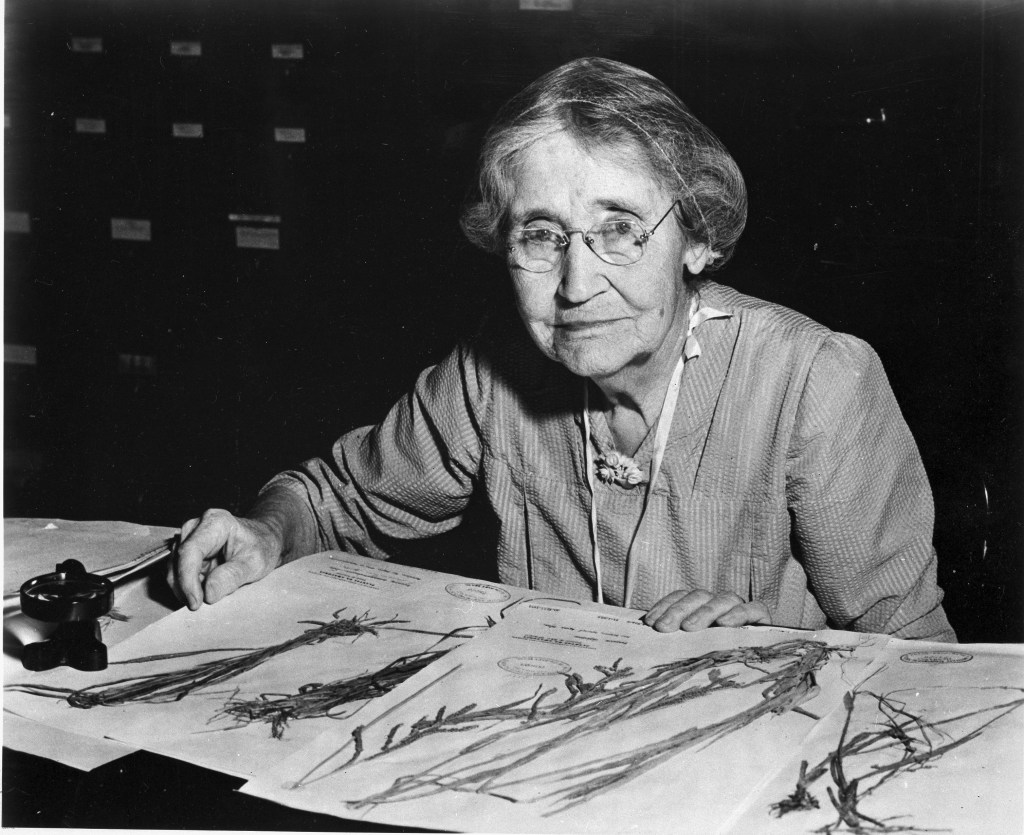
Image from Smithsonian institute from Wikimedia Commons (Creative Commons)
Mary Agnes Chase was best known for being a grass specialist worked as a botanical illustrator. Illustration was one of the few ways that women were able to enter science at that time as a woman. Chase also around the same time was involved in the suffrage movement and other political movements pushing for women’s rights. This was met with resistance from the USDA who threatened to kick her out of her illustrator position. One main reason why she was not kicked out was because of how exceptional of a scientist she was. Despite these threats, Chase pushed for more women to get involved into botany, and she also continued to train women botanists. She is also known for surveying grasses in Southern Brazil and later in her life, at around 70 she was hired to survey grasses in Venezuela and advised the government based on that survey.. Her deep interest in grasses came from the fact that she believed that they are what hold the world together.
One thing that I found interesting about Chase’s story was that she grew up in a time where for example, when it came to field work, women often wouldn’t get funding to carry out research in the States. So Agnes’s solution to this was to fund it herself (with help from her connections in the women’s groups she was involved in). In my view, it is because of people like Mary Agnes Chase that we now have more ecologists and botanists in North America. If she and others who had paved the way had given up, it would have been less likely that someone like Rachel Carson 50 years later would get the recognition she did for her work. It would have also made the path to science degree more difficult for all the female botanists and (plant, insect and animal) ecology professors and students that we have in North American universities.
If you would like to learn more, here are the links I used to write my blog:
The Woman Agrostologist Who Held the Earth Together
https://siarchives.si.edu/history/featured-topics/latin-american-research/mary-agnes-chase
Ecological Footprint (The Revelation)
A few weeks ago, as a class, we received a guest lecture about ecological footprint given by Chaya Kapoor. This sparked my interest on the topic and I decided to conduct further research myself. I came across a journal by Wackernagel and Rees. It explains what ecological footprints for beginners e.g. non-scientists, describes as a tool used to find out the rate at which resources are used and how waste is assimilated in an human population.
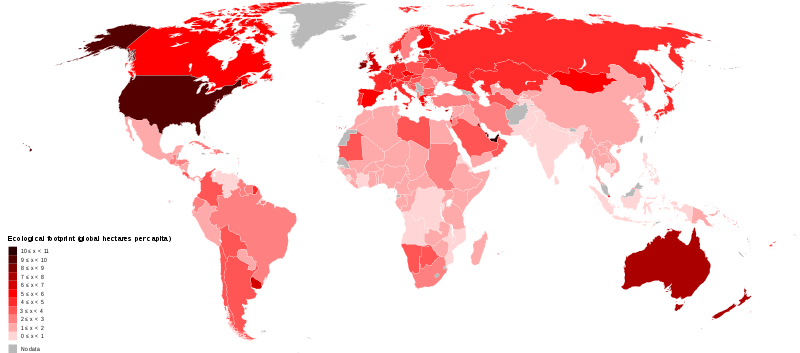
The main focus of ecological footprint is incorporating ways in our daily lives to decrease it. Below are some simple ways to decrease our ecological footprint.
- Switching to renewable energy
- Eating less meat as it is a major source of greenhouse gas emissions
- Reducing waste by using compost
- Buying in bulk
- Buying reusable products
- Recycling
- Driving less and using public transit or walking more
- Switch to electric vehicles
- Choose food with less packaging
- Unplug electronics when not in use
- Take shorter showers
 Applied Plant Ecology Winter 2020
,_sitting_at_desk_with_specimens.jpg#/media/File:Mary_Agnes_Chase_(1869-1963),_sitting_at_desk_with_specimens.jpg)