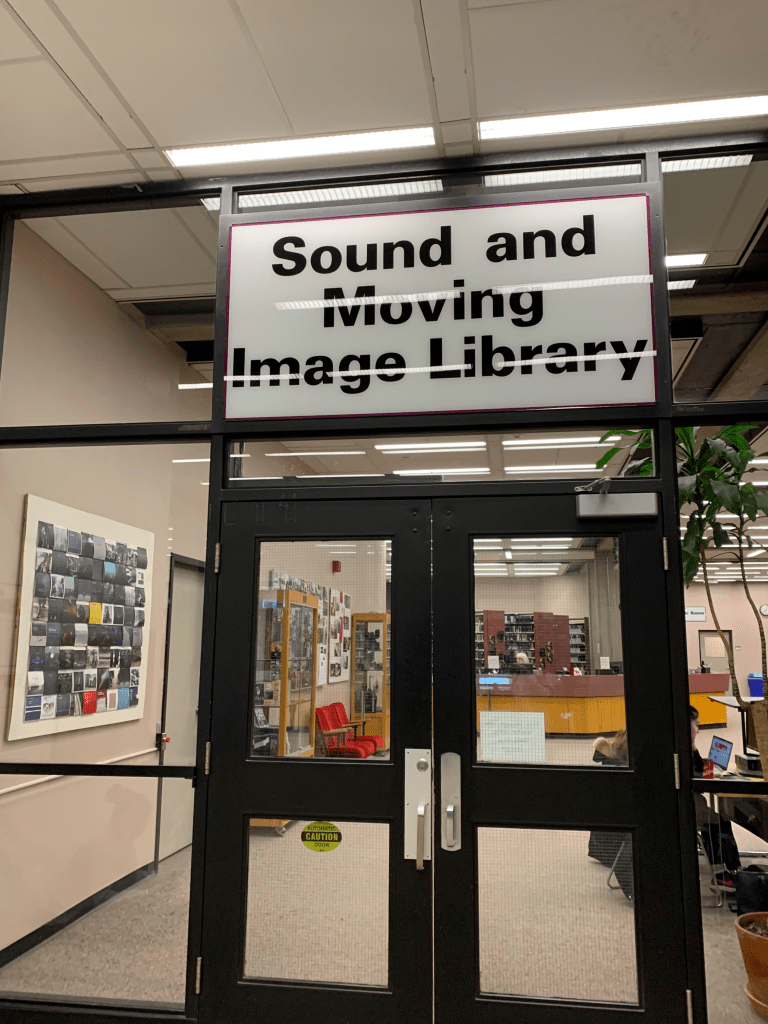
For the past three years, I always study at the Map Library at Scott’s, which is exactly in front of the Sound and Image Library. During all these years, I never had the chance to explore it or know the facilities they can give.
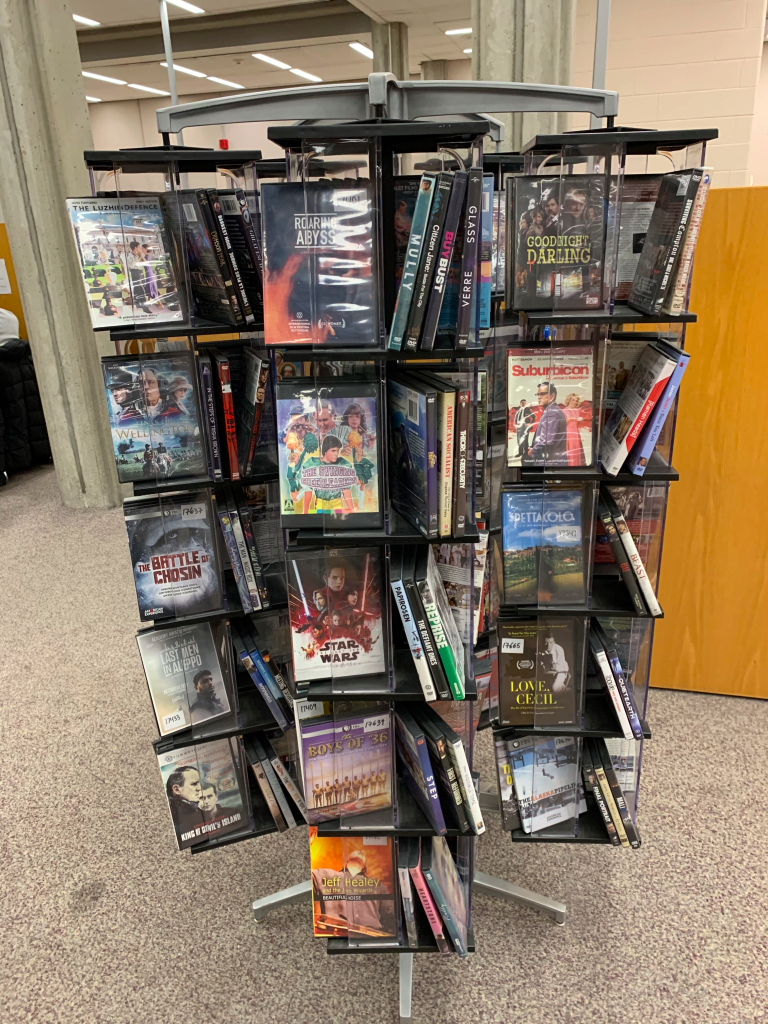
Upon my visit to the library, I saw something similar to what you would see in a vintage movie rental store; a shelf that contained some of my favourite movies! This is when I realised I should have visited this place much earlier.
I asked the lady at the front desk to help me to see movies that are related to plant ecology. She advised me of surfing omni, which is the searching platform of York University’s libraries. I have only used omni to search for formal review papers or journals, but never for a film! The searching platform allows you to see if the film you are looking for is available (and at which library), if its available online or if its in storage. In case that is its available in storage, you need to request that movie or film and it would take a day in order for the librarians to be able to get it for you.
This amazing library also has two music rooms and a screening room. The rooms seemed to be locked down for individual use, which is so much better than listening to music or watching a movie in a hall full of people. Also, some of the desks have DVD players installed on them with headphones. These facilities make the Sound and Image Library a great place to visit if you are interested in watching a movie.
“It is impossible to live without failing at something, unless you live so cautiously that you might as well not have lived at all, in which case you have failed by default.”
In recent years podcasts have spiked in popularity and have grown to cover a wide range of topics. One of my favourite podcasts is “Welcome to Night Vale,” a podcast presented as a radio show that documents the strange events occurring within a fictional town, but I recently decided to listen toEpisode 174 of “People Behind the Science”. This is a podcast hosted by Dr. Marie McNeely that explores the lives and discoveries of many of today’s brilliant scientists. Episode 174 features our very own Professor Dawn Bazely as she discusses her research and gives several great pieces of advice to science students.
Around the 1-hour mark (time stamp- 1:01:00) Dawn mentions that as science students we should allow ourselves to fail and upon hearing this the first time around I was in disbelief. As students in the faculty of science I’m sure we’ve all experienced our fair share of mistakes and failure at some point in our academic careers. Past failures can instill fear in us and discourage us from persevering or trying new things. I can speak from personal experience and say that I’m often hesitant to start tasks I find daunting due to a fear of failure. Listening to this podcast really gave me a new perspective on failure and Dawn’s advice makes perfect sense.
The best way to master something is to fail at it, see how you can improve from your mistakes and try again. If we constantly worry about avoiding failure, we’ll miss out on opportunities and learning experiences. As science students we will constantly come across challenges and difficulties. It’s an unavoidable aspect of human nature. And it’s okay. The best thing we can do in the face of adversity is use our struggles as motivation to improve for the future, whether this be studying for a midterm, writing a lab report or even giving a presentation. Dawn also mentioned one of her favourite quotes by Winston Churchill and it resonated deeply with me; “Success is the ability to go from failure to failure without losing your enthusiasm.” Failure leaves us feeling deflated and disheartened and in order to truly succeed it is important we overcome these feelings, focusing our energy into bettering ourselves and working on the tasks ahead.
I would give similar advice to science students and recommend reaching out when you’re struggling and need help. Failure and self-doubt go hand in hand and low self-confidence can cause us to feel isolated and uncertain. It’s important to have a strong support system so that when we do feel discouraged by failure, we know we have people in our lives that can uplift and comfort us. Studying with a friend or classmate is a great way to have positive social interaction while getting things done and increasing your understanding of a subject. Learning by teaching others has been proven to be extremely effective and this form of collaboration can give us new perspectives we might have not recognized before.
It was inspiring to hear Dawn talk about how she used her experiences with failure and turned them into opportunities. Her advice from this podcast was extremely useful and made me look at failure in a new way. Of course, it will be difficult to overcome the fear of failure but with this advice in mind and the support of friends and family, we as science students can learn to view failure as a steppingstone not a roadblock.
I’ve linked the podcast down below, I encourage you all to give it a chance and hear what Dawn has to say. Happy listening!
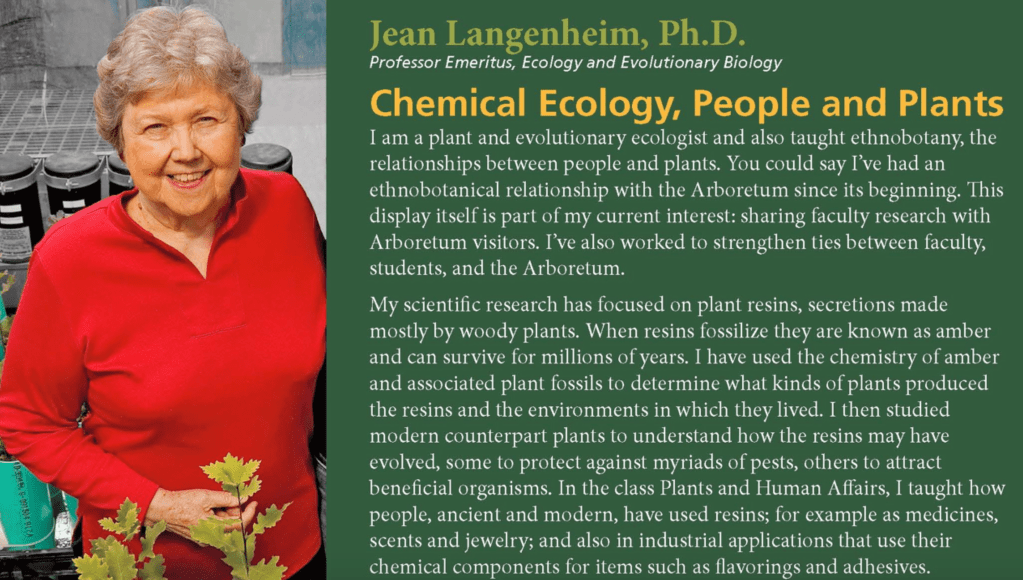
In 1996, an ecologist, Dr. Jean Langenheim began a project named, “women ecologists” by sending letters to various women who were studying and practicing in the field of ecology in the United States of America.
“In 1988 I hoped that there would be no further need to discuss the contributions of women ecologists because we would be recognized just as ecologists. … Although women have become increasingly prominent as ecologists, it still seems timely and useful to consider the progress women ecologists have made in overcoming both personal and societal obstacles, particularly with regard to research contributions.”
Jean was able to break new ground for women in science and she conducted field research on five continents, and crossed the disciplinary boundaries of botany, geology, and chemistry. She began her career when the numbers of women in science were discredited and limited – however that did not stop her from becoming the first woman to serve as president of the Association for Tropical Biology and the International Society of Chemical Ecology (which she founded), as well as the second woman president of the Ecological Society of America and the Society of Economic Botany.
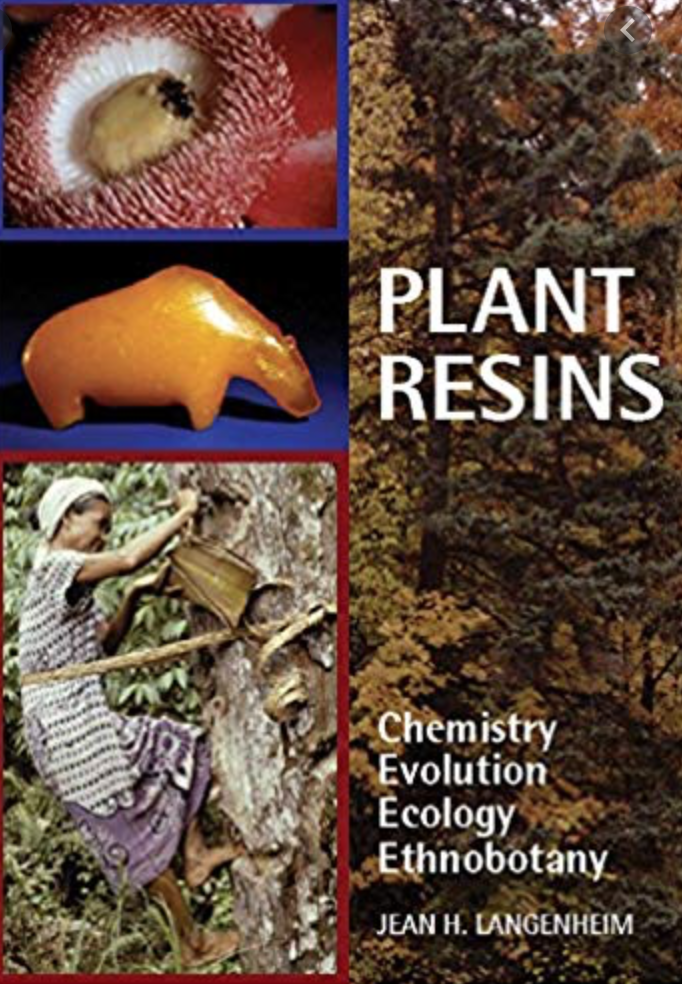
For her research she was able to travel throughout the world ranging from tropical lands to arctic and alpine environments. She became widely recognized for her use of innovative chemical techniques in order to evaluate the plant origins of amber (fossilized resin) which allowed her to publish a book, Plant Resins (Timber press).
Jean studied with William Skinner Cooper, a leading plant ecologist and geobotanist, finishing her Ph.D. in 1953, a time when there were few women field scientists. Jean later published a reminiscence, “W. S. Cooper as I Knew Him: Teacher, Mentor, and Friend” [Bulletin of the Ecological Society of America 96 (2015): 184-208], in which she commented that Cooper’s efforts to give women advanced training in ecology and help them overcome hurdles had not been generally recognized. It was departmental policy at the time to allow women to do only master’s degrees, with the idea that they would become teachers.
In 1966 Jean returned to the University of California as Assistant Professor at the newly founded campus of UC-Santa Cruz, where she taught additional graduate courses that offered new ideas and perspectives in chemical and tropical ecology, including ecological history concepts.
In addition to examining the history of ecology over her long career, her biography helps us to understand the changes in the status of women in STEM over many decades, changes that Jean herself helped to bring about. Jean has written about women in ecology, “The Early History and Progress of Women Ecologists: Emphasis on Research Contributions” [Annual Review of Ecological Systems 27 (1996): 1-53], which displays remarkable women in STEM who have added to the field of ecological research.
Applied plant ecology focuses around the main topic of promoting and learning how to conserve the environment. In 2008, Disney Pixar studios released a film named, Wall-E,which in my opinion has been one of the most underrated movies targeted towards younger audiences – importantly their families. It is important for films to target younger audiences as it is hoped that they can bring changes into this world by learning more, seeing more, and doing more. In a way this also in turn allows for families of these younger audiences to also receive the underlying messages to encourage everyone in how to conserve the environment, and what small steps can be established in starting to do so.
Wall-E is an animated fictional film set 700 years into the future, where planet Earth has been reduced to a deserted ghost town filled with an overflow piling of just garbage. Wall-E is a robot that is the last living entity on Earth as humans have fled the Earth to live in gigantic space crafts that hover above the Earth. However, one day one of those spaceships arrives back on earth bringing along another robot, Eve, allowing Wall-E to travel back to space with her to eventually convince the humans to return back to Earth. The way the earth is set up physically in the movie urges viewers to take caution of how their impacts are affecting the environment and foreshadows what will happen if actions are not taken appropriately.
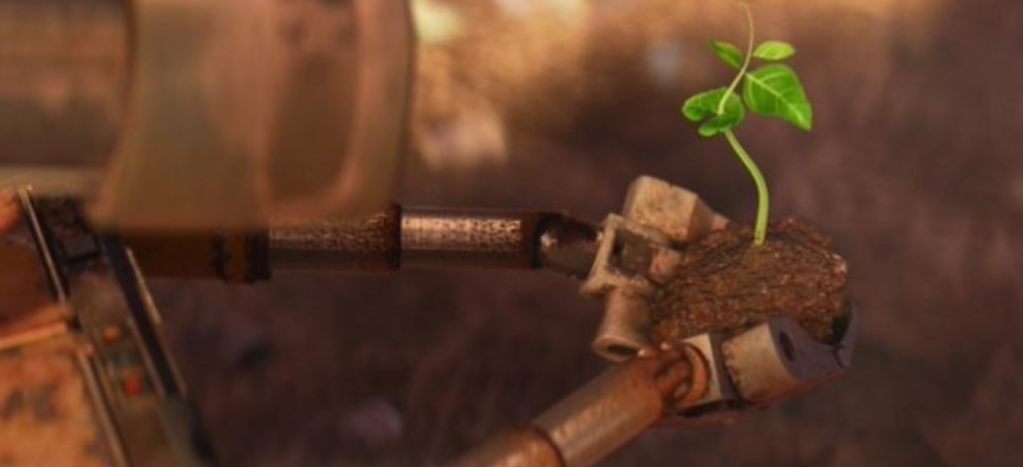
In the film, Wall-E spends his time on Earth tidying up the garbage as much as he can all alone. However, Wall-E is able to find a lonely plant in which he puts it into a dirt-filled old shoe in order to conserve the plant. Eve is sent by humans to track vegetation on Earth – but is unable to do so.
Wall-E introduces the plant to Eve and together they teach humans how to nurture the plant and by doing so how they can further heal the planet they once left damaged and impaired. Humans are brought back to their senses somewhat when vegetation begins to re-grow and humans are able to care for them.
Wall-E actually stands for “Waste Allocation Load Lifter-Earth”class, and Eve stands for “Extra-terrestrial vegetation evaluator”
In summation, the film displays two main themes including the portrayal of human ecology that encourages conservation and organismic ecology which demonstrates the need for mutual dependence.
“Unless someone like you cares a whole awful lot, nothing is going to get better. It’s not.”
–The Lorax (2012)
Film is a powerful medium that has the ability to unite humanity. With subject matter ranging from comedy to horror to documentaries, there are no limits as to what film can be and what stories can be told on the silver screen. Film is more than just a source of entertainment; with the right planning and resources, films have the power to educate an audience about past and current events and also create an image of what our future society could become. I spent a good chunk of reading week viewing several documentaries, movies and TV series that discussed a variety of ecological issues and when it came time to submit my nomination for the #BIOL4095 film festival, I struggled to choose which film I wanted our class and members of the York University community to view. Ultimately, I chose Trouble in the Forest (1988), a David Suzuki documentary about acid deposition and its effects on plants and forests. However, I felt it was necessary to draw attention to another one of my top contenders, The Lorax (2012).
Clip from The Lorax (2012) showing the effects on the environment once the last tree falls. Obtained from YouTube
I’m sure many of you are familiar with the brilliant and imaginative works of Dr. Seuss and have probably read The Lorax at least once in your lifetime. Published in 1971 and adapted into film in 2012, The Lorax is a timeless story that should be heard now more than ever. Society is constantly developing to meet the demands of our burgeoning population and we often exploit the environment and take creation for granted. The Lorax touches on multiple lecture themes including sustainable forestry, habitat loss and loss of biodiversity. The story follows Mr. Onceler, a greedy businessman that clear-cuts multiple forests to produce “Thneeds” for consumers. The Lorax (the tiny orange guy with the huge yellow moustache) acts as a steward of the Earth and warns Mr. Onceler that the industrial clear-cutting is destroying the forests and causing biodiversity loss, but the greedy businessman ignores him. Eventually all the trees get chopped down, destroying the ecosystem and causing Mr. Onceler to go bankrupt. The story finishes with Mr. Onceler encouraging others to plant new trees to try and restore the environment back to its original state.
I believe The Lorax is a great demonstration of applied plant ecology that is easy for audiences of varying ages and scientific backgrounds to follow. It manages to be a light-hearted film packed with likeable characters and vibrant colours while still being a cautionary tale that takes environmental issues seriously. It shows that if we do not make our voices heard by policy makers and encourage sustainable forestry, our environment will suffer as a result. The film diverges a bit from the original story by adding in a romantic sub-plot, but the ecological message remains. Deforestation is a huge issue threatening the world as we know it and films like The Lorax stress the importance of sustainable forestry while still keeping your interest. Sustainable forestry doesn’t mean stop logging altogether, it simply encourages a balance between meeting societal needs while also maintaining the biodiversity and health of forests. Without proper regulation, these cumulative effects will cause irreversible damage to our ecosystems. The Lorax demonstrates all of this and although it wasn’t my final choice for the film festival nominations, it’s a film with a lot of heart and it supports a crucial environmental cause that requires urgent action from all of us.
Can’t wait to sit down with a nice bowl of popcorn and see everyone else’s nominations!
As the global human population rises, there is also increasing pressure on food production. Presently, the pressure to optimize food production with as little investment as possible. The increased demand for food threatens global food security, hence commercial farmers have responded by maximizing crop yield. Commercial farmers have adopted environmentally unfriendly farming practices such as the use of genetically modified organisms (GMOs), pesticides, herbicides, excessive logging, and many others. These practices are harmful to the environment and lead to the escalation of global warming, loss of insect diversity ( through the use of pesticides), loss of animal diversity ( through habitat fragmentation) and many others. Therefore it is important that both commercial and local farmers practice sustainable farming practices. Sustainable agriculture is cultivating crops in controlable ways, which means meeting society’s present food and textile needs, without compromising the ability of future generations to meet their needs. Sustainable farming takes on many different forms. One method of sustainable farming is the use of leguminous plants in farming. The fix atmospheric nitrogen into the soil and reduce the need for fertilizers. Another method involves the use of crop rotation. Sustainability may also involve rotating crops. Crop rotation and the use of cover crops protect soils from eroding, by the means of keeping the topsoil anchored to the ground layer making it resistant to water and wind. Effective crop rotation can reduce pest pressure on crops and replenish nutrients within the top layer of soil. This removes the reliance on fertilizers to enrich the soil. These practices ensure that the next generation is able to inherit a healthy and functional ecosystem
Dr. Seaton was one of the first African American women awarded a doctorate in Belgium, in a time and era where that was not the norm. Notable for her study in Embryology, she was a biologist. With her husband by her side, an International lawyer, they moved around to countries in East Africa, Bermuda, and Seychelles and pursued academic career as well as got involved in African independence movements. She attended the notorious Black College, Howard, where she met her husband, who was also a biology student. Her move to Europe, where she later attained her PhD was driven by the high barrier that were on African American in pursuit of post graduate study. Only a few African American went into postgraduate, yet alone, African American women to gain PhDs in the United States, in the 1940s.
Taken From Wikipedia
Not only a biologist, Seaton as also involved in African freedom movement until later returning to the U.S. with her family in 1953. She became the assistant professor of biology at Spelman College in 1953 and spent time as a research fellow at the California Institute of technology. It was not until 1960 that she became a full professor at the Texas Southern University. She was also awarded several grants for her research in antibodies and cell division in sea-urchin eggs.
Seaton’s latter years consisted of time lecturing in biology in Seychelles, Bermuda and Uganda, where her husband was a judge of the Supreme court in Bermuda. She was a member of the American Association for Advancement of Science, and so many other associations. She died in 2014 in her hometown Houston, Texas at the age of 89. She will be remembered as being one of the first prominent black women biologist.
When looking back on the history of science and comparing it to the scientific community today, it’s evident that we’ve come a long way in terms of diversity. A field typically dominated by straight, white men has slowly evolved into one that is representative of the human population and far more inclusive and equal. International Day of Women and Girls in Science was celebrated only a few weeks ago and looking at all the accomplishments of women in STEM made me wonder why women have been such an underrepresented group in the scientific community. In older times, societal norms required women to take on child-rearing and housekeeping roles and the women that did pursue STEM were often credited at a much later date or their discoveries went unacknowledged. The more we look back at science we realize it has always been diverse, the accomplishments of these underrepresented groups have simply been pushed to the side or overshadowed. While reading about different ecologists and botanists I came across a woman whose story I simply couldn’t ignore.
Imagined image from 1817 of Jeanne Baret dressed as a sailor and disguised as a man. Obtained from Wikimedia Commons.
JEANNE BARET, an overlooked contributor to the history of science, was a French ecologist who could be described as the Mulan of botany. Born July 27th, 1740 in Autun, France, Jeanne Baret would grow up to become the first woman to circumnavigate the world. It’s argued that Jeanne Baret made more discoveries than Carl Linnaeus but like most women in her field at the time, her accomplishments were pushed aside and only recently recognized in the history of science. She had no formal education but living in a rural area gave her an advantage. Jeanne and her family lived in poverty and her father worked as a farm labourer. As a young girl she developed an affinity for plants and frequently collected and gathered samples, allowing her to become incredibly knowledgeable in the field of botany.
Jeanne eventually got hired as a housekeeper for a French naturalist by the name of Philibert Commerson. After the death of his wife, Jeanne and Philibert began to share a personal and intimate relationship. The duo moved to Paris in 1764 after Jeanne became pregnant with their child. At the time, women who became pregnant out of wedlock were required to obtain a pregnancy certificate stating the name of the unborn child’s father however Jeanne refused to sign one. The child was placed with a foster family and died the following year in 1765.
That same year, French admiral and explorer Louis-Antoine de Bougainville invited Philibert Commerson to be the onboard botanist of the Étoile, the ship that Bougainville would be using on his voyage to discover new French territories. Commerson insisted that he was to be joined by his “assistant” Jeanne Baret but French law did not allow women on board. Determined to board the Étoile, Jeanne devised a plan to disguise as a man and use the alias “Jean Baret”, hence the reason I have decided to call her the Mulan of botany. “Jean Baret” was hired as Commerson’s assistant and Baret, Commerson and the rest of the members aboard the Étoile travelled through much of South America making several discoveries along the way.
Bougainvillea flowers discovered by Jeanne Baret, obtained from Wikimedia Commons.
Baret’s most notable discovery from this voyage is said to be a flowering vine with pink and purple flowers. The plant (seen above) was named Bougainvillea after Louis-Antoine de Bougainville, the leader of the voyage. Unfortunately, Baret’s discoveries could not be logged and recorded as her own so any discovery made was logged under Commerson’s name. Jeanne’s identity stayed a secret until 1768 when the Étoile reached Tahiti. Natives on the island immediately discovered that she was a woman and Jeanne was forced to confess. Jeanne was harassed by many of the crewmen so she and Commerson made the decision to remain on Mauritius instead of heading back to France with the Étoile. Jeanne Baret and Philibert Commerson stayed on Mauritius until Commerson’s death in 1773. Jeanne then returned to France, married a soldier and later died in Saint-Aulaye on August 5th 1807.
Image found on Wikimedia Commons of Solanum baretiae, the flower named in Jeanne Baret’s honour.
Jeanne’s achievements were only recognized recently in history, despite notes in Commerson’s travel logs which said Jeanne Baret should be acknowledged for her contributions. Commerson often still gets credit for many of Baret’s discoveries, but the Solanum baretiae flower was named in her honour. Stories like Jeanne Baret’s are inspiring and show the adversity women of the past had to face in order to be able to pursue science. Although we’ve come a long way in terms of diversity and inclusivity in STEM, there’s still lots of work to be done. I encourage you all to push for more diversity in science because diversity leads to innovation and anything is possible when we all unite and create an equal playing field!
Eric. J. Tepe, Glynis Ridley, and Lynn Bohs. “A new species of Solanum named for Jeanne Baret, an overlooked contributor to the history of botany.” January 3, 2012. https://www.ncbi.nlm.nih.gov/pmc/articles/PMC3254248/.
Part 1: As of Monday, February 24, 2020, I am now a Wikipedian that goes by the username, “Plantsrgreat”. We learned how to edit our profile and what to include in our profile. This was my first-time navigating Wikipedia, and in the next few days, I will be trying to understand better how to make edits on it. However, first, I have to find articles to edit. Because I like learning about endangered plants, I will likely do more research on this matter.
Part 2: I have now completed my training module and my edits. I chose the Rhamnus plant. The training modules had a lot of information, and the one thing I was reminded of was that Wikipedia prefers that one avoid using both primary and tertiary sources. Ideally, they prefer to review papers that are more likely to have consensus information. I also found generally; review papers had the best information anyway, so my Wikipedia edits were made more manageable. I also learned that making one-two sentence changes and then publishing those changes was best practice. Though luckily, I had already been only making micro edits thus far. Still, it is worth bringing up because it can make keeping track of one’s edits easier. The training modules overall were helpful and thorough. When I started making my edits, I had a mental refresher of what to do and not do.
For this blog, I will briefly describe the UN convention by the name “International Plant Protection Convention”. This UN convention was put into place mainly to standardize how to prevent the spread of pests when plants and plant products are being moved around. Canada abides by these conventions and it is the only treaty that deals with this concern of plant protection. The convention covers conduct on this matter extensively and covers sources of pests such as vehicles. These vehicles can extend from aircraft to ships. A certificate is issued if the UN plant sanitary standards were met The certification system is meant to help facilitate safer trade between countries without worrying that plants have pests. It helps protect agriculture, biodiversity and forests. They furthermore also hope to no be so restrictive in their requirements that the whole process becomes burdensome.










 Applied Plant Ecology Winter 2020

