Sustainable agriculture is the way of immersing farming into a way that protects the natural environment while improving the production of agricultural products. It directly removes the industrialization of the farming industry and rejects the idea of large scale monocrop harvesting. Sustainable agriculture introduces the use of multicrop plots in order to increase biodiversity while farming in order to prevent the use of pesticides and encourage economic growth by reducing loss of product. By using varying species in the same farm plot the risk of disease spreading to other species and damaging products is lowered as multiple species who may be resistant to said infection will still be able to be harvested. Unfortunately the ideal of environmental preservation is not a satisfactory idea for large corporations to change agricultural production, but rather economic incentive is required to make the change. Fortunately though we do see economic opportunities when it comes to sustainable agriculture as reduction of loss products allows for larger profits. Environmental stability also takes into account social responsibility and equity as a core principle in its ideology. By making farming accessible to the general public, sustainable agriculture allows for everyday people to grow their own produce for personal use and allows for the preservation of the environment.
Scientific research in applied plant ecology is constantly happening, and learning about an article written in my birth year allows for the understanding of how important topics we learn about today have been studied in the past, to provide the information we need to educate ourselves. An article written by Marcelo Sternberg et al. (1999) about plant community dynamics under conditions imposed by climate change. They experimented in a grassland in the UK where the team simulated conditions of climate change with two factors: Warmer winters with increased summer rainfall, and warmer winters with summer drought. What the researchers found was that when conditions are warmer in winter succession in species is decreased as annuals are able to colonize the sward and allow for them to persist. Wetter summers allowed for grassy species to become dominant during this time further preventing the succession of species. Also found in this study is that in warmer winters with a summer drought, litter concentrations increased. The study of climate change is consistently necessary as industrialization has taken over the modern world. Increased effects of pollution and damage to our natural environment from industrialization and use of fossil fuels is creating problems in nature that now humans have to deal with. We’ve seen difficulty in species preservation and are now considered to be in a human generated mass extinction event (The Guardian 2017). The study of the conditions we face now allow us to prepare and combat the effects of climate change.
Being a biology student, having access to journal articles is a staple of not only my degree but my life. Unfortunately many of the resources I require to continue with my education are blocked by a paywall. While this hinders my ability to perform as a student, there are many ways to get around a paywall. I am fortunate enough to be able to learn in BIOL 4095 about applications like PressReader. This website allows everyday citizens to get around paywalls that block media articles that exist on websites like The Globe and Mail.
Getting past the paywall is only one part of the issue when it comes to being an educated young adult. It is not enough to be able to have access to many articles, as understanding what part of these articles give accurate and reliable information is also a skill we must possess. Reliable information is directly linked to funding as certain agendas may be able to be pushed by selective reporting. If a company wanted to advertise their product a certain way they may have an article remove information about their product that would be harmful to their sales. This is why it is important to understand as more recently the argument on climate change has been subject to this very agenda. Reliable news sources take into account scientific evidence and come from an unbiased publicly funded account. When privatization takes over media consumption the consumer is unable to differentiate and understand what their being told is true. It is always important to understand where the news you are getting are getting the money to spread said news.
The ability to find information on any topic can be what determines someone who can make a good argument versus a great one. Knowing what kind of sources you are looking at and what makes a good source is vital when doing research. Three distinctive types of literature are defined in research: Primary, Secondary, and Tertiary. These different resources can provide varying information on the same topic. Primary articles deal with direct research done, for example this journal article by Kent, Stevens, and Zhang (2001) who wrote a peer reviewed article about urban plant ecology patterns. Secondary articles are a collection of primary articles compiled into one source, often having references to these articles they use. For example an article by Nitoslawski et al. (2019) which discusses trends, technologies, and turning points for urban forestry. This review compiles evidence from many sources to provide a large amount of information summarizing which summarizes said sources. Tertiary sources are sources that take information from primary and secondary sources to compile this information for simpler understanding. Wikipedia and news articles are examples of tertiary sources specifically an article written by Mark Kinver (2014) which discusses a study done by another team on the effects of urbanization on biodiversity. Tertiary sources are not meant to be used in academia nor research but they provide links and resources to find the primary and secondary sources that can then be used as solid resources. Understanding what source you are looking at when developing ideas is a concrete way to building arguments and understanding literature.
Scientific study has been around for thousands of years, but they way researchers have achieved a result from their hypothesis, has changed throughout time. Even within the last one hundred years confidence in scientific results have changed with the evolution of statistical analysis. Statistical analysis allows researchers to test their data for variables that may be present in order to gain a confidence level in their results. We see an example of the evolution of study from an article written by Arthur Tansley (1917) who studied competition between different plants in varying soils. Tansley published his paper using mean as a way to perform statistical analysis on his data, which only gave an average number for his dataset. The average number does not tell us much when it comes to data until it is further processed through a statistical test like an ANOVA or a T-test. These tests create an understanding and a confidence level that the data retrieved from an experiment are, or are not outside of a normal data range to be found. Researchers now are all required to perform these kinds of analysis on their data in order to be published in a journal. This is how modern research is able to give us more concrete results from their experiments as they account for the possibility of random chance in nature. The evolution of statistical analysis is creating new standards for research and learning from the past of how research is done allows for researchers to better their practice.
Wikipedia — it’s a name everyone has heard of before and most likely has seen or used in one way or another. Wikipedia is an online encyclopedia that has almost any topic you can think of contained within its seemingly limitless database. It’s a great source of tertiary information and (despite our high school teachers saying otherwise) is a great place to start when researching a topic. While we, ordinary digital citizens, like to take the availability of the info we find online for granted, many have never thought about the hard work and dedication taken to structure these sites into what they are today.
I have always been interested in online databases such as Wikipedia and other such community-driven databases and amazed at the complexity of these websites. While I have contributed to some other fan wikis in my life, I have never thought of (or rather, felt the need to) contribute to something as big as Wikipedia because after all, everything you search for is already there! Or is it?
After reading Dawn Bazelys article on Donna Strickland, I thought to myself that maybe Wikipedia is not as omnipotent as some think it is. With this thought in mind, and inspiration from that article, I decided to make it my mission to find a Wikipedia page which was a stub, and to edit that rather than adding info to an already developed page. After browsing Wikipedia pages for a while about plant ecology related topics I knew, I eventually came across a quaint little article for the flower Centaurea gymnocarpa, a threatened species that I recall from my trip to Italy a few years ago. When I first saw the page, it was just a short sentence giving a brief description of the flower with the generic picture & sidebar you see on many species articles.
After a search of the internet, I was able to find updated information pertaining to the conservation status of the species and so I began, developing the page adding all the information I could find and even learning a few things (I was shocked that the flower was considered one of the 50 most endangered plant species in the Mediterranean, as it was found all over the island on my visit!) In the end, I fleshed out the page and made it look more like an actual Wikipedia page, and even cleared up some misconceptions the original page had about a garden plant of the same name! (which actually kind of made me see first hand why Wikipedia should not be used as a primary source of info).
Editing Wikipedia was definitely a learning experience for me, as I learned a lot about the process involved in editing just a small amount of a page. While it may seem discouraging to build a page from scratch, as long as you have a topic and find reliable sources, Wikipedia is very user friendly making editing is a breeze, and they have many templates to assist you if you so choose!
Editing Wikipedia also has helped me develop my science communication skills as it encourages you to write clearly and concisely (as everyone who reads your article may not be a scientist), and also to make sure your edits are neat and readable, or else you will get struck down by bots or other users undoing all your hard work!
Overall, I would rate my Wikipedia experience as a great one, as I learned a few things and even got to look under the hood and edit the guts of one of the most used websites on the internet! It also helped me develop my skills which I can use as talking points in the future on my resume, as while everyone can do it, how many people can actually tell you they edited Wikipedia?
Registering with Wikipedia Education
While we were not presented with the opportunity to register with Wikipedia education (a site designed to teach newcomers the basics of Wikipedia editing) before our individual Wikipedia adventures, I still found the site fascinating and great even if you already have experience with Wikipedia. The website offers a suite of training modules to teach you how to properly set up a Wikipedia page, which honestly i did not find much use for as much of it was review of basic grammar and citation etiquette as well as how to prevent plagiarization, which we as university students have had plenty of background training on already. The modules did however have some great guides on how to structure a Wikipedia article and how to add new information, which i feel would have been great to know before I expended the stub of the wiki page that I chose. Even experienced wiki users can find some use with the dashboard, as you can find, add and track articles that you plan on editing, and the website gives you a great checklist to make sure that any edits you make will be up to Wikipedia standards before you publish them. I would highly recommend using this website for anyone who plans on wiki editing regularly.
As we all know, global warming is a global issue that we all must be concerned about. As such, the United Nations has developed a panel called the Intergovernmental Panel on Climate Change (IPCC). The IPCC is an international organization consisting of scientists from around the world who review the latest science in order to deliver information about climate change to decision makers. The organization consists of three main groups who have three main areas of focus:
Working Group I: physical science Working Group II: impacts, adaptation, & vulnerability Working Group III: mitigation
Every few years, each group puts out an assessment report detailing the latest news and developments in their respective area of climate change to give policymakers a general insight on how climate change is both affecting us and being tackled globally. The IPCC also sometimes releases special reports which detaila specific topic of climate change, such as the 2018 special report that looked at the impacts of global warming of 1.5 ºC.
While the special report details the impacts on both natural and human systems, the section about natural systems is quite eye opening. While there are way to many results to list in one blog post, some notable impacts of global warming to 1.5°C (which we are currently at) on Terrestrial and Wetland Ecosystems include:
-6% of insects, 8% of plants and 4% of vertebrates are expected to lose over 50% of their geographic range. -High latitude ecosystems (tundra and boreal forest) are expected to recede north as permafrost thaws and woody shrubs encroach on the lands. -Similarly, many desert terrains in the medeterranian will expand outwards as drylands become drier -Due to warming waters and ocean chemistry, ocean diversity will drastically become reduced as coldwater species move north and tropical species and sessile organisms die out (aproximately 70–90% of coral reefs will become extinct even if global warming stays at 1.5°C).
In additon, there are many effects on plants, particarly in agriculture, what should be concerning. Temperature changes will cause water security to decline in many regions, making agriculture more difficult or costly to maintain. Climate change will also negatively affect many staple crops we rely on such as wheat and rice by reducing yields and nutritional quality, as well as luxury crops such as coffee and chocolate. This means that food security will be a concern for those who rely on their agriculture to live, and will also increase costs for basic products that we use every day (increases in coffee bean price may mean your daily Tim Horton’s coffee might not become affordable anymore).
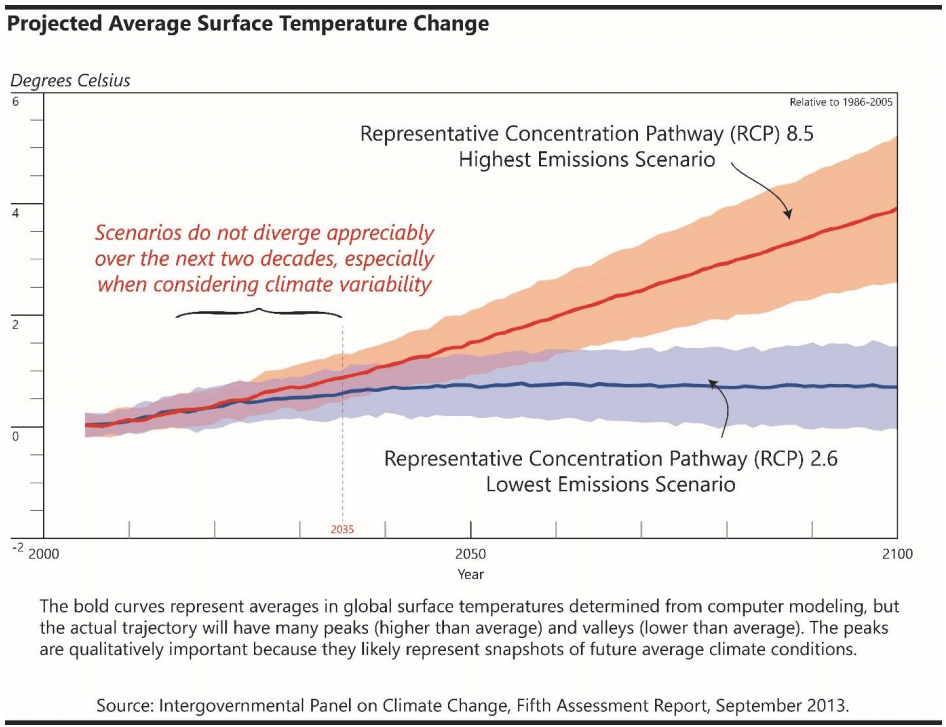
The lowest emissions scenario projected by the IPCC is still a increase in global temperature of over 1°C, which still has negative effects. By National Intelligence Council [of the United States] – Extracted from File:Implications_for_US_National_Security_of_Anticipated_Climate_Change.pdf, Public Domain, https://commons.wikimedia.org/w/index.php?curid=73511874
The effects of climate change that the IPCC has found are particularly concerning as these impacts are happening at current rates, meaning that if Earth went carbon neutral today (we produce as much carbon as the earth can remove in a year) and maintained the current temperature increase of 1.5°C, these are the effects we can expect to see in the next few decades. This report just goes to show us how important reducing emissions are and why we should all strive to do our part.
The monkey puzzle is a tree in Chile that is sacred to the local Pehuenche people. They use the seeds for food. What’s odd is the fact that Chile has no monkeys yet this tree is called the monkey puzzle. Its name possibly comes from the illusion that it would be a real puzzle for monkeys to climb up its whorls of spiny leaves. Another amazing fact is that this tree was alive for 200 million years ago, which means it also existed with the dinosaurs! This tree can live for 1000 years and grow as tall as 50m and a diameter of 3m. Its habitat is on slopes of volcanoes. This is possible since the seeds (which take 2 yrs to mature) are fire-resistant and cannot be harmed by lava. It thrives in well-drained and slightly acidic soils. It is usually found above 1000m altitude in its natural habitat. The monkey puzzle is also important for its wide range of uses such as making railway sleepers to access the coal fields, steel works, paper mills and ceramics industries around the port at the industrial heart of Chile. It’s timber was also used for general carpentry, skis, piano interiors, oars, aeroplanes etc. Now that it is realized how astonishing this tree is, it is also important to know that in 1976, they were declared ‘natural monuments’ and their felling was strictly prohibited due to the heavy logging it had experienced. However, they are still endangered, even after national nature reserves were set up to protect them.
Climate change is an ongoing topic in today’s contemporary society. The farming of livestock has been heavily associated with being a factor in global warming, as opposed to its counterpart, vegetation farming. As such, sustainable agriculture is imperative in being an adaptive and mitigating factor against climate change. Local Food Security is one of the factors that threatens sustainable farming, as there has to be an equilibrium established between the two principles.
All through high school teachers told us that Wikipedia is not a reliable source to get information. However, this idea completely changed when I myself learnt how to edit Wikipedia posts. I made my first ever Wikipedia account in an event that happened at York University’s Kaneff tower. It was an amazing event where I learnt all aspects of editing Wikipedia. I remember one of the organizers of the event telling me how she made her first ever Wikipedia account in an event similar to the one she was organizing that day. Becoming a wikipedian is a skill that I would have never learned if I had not taken the Applied Plant Ecology course (Biol 4095).
At first the thought of actually editing things online on such a large platform such as Wikipedia scared me. However, as I started exploring I genuinely started learning a lot of new things. The idea of editing things encouraged me to read about new plant ecology articles. Apart from this adding new things to articles is very exciting, but my favorite thing to do is edit grammatical errors in an article. I also truly like the idea of welcome virtual cookies that everyone gets on making a new Wikipedia account. Something new that I also learned through editing Wikipedia is how things work in a professional world. Becoming a wikipedian not only made me confident but it also gave me a lifelong asset in writing. At last but not the least I think everyone should at least once in their life become a wikipedian and I guarantee no one would ever regret it.
Wikipedia Edu
Recently my Applied Plant Ecology (Biol 4095) class gave me the opportunity to explore Wiki Edu. At first it was overwhelming to see the amount of information presented in my Wiki Edu account, however, as I started exploring I learned many new things about working with Wikipedia. The amazing tool had a few modules and exercises sorted in a weekly manner. Each week’s module helped explore Wikipedia step by step. It not only teaches us how to edit and add pages in Wikipedia, but rather also encourages everyone to be “BOLD” when doing so. I also learned about a few Wikipedia rules that I previously was not aware of. One of these rules was the difference between copyright violations and plagiarism. These two major topics might sound similar as they did to me, but after doing the modules and watching the video I realized the difference between the two. Apart from this I also learned what is considered a good source of reference when working on Wikipedia. Another great fact that I learned through the training modules was that Wikipedia is neutral and that editors are not allowed to present biased personal opinions or beliefs. This encourages editors to only add information backed up with a strong sources of reference. At the end of the training modules I was much more confident working with Wikipedia pages. Overall my experience with Wiki Edu was absolutely great as it was really helpful to go through the Wiki edu dashboard to edit pages on Wikipedia.


 Applied Plant Ecology Winter 2020