In order to fully understand a particular ecosystem, we need to understand its history—both natural and anthropogenic. While the North American grasslands have a rich natural history, their development since the arrival of European settlers has been rocky, to say the least.
Need for Research on Grasslands by Hanson and Vorhies was authored more than 80 years ago, and yet the problems addressed in this paper sum up many of the issues still faced by prairie ecologists to this day. I chose this paper because it is a great starting point for beginning to understand the state of grassland research as it exists today. For example, grasslands are often considered—by ecologists and the general public alike—to be degraded or inferior ecosystems left over from deforestation. Grassland management still focuses primarily on commodifying the landscape rather than preserving and fostering it; how can we maximize the number of cows on the land? How do we restore the ecosystem in the cheapest and fastest way so we can be approved to drill another oil well? Even today, 80 years after Hanson and Vorhies expressed these concerns, the general attitude towards the prairies is lukewarm at best.
We need to recontextualize how we see grasslands—as beautiful, diverse, and unique landscapes in their own right, rather than bleak expanses to be tamed—and this paper is an excellent starting point. It’s easy to read and doesn’t require prior knowledge of the prairie biome to understand the issues that the authors discuss. I hope you enjoy it as much as I did, and that it makes you pause and think about how you might perceive one type of ecosystem over another.
I chose these reports to understand and demonstrate how EF&B analysis relates to ecology (as I have a science background who is joining the social sciences).
The EF&B concept was conceived by Mathis Wackernagel and William Rees at the University of British Columbia in the 1990s. Their concept asks and answers the question:
“How much human demand is placed upon the planet’s regenerative capacity?”
In other words, how do we determine the amount of natural resources humans have used (ecological footprint) compared to what is available and/or what the Earth can regenerate (biocapacity)?
EF&B analysis can provide an overall account of natural resource use at the global, national, regional, city or individual scale. It is “human-focused” and illustrates our demand for natural resources to run global and national economies.
There are ecological implications associated with these human activities. Thus, the analysis has been used to assess the ecological implications of resource extraction in the two readings I selected for students.
The Living Planet report uses EF&B analysis to indicate an increase in all six components of the world’s ecological footprint of consumption over time. Overall, our increasing demands for energy and resources to consume are drivers that threaten biodiversity and ecosystems.
What are the biggest threats? Habitat loss and degradation due to agriculture and over exploitation of land/oceans.
The second report assessed the status and trends associated with Ontario’s EF&B in 2005. Ontarians are demanding much more from the Earth than it can provide and are consuming more than what’s expected globally per person. Hence, Ontario’s high per capita ecological footprint is putting immense pressure on biodiversity which is most likely driving impacts such as terrestrial and aquatic habitat loss, pollution, etc.
These reports use EF&B analysis to associate human activities with ecological impacts both globally and regionally. Although defined as “grey literature”, the reports were chosen because they are written and published by seemingly credible environmental non-governmental organizations (eNGOs).
When I saw that the Wikipedia Edit-a-Thon assignment was a part of the course syllabus for Applied Plant Ecology, I was confused. Throughout my academic career, I had been constantly taught that Wikipedia is an unreliable source. However, Dr. Bazely taught me otherwise. As she stated in her three-partedWikipedia Edit-a-Thon Chronicles blog post, she had discovered that pages for those areas of science where she has expertise in are actually very well fact-checked.
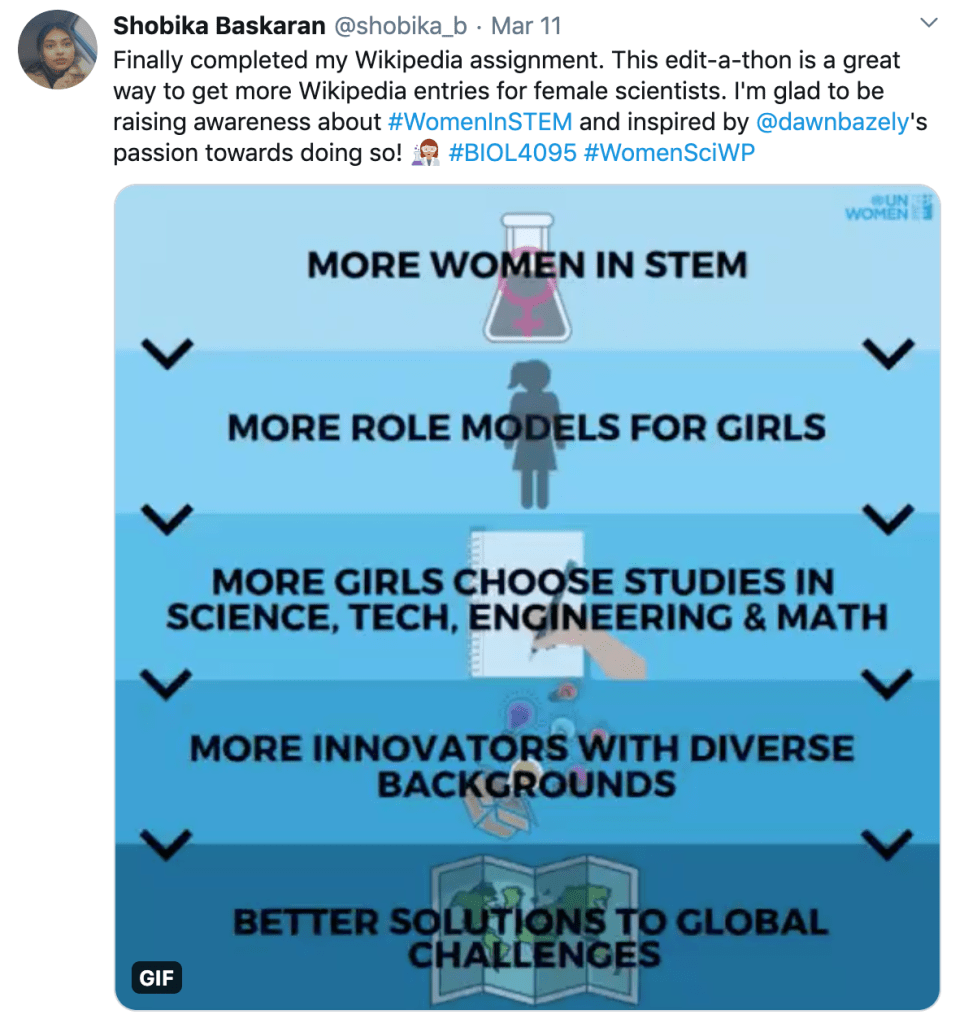
In 2013, Dr. Bazely introduced Wikipedia Edit-a-Thon to Ecology courses to teach students how to write and edit Wikipedia pages. In 2015, Dr. Bazely, alongside Steacie Librarian John Dupuis, launched the annual York University Ada Lovelace Day Wikipedia Edit-a-Thon to increase the recognition of women in the fields of science, technology, engineering, and mathematics through the addition of more Wikipedia entries. The Twitter hashtag for this is #WomenSciWP.
For the Wikipedia Edit-a-Thon assignment, I created a Wikipedia account under the pen name Plant Power 4095. I had to choose pages that were related to the student lecture topics of the course and edit, improve, and expand its content. Throughout my experience doing so, I learned:
• I can’t cite Wikipedia in my research essays and lab reports because it’s a tertiary source of information, and both the primary and secondary sources that it uses should be cited instead.
One of many things the training module additionally taught me is that:
• There are a few different types of free licenses you can use on Wikipedia. Wikimedia Commons defaults to a CC BY-SA license. This means that anyone can use, copy, or share media or modify it and share it as a new work as long as the person using it provides credit to the original author and notes the license and releases any modifications of the work under the same license.
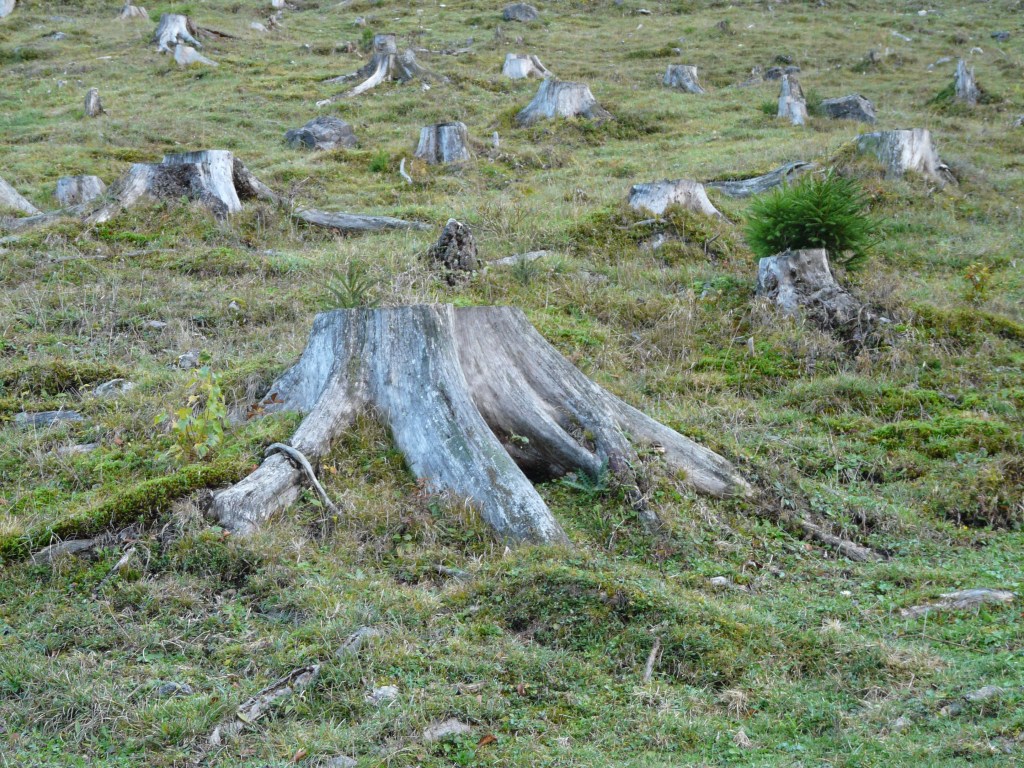
source: Wikimedia commons Deforestation-62486.jpg Created: 21 October 2012
The article by Bastin et al. was chosen in relation to afforestation in southern Ontario’s mixedwood plains. Trees are vital to our planet’s ecosystems and to human health and well-being. Temperate forests play a significant and vital role in sequestering anthropogenic carbon dioxide (Jarvis 1995). Atmospheric CO2 is now over 415 parts per million (ppm). In pre-industrial times it was 280 ppm. In 1958 when continuous monitoring began at Mauna Loa Observatory atmospheric CO2 read 316 ppm.
The Intergovernmental Panel on Climate Change, in its Fifth Assessment Report (IPCC 2014, 102) recommends that:
The most cost-effective [GHG] mitigation options in forestry are afforestation, sustainable forest management and reducing deforestation, with large differences in their relative importance across regions…. About a third of mitigation potential in forestry can be achieved at a cost <20 USD/tCO2-eq emission. [WGIII SPM 4.2.4](IPCC 2014, 102).
Forestry plays an important part in sequestering carbon and climate change mitigation. Besides sequestration, we need to think in terms of carbon conservation and carbon substitution (FAO 2001). Grasslands are somewhat less effective than forests in sequestering carbon (Tallgrass Ontario 2020). A recent Science study (Bastin et al. 2019) postulated that planting another 1 to 1.5 trillion trees worldwide is both possible and imperative:
Ecosystems could support an additional 0.9 billion hectares of continuous forest. This would represent a greater than 25% increase in forested area, including more than 500 billion trees and more than 200 gigatonnes of additional carbon at maturity. Such a change has the potential to cut the atmospheric carbon pool by about 25%.
Canada’s Paris Accord commitments call for significant reductions in greenhouse gases (GHG).
Canada contains 24% of the world’s boreal and 15% of the world’s temperate forests, which comprise 9% of the world’s total forest cover (Biodivcanada 2014). How we manage our forests will play a very important role in GHG reductions (Bellassen & Luyssaert 2014; Henschel and Gray 2007, University of Wisconsin-Madison 2009).
Agriculture and forestry account for approximately 25% of all global greenhouse gas emissions. One acre of mature trees can absorb 2.5 tonnes of CO2 per year and create enough oxygen per year for 8 people (Novak, et. al. 2007). Using estimates of 6.4 tonnes sequestered per ha per year by temperate forests, increasing forest cover in southern Ontario by 10% (1,759,630 ha) could sequester 11.26 million tonnes per year. This is equivalent to sequestering what 665,581 Canadians produce annually. Every person in Canada on average creates 16.92 tonnes of CO2 per year.
In Ontario, the bulk of our forests occur in the boreal ecozone of northern Ontario. Ontario’s 107.6 million hectares (ha) of land include 93.2 million ha of public land. 71.1 million ha is forested, and 56.1 million ha is “productive” forest. In northern Ontario, our forestry occurs primarily on public lands.
In southern Ontario’s mixedwood plains, forest cover has been reduced to 25% from over 75% pre-settlement. Almost all of this is privately owned land (Biodivcanada 2010).
The mixedwood plains region of Canada is one of the most densely populated and least protected areas of Canada. Less than 1%, just over 66,000 hectares, of this region is protected (OMNR 2011) and one third of Canada’s species at risk are located in this area (Environment and Climate Change Canada 2015). Protection of our existing forests, and planting new ones will have multiple benefits to society and to biodiversity, from flood control, source water protection, climate change mitigation, air pollution mitigation, urban cooling, recreation, psychological health, and many more.
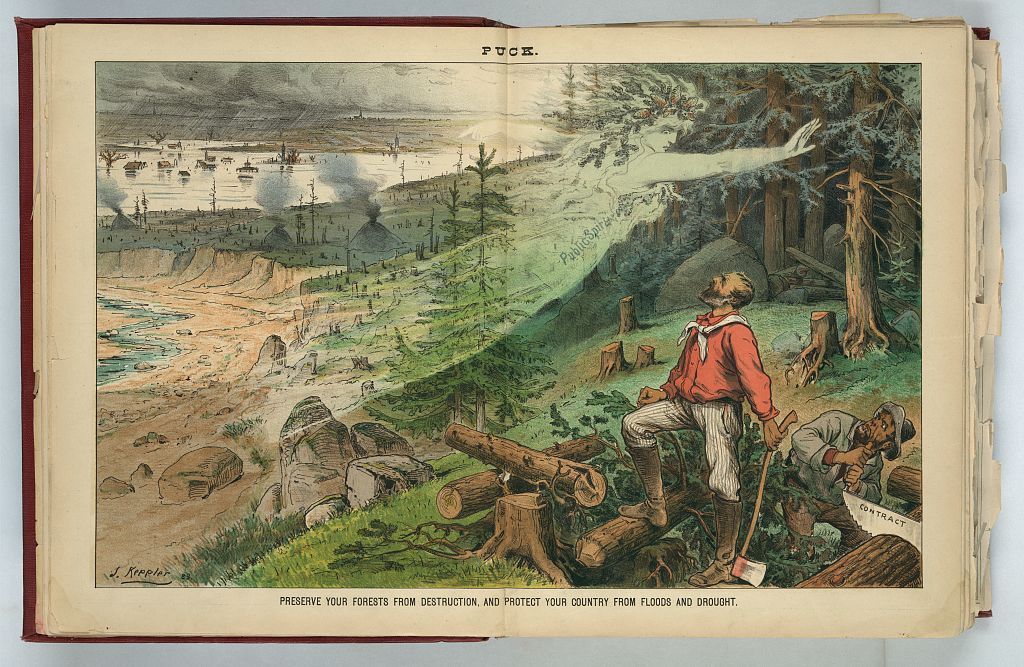
source: Wikimedia commons: Copyright 1884 by Keppler & Schwarzmann.; J. Keppler.; Illus. from Puck, v. 14, no. 357, (1884 January 9), centerfold Library of Congress Catalog:http://lccn.loc.gov/2012645164
In the 20th century we did just that. From 1906 to 1996 we increased forest cover in southern Ontario from 5% to approximately 25% by planting over 2 billion trees (Bacher 2011).
We are now losing forests in southern Ontario at a rate of 700 hectares per year (Saxe 2018; Sproule 2019). Most of our watersheds have less than the 30% forest cover recommended for healthy ecosystem function (Environment Canada 2013). This is driven by agriculture, urbanization, and by global demand for corn and soy biofuels. In Ontario we require gasoline to contain 10% (agriculturally derived) biofuel, and 15% by 2025.
We can reverse this deforestation. We can easily fit another 2 billion climate resilient native trees into southern Ontario. But even if we do, it may be a long time before our forests will become net carbon sinks again (OMNR 2011). Canada’s forests as a whole were net carbon sinks before 2001 (Natural Resources Canada 2018). Since then these forests have emitted more CO2 than they absorb. Forests encompass biological organisms that respond to changing conditions. We can continue afforestation efforts, and manage existing forests effectively.
References:
Bacher J. 2011. Two Billion Trees and Counting: The Legacy of Edmund Zavitz. Toronto(ON): Dundurn Press. 280 p.
Bastin J-F, Finegold Y, Garcia C, Mollicone D, Rezende M, Routh D, Zohner CM, Crowther TW. 2019. The global tree restoration potential. Science 365: 76-79. http://science.sciencemag.org/.
Henschel C, Gray T. 2007. Forest Carbon sequestration and avoided emissions. A background paper for the Canadian Boreal Initiative/Ivey Foundation Forests and Climate Change Forum, October 15th to 17th, 2007, Kananaskis, Alberta. Toronto (ON): Ivey Foundation. http://www.cef-cfr.ca/uploads/Reference/climate_forest.pdf
IPCC, 2014: Climate Change 2014: Synthesis Report. Contribution of Working Groups I, II and III to the Fifth Assessment Report of the Intergovernmental Panel on Climate Change [Core Writing Team, R.K. Pachauri and L.A. Meyer (eds.)]. IPCC, Geneva, Switzerland, 151 pp. https://www.ipcc.ch/site/assets/uploads/2018/02/SYR_AR5_FINAL_full.pdf
Jarvis P G. 1995. The role of temperate trees and forests in CO2 fixation. In: Hirose T., Walker, B H. (eds) Global change and terrestrial ecosystems in monsoon Asia. Tasks for Vegetation. Science, vol 33. Springer, Dordrecht. https://link.springer.com/chapter/10.1007/978-94-011-0343-5_15.
McCauley, D. J. (2006). Selling out on nature. Nature, 443(7107), 27-28. Reply to McCauley Reid, W., Mooney, H., Capistrano, D. et al. (2006) Nature: the many benefits of ecosystem services. Nature 443, 749. Reply by McCauley McCauley, D. J. (2006). Nature: McCauley replies. Nature, 443(7113), 750-750.
Dear BIOL 4095 Class,
I chose these readings based on two criteria: 1) relevance to my own research and 2) article type.
Reason One: Relevance to my own Research
The original article by McCauley (2006) is a seminal paper in the area of nature valuation. It has been cited 825 times (Google Scholar, 2020. This means that other researchers thought the ideas presented by McCauley were important enough to include when they wrote their own articles. This does not mean they all agreed with McCauley’s ideas.
Reason Two: Article Type
You may have noticed McCauley (2006) is in the Commentary section of the journal Nature. I suspect most of you are more familiar with original research (ex. experimental) or review (essay style) articles. McCauley (2006) is very similar to a review type article; however, there is an important difference: an overall thesis. A typical review article summarizes previous research on a topic and makes suggestions for future research. Whereas in a commentary article the author uses previous research to support their thesis statement. A well written commentary article is thought provoking and sparks debate. I assigned the reply to MCCauley (2006), Reid and colleagues (2006) and McCauley reply to Reid et al. 2006 to give you all a small sample of the debates that occur in science.
Class Questions
What was the thesis of McCauley (2006)?
What was the thesis of Reid et al. (2006)?
In your opinion, did McCauley’s reply address the critiques of Reid et al. 2006?
For this blogpost I was asked to explain why I chose the course reading that I have selected for the students after giving my guest lecture and what the students should take from it.
As an international graduate student from Suriname I met many Canadian and other international people here in Canada. Eight of the ten people I met do not know about my country, which is not really surprising for me. By choosing a paper for the students I wanted to share some background information about my country too.
The paper I have chosen for the students gives a good overview not only about the small scale farming systems but also the general diversity of culture, religion and language in my country. The three districts, Paramaribo (capital), Saramacca and Commewijne are unique for its own historical background and as given on the map in the paper you can see that these districts are located on the coastal part of the country. Due to the poor soil conditions and forestry in Sipaliwini, a district on the interior that as a result participates in very little agriculture.
The paper covers the three pillars of sustainable agriculture which I mentioned in my guest lecture. Aspects of economic contribution of farming, social equity and environmental factors, the farmers are dealing in Suriname are presented well. The study gives a better understanding of the status and challenges the farmers are dealing with when they are producing food for both the local and international markets.
Studies show that many people are suffering from chronic hunger and prices of food are increasing. Recent debates of policy makers, scientists and professionals are going about new approaches to improve agriculture and food security with sustainable environmentally and socially farming practices.
In my opinion most of the problems mentioned by the farmers in the paper can be reduced with application of innovation, knowledge and new technology. The small scale farmers should bring agrodiversity in their production systems. With a diverse production system the farmers can increase their yearly income.
Agrodiversity farm in district Saramacca. Polyculture of Pineapple, Plantain and Citrus.
Use of high yielding crop varieties, machines, chemicals are the key aspects of conventional agriculture. At the other hand agrodiversity and food security are sustainable farming approaches that generate multiple benefits for small farmers. Policy makers and scientists should take the traditional knowledge of farmers to create technology that is adaptive for the farmers. Agrodiversity is about cultivation of different crops at small scale level in order to ensure sustainable agriculture with high biodiversity and environmental sustainability, which refers to prevent soil erosion and land degradation. Agrodiversity can also be done in combination of livestock, fishery and forestry. Food sovereignty is about healthy produced food and institutionalization of adding value to food. Innovation in current governance institutions is required. To make progress government, businesses, scientists, and development actors must collaborate to improve the production of food and ensure safe and healthy food and environment in Suriname.
I first ran our course in Winter Semester of 1993. That’s before most of you were born. When I proposed this course in 1991, there really was not much like it available for students in the Biology Department, except for Conservation Biology. Applied Plant Ecology first ran under the temporary code, BIOL 4170, that was used to designate all new courses. The curriculum included familiar topics like acid rain, the ozone hole, and global warming. I chose Bill Freedman’s Environmental Ecology (1989) as the course text.
The first and second decades of BIOL4095
In the 1990s, I took a broad taxonomic approach, and the course covered both plants and animals and biogeochemistry. Back then, a more accurate course title might have been Environmental Ecology. When I looked at my original course outline, I was surprised to see the impact of war on vegetation. I completely forgot that I included this. War is a human disturbance that affects ecosystems, and often requires ecosystem management and habitat restoration!
But, like viruses, courses evolve, and BIOL 4095 has changed in the eleven times or so, that it’s been taught over the last 28 years, though not always by me. I didn’t teach it when I was a research institute director from 2006-14.
The general topics have remained fairly constant, but Applied Plant Ecology has become much more botanically focused over. New faculty members hired after me, developed their own upper year courses, many of which havw an applied ecology component.
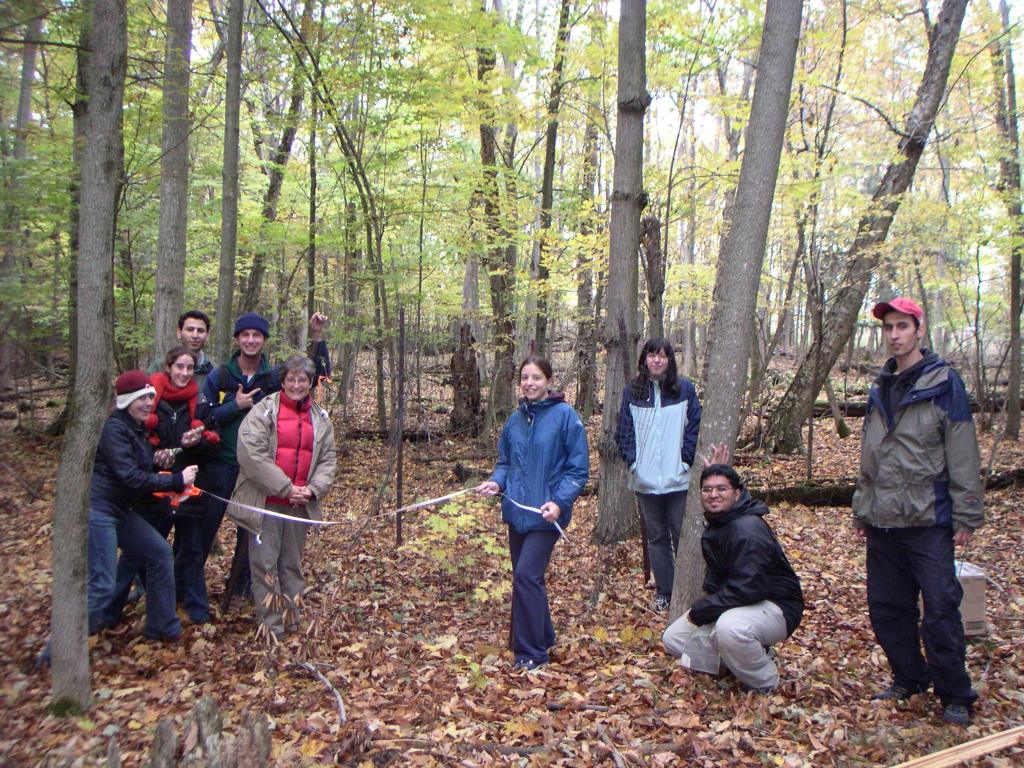
Applied Plant Ecology Field Trip to Presqu’ile Provincial Park in October 2003
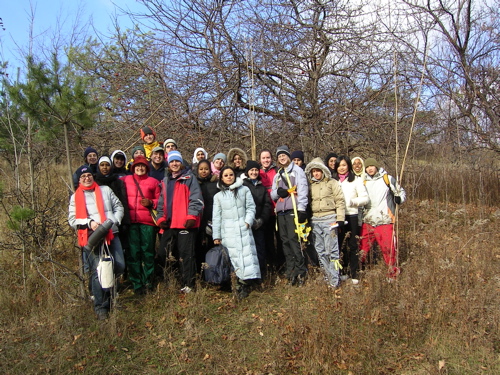
Applied Plant Ecology Field Trip to Highfields Family Farm in Fall 2008
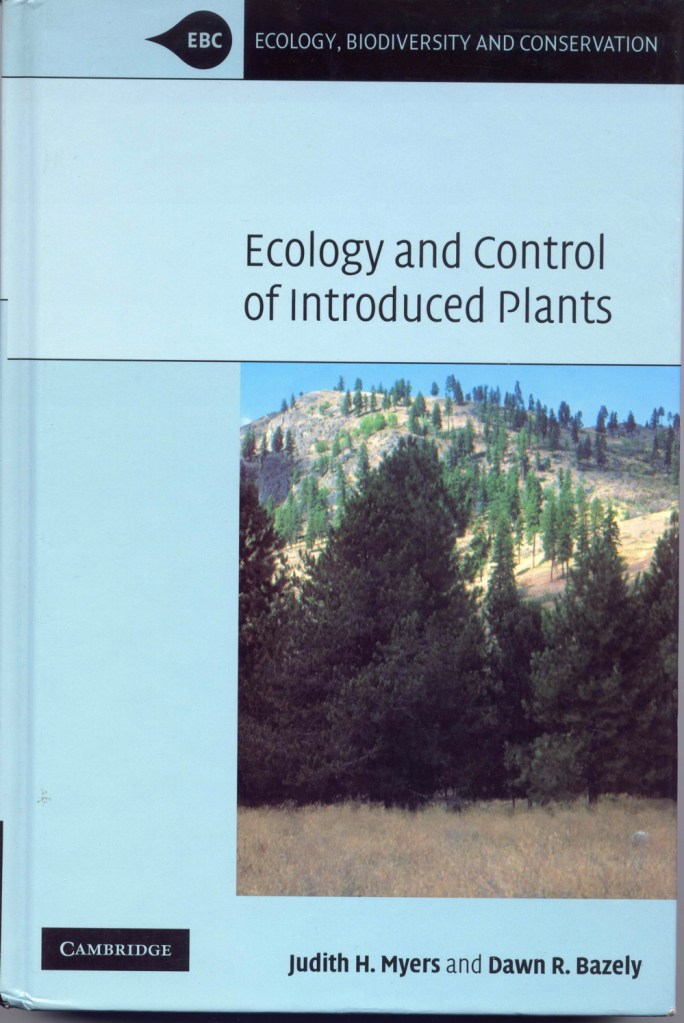
After 2003, the course heavily emphasized the management of non-indigenous, invasive plants, when Judy Myers and I published our book: The Ecology and Control of Introduced Species: Managing Invasive Plants. This topic replaced the Ecological Impact of War!
The third decade of BIOL4095
In 2014, I introduced an explicit science communication component, based on what I learned while directing York’s pan-university research institute in sustainability, IRIS (sadly, now closed). At IRIS, I learned about how and why science communication to policy makers often fails. I also learned many practical communication skills like social media and blogging. Your assignments about science communication to non-scientists this course, which is, after all, about applying ecological research, are based on my experiences.
There are two constant themes across the course over the past three decades:
A field component, which today, would be called experiential education. In the 1990s and 2000s the course ran in both Winter and Fall semesters, and students would go on a big field trip to collect browse data from provincial parks and private forest (photos above). This year, we are running a Film Festival project to select the 11 most important films (documentaries, TV show episodes and fiction films) about Applied Ecology issues that we think that all members of the YorkU community should see.
Visiting speakers. In 1993, an Ontario Ministry of Natural Resources biologist, Michael Rosen spoke to the course about managing Ontario forests. This year, we had seven visiting speakers!
As they say “plus ça change, plus c’est la même chose.”
P.S. The topic of this post, which has a historical focus, loosely falls into Topic #2 of your choices: “Write a post on a peer-reviewed journal paper published in the year of your birth, that is about Plant Ecology in general, and which loosely relates to one of our 11 applied plant ecology lecture topics. Summarize its main research question(s) and its results, and explain why you settled on this particular paper.”
No monkeys allowed sign used in reference to the fact that monkeys are unable to climb this tree.
Araucaria araucana, also known as The Monkey Puzzle Tree, is an unusual looking evergreen conifer native to Chile (national tree) and Argentina. It has gained this strange name due to the fact that a monkey would be unable to climb it. This tree is characterized by its strange leaves and distinctive trunk with branches that originate from the trunk in whorls. It is believed that the ancestors of this tree existed at the time of the dinosaurs and composed some of the larger forests. The Monkey Puzzle Tree grows very slowly and has a growth period which lasts hundreds of years and is also thought to live up to a thousand years. Although it is native to Chile and Argentina, this tree has been introduced to many places where it grows as an ornamental plant.
The Monkey Puzzle Tree in Hesse, Germany
The mature Araucaria araucana can reach up to 150 feet in height with a trunk diameter of 7 feet. (Just from these measurements, I could only imagine how large this tree must be!) Furthermore, the leaves of this tree overlap and are said to resemble reptile scales. This tree is dioecious meaning that they are either male or female. The male cones are known as pollen cones and the female cones are known as seed cones. Wind-pollination is the type of pollination which occurs between these trees as through the wind the transfer of pollen from the male cones to the female cones occur. The seeds of this tree are large, edible and delicious.
The arrangement Monkey Puzzle Tree leaves.
Araucaria araucana is endangered as the number of trees are reduced due to deforestation caused by logging and burning. These activities enforce the clearing of the trees on land and this tree is also harvested for its wood. Although it is illegal to cut down the Monkey Puzzle Tree in its native habitat they continue to be cut down illegally. As mentioned previously, because these trees grow very slowly, it is more difficult for them to recover from any population stresses and that is why the conservation of these trees should be considered. Attempts to save this tree are being done within Chile as well as in Scotland and there are a few conservation projects in progress. The Royal Botanic Edinburgh even imported thousands of Monkey Puzzle seeds to save the genetic diversity of this species and are also growing hundreds of trees in a greenhouse.
The flag of the United Kingdom.
It is believed that UK gardeners can assist with the potential threats this species is enduring. The first monkey puzzle tree was introduced to Britain in 1795 by Scottish botanist Archibald Menzies. Furthermore, these trees remained rare in Britain until the 19th century until William Lobb began to collect seeds and prepared a nursery where he sold the seedlings. These seedling were sold to the elite and were only observed in the gardens of areas for the upper middle classes. During the 1920’s the Araucaria araucana were to be found grown as a statement of prosperity, in the small gardens of suburban Britain. They were later then forgotten in World War II. It was after this that these trees began to become ingrained in the British history and in the landscape of the UK. Because of the long history this tree has had in the UK, they can make significant conservation efforts for this plant.
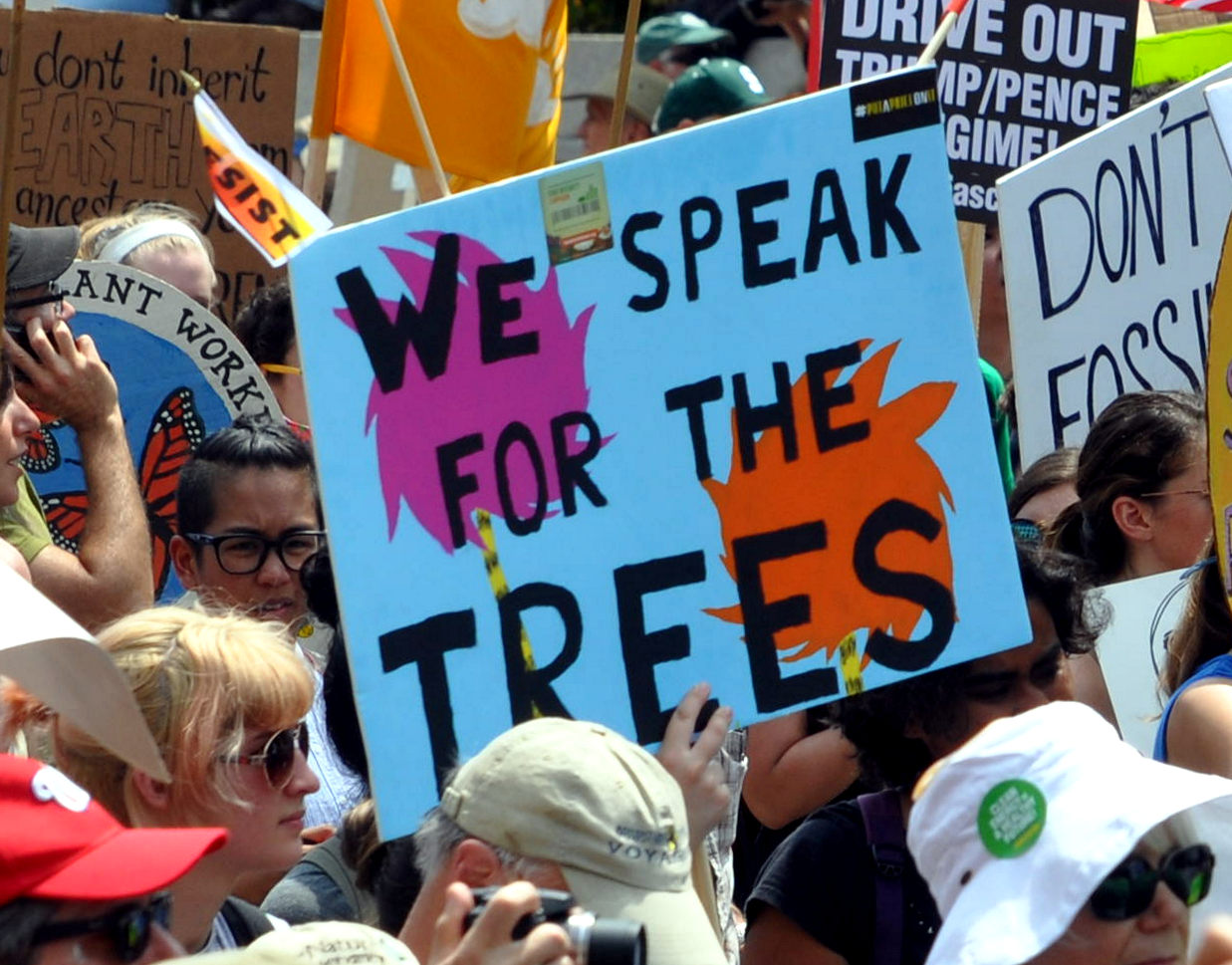
A movie which I considered nominating for the Film Festival but didn’t was the 2012 depiction of Dr. Seuss’ book The Lorax. In this movie, a young boy named Ted is searching for something which his crush Audrey desires—a Truffula tree. Unfortunately, Ted and Audrey live in the polluted town known as Thneedville where no trees and no flowers grow. The young boy is curious about the tales of the Lorax—a forest-dwelling creature—and the only person who knows about this creature is the Once-ler. The Once-ler is an old, antisocial inventor that tells the tale of the Lorax to Ted for a small price. He tells the tale of the greedy developer who destroyed his natural environment—which was in fact him. The Once-ler arrived in a beautiful and fertile environment with colourful “Truffula Trees” and creatures such as the “Hummingbird Fish”, “Swomee-Swans” and “Brown Bar-ba-loots” and decided to settle down in this town as he was fascinated by its beauty. He decides to chop down one of the Truffula Trees to build his shop and sell “thneeds” which were some sort of knitting invention that he believed would gain him a lot of attention. This would soon prove to have consequences because once he cut down the tree, the Once-ler conjured up the Lorax—the guardian of the trees who speaks for them as they cannot speak for themselves. The Lorax warned the Once-ler that his action of cutting down the trees would have consequences. Overtime, the Once-ler’s thneeds business had flourished as he continued to chop down these trees for raw materials and had a factory which was constantly pumping out smoke and fumes. This caused the entire town to become extremely polluted and all these creatures which were there began to die and become extinct as their habitats were becoming destroyed. Eventually, the Once-ler kept chopping down the Truffula trees until the very last one before realizing that he had destroyed the environment and without these trees his business was in jeopardy. Before the business ended, the Lorax left a message for the Once-ler that read “Unless” which he had only realized when telling Ted the story suggested that unless people cared about the environment they would continue to face the consequences. Telling this story allowed him to realize the importance of trees which prompted him to give Ted the last Truffula seed so that he could plant it and regrow. This would then allow all the trees and creatures to return back to Thneedville.
A fictional representation of a “Truffula Tree” forest.
Essentially, this is a story about the environmental destruction of a town due to the greed of these contractors and business owners and this is why it relates to Plant Ecology. The Lorax in this tale symbolizes the environment as he is the speaker for all things that cannot speak but are destroyed for the making of raw materials. Eventually, what we end up with is polluted areas and many species end up dying due to a loss of habitat. Deforestation occurs all over the world for the purposes of money and it is unfortunate to say that many species go extinct because of this deforestation. The town of Thneedville represents the harsh reality of what our world will come to if we continue to destroy our environment to make factories and raw materials. We should not have to go that far before realizing that what once was is rapidly leaving us and we are working towards a mass extinction.
A poster that says “We speak for the trees” in direct reference to the movie Dr. Seuss’ The Lorax seen at the Climate March 2017.
The Podcast or Perish is a podcast about academic research and why it matters and is hosted by Cameron Graham, a professor of accounting at York University. In episode 005 of this podcast (November 4th 2019), Graham sits down with Dawn R. Bazely—a biologist, ecologist, and my University professor at York University. Dawn is very passionate about women and people of colour in STEM (Science, Technology, Engineering and Math) and finding ways to build structures of recognition for them.
In this podcast, Graham brings up that two Nobel prizes were awarded to women in the field of economics (34:00-36:40). Dawn then brought up the fact that based on research conducted in economics, it is proven that young women who are a part of a collaborating team have their contributions consistently devalued and that it is the young men’s research which is prioritized and heavily valued. Dawn then suggests that a way for women to combat this may be to publish alone rather than have their work be published in collaborative author teams. She says that this is the only way for women to guarantee that they receive all the credit which they deserved (36:55-41:00). Dawn goes on to mention that in several conferences and talks that she has attended, she has seen women—more specifically women of colour—constantly being ignored by speakers when raising their hands for questions.
Dawn’s advice is essentially that something these women can learn from the “self-congratulatory” attitude they are subjected to by men is “ramped self-promotion” or what she coins as “RPS”. I definitely and wholeheartedly agree with everything Dawn mentioned in this podcast. Women in all types of professions are repeatedly underrepresented and uninvited to the conversation which includes men. It is almost as if women are required to work twice or three times as hard for their contributions to be recognized. We observe this in the sexist and misogynistic-fueled wage-cap which exists and has existed for decades. I think it is very important that there are women—such as Professor Dawn Bazely—who are able to speak out on the lack of representation of women in all fields including STEM and work to raising the profile of these women and women of colour. With this in place, other women will be able to put out their own work without the collaboration from their male counterparts and deserve all the credit that they deserve.
Women are consistently being regarded as not be “notable” and there are many people whose intentions are driven by misogyny who intend to discredit these women. This was also observed when Dawn mentions her colleague—and Nobel-prize winner—Donna Strickland who wanted her children’s names on her page and whose Wikipedia page was later rejected because she was not considered “notable enough” (15:15-16:30). I just really believe that it is unfortunate that women continue having to be subjected to this inequality and similar to Dawn, I encourage women to self-promote themselves and their work as much as possible.









 Applied Plant Ecology Winter 2020