Types of Scientific Literature

Different types of sources can be very helpful for different types of people in different scenarios. The three most common types of literature used in scientific writing are peer reviewed primary, secondary and tertiary literature. Peer reviewed primary literature contains content that is gathered firsthand by the author. The experiments are done, studies are conducted and results are collected and reported by the author themselves. The paper is then peer reviewed. This process can take quite some time, with the literature being looked over and approved by others in similar fields, to ensure the content is appropriate and accurate. One example of a peer reviewed primary source is a paper on elevated growth and biomass along temperate forest edges (Morreale et al., 2021). Secondary literature interprets another author’s work. The information is obtained from primary sources and the literature is written about it. These include things like reviews, critiques, studies and analyses. The raw data is not collected by the author. An example of this is the review written by Hanley et al. (2020) about coastal ecosystems. The final type of literature is tertiary literature. This is a compilation or summary of sources, often giving secondary sources but can be primary as well. This can be used as a resource or tool for people to use for references. This type of literature includes encyclopaedias, databases and catalogues. The Wikipedia page on the temperate deciduous forest is an example of this type of literature. Each type of literature can be used for its own individual scenarios.

Hanley ME, Bouma TJ, Mossman HL. The gathering storm: optimizing management of coastal ecosystems in the face of a climate-driven threat. Ann Bot. 2020;125(2):197-212. doi:10.1093/aob/mcz204

Morreale, L. L., Thompson, J. R., Tang, X., Reinmann, A. B., & Hutyra, L. R. Elevated growth and biomass along temperate forest edges. Nature communications, 2021;12(1), 7181. https://doi.org/10.1038/s41467-021-27373-7   

Temperate Deciduous Forest. Wikipedia. https://en.wikipedia.org/wiki/Temperate_deciduous_forest. Published February 23, 2022.
Different Types of Research

Today, research and fact checking are incredibly important to do in order to get the best information regarding any topic. There are a variety of ways to gather research but even if a researcher gathers a lot of research, it is possible that they will miss important facts. To mitigate this, most researchers would look at peer-reviewed literature. To break it down further, there are three types of literature. Primary, secondary, and tertiary. Each are important on their own ways and can act as a means to continue researching and learning about a topic. In plant ecology, knowing which type of research to use is beneficial since some peer-reviewed sources use ideas and research from other sources.

Firstly, many researchers would look at tertiary sources to begin their research. While this type of source is not usually referenced in research papers, tertiary sources summarize a lot of the important research and findings of plant ecology. Additionally, these sources provide links to other resources and show where the author got their information from. Some examples of tertiary sources include encyclopedias, dictionaries textbooks etc. Wikipedia articles such as the article about Forest ecology (https://en.wikipedia.org/wiki/Forest_ecology) since it gives an overview of major research findings and other important information on forest ecology (both plants and animals.

Next, researchers would look at secondary sources. These sources can also be found in textbooks and encyclopedias but are typically reviews of primary research articles. An example of this is the review: Trait-Based Plant Ecology by Nathan Swenson. This is a review of the book titled Plant Functional Diversity, organism Traits, Community Structure, and Ecosystem properties by Eric Garnier et al. the review summarizes the most important points in each chapter. The review is concluded by the author stating that the book is a good way for researchers to begin to think about trait-based ecology.

Finally, researchers would look at primary research literature. This type of literature always contains a section for methods and observations. Interviews, surveys, observations, and research papers are all examples of primary research because the researcher had collected the research with a team or by themselves. An example would be the article, Evolutionary ecology of plant–microbe interactions: soil microbial structure alters selection on plant traits by Jennifer Lau and Jay Lennon. This article discussed the influence that bacteria and other protozoa have on plant diversity. Additionally, they manipulated the soil environment to see the impacts that the differences would have on natural selection of plant traits.

How Invasive Species Modelling Can Apply to the COVID-19 Pandemic

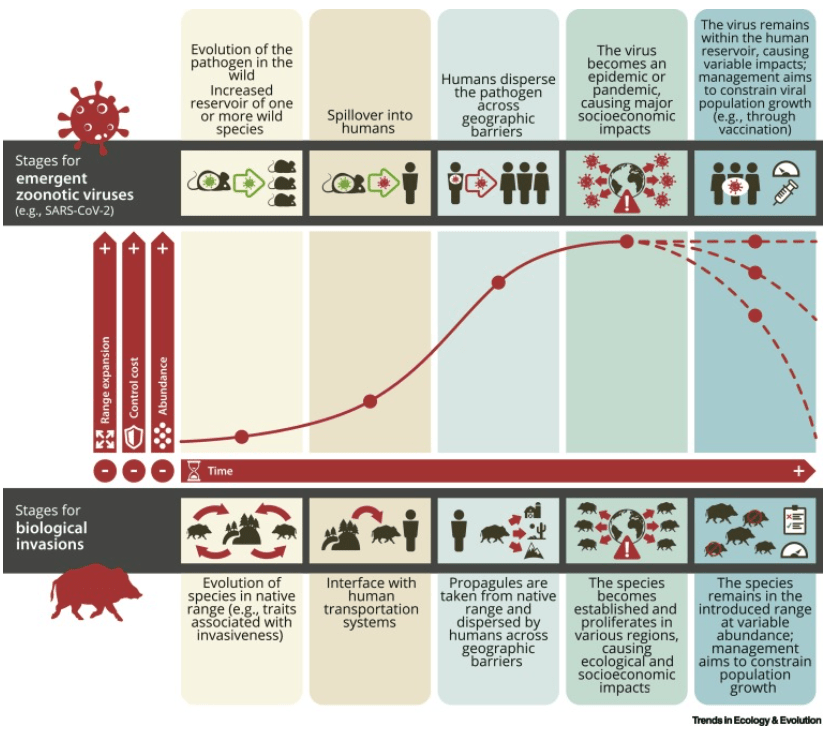
Models for invasive species can also apply to COVID-19. It is strange to think of the current pandemic in such a light but there are many similarities between the two. Procedures that prevent the spread of invasive plants and animals will also apply to prevent the spread of COVID-19, procedures that were unfortunately not applied aggressively or quick enough. To illustrate how similar COVID-19 is to an invasive species consider the following graphic:

Figure 1: Stages of a Zoonotic viral Epidemic compared to those of a biological invasion. Taken from https://doi.org/10.1016/j.tree.2020.05.004

Note the many similarities between the two. It is for this reason that many of the actions you would take for containing an invasive species will also apply to COVID. Of course, given that we are still in a pandemic, these actions were not implemented properly or at all. To give an example, to prevent an invasive species from growing into a problem too large to handle it is best to contain them before they get the chance to procreate and spread, and in the case of COVID, closing borders and isolating the infected. However, because COVID was handled poorly it has become something that will likely never go away and the best thing to do now is to get vaccinated so when you do contract it the consequences will be minor and non-life threatening.

Works Cited

Nuñez, M. A., Pauchard, A., & Ricciardi, A. (2020). Invasion science and the global spread of SARS-COV-2. Trends in Ecology & Evolution, 35(8), 642–645. https://doi.org/10.1016/j.tree.2020.05.004

Wall-e (The Other Film I Chose)

For our film festival assignment, we had to choose three movies and explain why we chose one of them. The main movie I chose was a documentary called Parched and it was about the ongoing water crisis. One of the other movies I chose to nominate was the movie Wall-E. On the surface, it is cute children’s Disney movie that is about a little waste-collecting robot (WALL-E) and how he fell in love with a reconnaissance robot named EVE. Wall-E had deviated from his initial job to clean the earth to follow EVE back to the spaceship where the humans live. The movie does an excellent job at giving attention to the impact of climate change due to human actions (and inaction). Earth had become so unstable that human, animal, and plant life will not survive (obviously until the EVE robot takes a sample of a plant that had survived). According to the movie, the ecological collapse was due to the amount of waste on the planet, and it stayed inhabitable for a very long time. Humanity escaped the dying planet 700 years prior to the events of the movie. This relates to plant ecology because plant life is vital to the survival of the majority of life. Should, plants die off due to environmental instability, the same will happen to most living creatures. I say most because there are many species that can survive really harsh conditions such as tardigrades. However, we are seeing environmental instability, the loss of biodiversity and the extinction of so many species in real-time. This movie gives an insight of how the planet could potentially be like should we continue ignoring this crisis.

An Introduction to Scientific Articles

Scientific papers can be broadly categorized into primary, secondary, and tertiary. A primary paper is where the paper discusses an experiment conducted by the author(s) and they report their findings. Primary papers typically contain a methods section and may include statistical tests with their findings. An example would be Urban streams across the USA: lessons learned from studies in 9 metropolitan areas written by Larry R. Brown and his associates. This paper looked at the relationship between urban stream syndrome (USS) and how urbanized a given area was. This involved concocting a system that ranked metropolitan areas based on how urbanized they were and comparing their findings with symptoms associated with USS. The data used here came from a different source but their methodology is theirs alone. A secondary paper is where someone looks at the findings of a previous experiment and writes about it. An example of this would be Urban hydrogeomorphology and the urban stream syndrome: Treating the symptoms and causes of geomorphic change written by Geog J. Vietz and his associates. They looked at the previous article mentioned and evaluated it while the author(s) proposed their own thoughts and conclusions. A tertiary paper is a paper that looks at both secondary and primary resources for information. An example would be Wikipedia articles. Many people consider Wikipedia articles untrustworthy not because anyone can edit them or because they are not peer reviewed because they are, but rather because they are tertiary sources of information.

Works Cited

Brown, L. R., Cuffney, T. F., Coles, J. F., Fitzpatrick, F., McMahon, G., Steuer, J., … & May, J. T. (2009). Urban streams across the USA: lessons learned from studies in 9 metropolitan areas. Journal of the North American Benthological Society28(4), 1051-1069. https://doi.org/10.1899/08-153.1

Vietz, G. J., Walsh, C. J., & Fletcher, T. D. (2016). Urban hydrogeomorphology and the urban stream syndrome: Treating the symptoms and causes of geomorphic change. Progress in Physical Geography: Earth and Environment, 40(3), 480–492.     https://doi.org/10.1177/0309133315605048

Janaki Ammal – India’s first female botanist

Janaki Ammal was an Anglo-Indian botanist who lived from 1897-1984. She was most famous for her work on plant cytogenetics, specifically in sugarcane and eggplant. Dr. Janaki Ammal first received an honours degree in botany from the Presidency College and went on to get her masters in botany from the University of Michigan. She then taught as a professor in India for a few years before returning to the University of Michigan for her PhD. Janaki’s most prominent work occurred when she joined the Sugarcane Breeding Station in Coimbatore. At the time, the sweetest and best variety of sugarcane was found mainly in Papua New Guinea and Indonesia and was imported into India. She was successful in crossbreeding hybrids and altering the ploidy of the sugarcane species, creating a strain of an equally sweet Saccharum Spontaneum that was originally from India. Despite her success in these experiments, she faced discrimination due to her caste and gender from her coworkers, causing her to leave the Sugarcane Breeding Station. After leaving, Janaki was then invited by the Royal Horticultural Society to join their team and work as a cytologist, as the first salaried female staff member. Her chromosomal and ploidy studies and the book Chromosome Atlas of All Cultivated Plants she co-authored are still influential to botanists today. Janaki Ammal has multiple species named after her, most notably including a variety of magnolia shrub and a hybrid species of rose which can both be found in the gardens of the Royal Horticultural Society. 

https://www.smithsonianmag.com/science-nature/pioneering-female-botanist-who-sweetened-nation-and-saved-valley-180972765/

https://en.wikipedia.org/wiki/Janaki_Ammal

Becoming a Wikipedian

Wikipedia is an online encyclopedia that allows anyone to search for information on a variety of topics. These topics range from people, plants, animals, companies, organizations and more. Though unfortunately it has gained a reputation of being considered to be unreliable because anyone can edit the articles that are posted. For this class I decided to edit the article about forest ecology. I noticed that the article had a notice at the top of the page stating that it needs more citations from reliable sources to be verified. The article itself is short compared to other related articles such as regeneration ecology, mountain ecology and others. Also, the article currently has 13 references. Only five of these references are from after 2010. Since it has been over a decade, I know that there is a lot more information that could contribute to this topic.

The process of creating a Wikipedia account is not difficult at all. You insert a username that is not shared by anyone else, create a password, add an email to verify the account and do a CAPTCHA security check. Afterword’s, you can edit your profile or follow the steps on Wikipedia’s suggested edits tab to (though I think this is here to help new Wikipedian’s learn to properly edit and eventually make articles). Our professor wanted us to make sure that we create a pen name or keep ourselves anonymous. I decided to use the same name as I have on my biology Tiktok account. I’m certain I can change it later if I don’t like it.

What are Viruses? A Basic Overview

Viruses remain somewhat of an enigma to scientists. They are still debating whether or not viruses should even be considered living or not with good arguments on both sides. What are viruses anyway? To put it simply, they are a collection of DNA or RNA enclosed in a protein coat. They are very simple genetically with the Sars-COV-2 virus only having around 15 genomes compared to a bacterium with 7500 genomes. The number of genomes is not everything though, as tomatoes have 30,000 which is about 10,000 more than a human, however, there is a limit to this as the amount of information that can be stored will be limited by the number of genomes you have. Viruses also lack the ability to reproduce by themselves so it infects other organisms to essentially hijack bodily functions for their own uses. It is for these reasons that I don’t see viruses as living things and consider them more akin to rogue DNA and RNA information that can’t help but behave this way. However, this discussion about viruses has been recently reignited with the discovery of mega viruses in 2003. These viruses are much larger and more complex than normal viruses. For example, a mega virus will typically have thousands of genomes and what is even stranger is that many of these genomes contain information for regular bodily function, things that a living thing would have. Research into mega viruses is still new and I’m excited to see what people find out.

How Climate Change Leads to an Increase of Zoonotic Viruses like COVID-19

Over the years people have discovered links between climate change, urbanization, and the spread of zoonotic viruses like COVID-19. I’ve done a podcast for a previous course (BIOL2050) on this very topic and my group members and I found interesting correlations between the three which I will try to summarize here. To begin, for zoonotic viruses to spread from its natural host to us it needs to pass several “barriers” to infection. This process is called spillover and the barriers could be proximity to the animal, our own body’s defenses, exposure, etc. Climate change and urbanization have been lowering the difficulty of some of these barriers making it easier for spillover to happen. For our podcast, we talked at length about deforestation and the effects climate change has on vectors. As we continue to destroy the natural habitat of many animals, we start seeing animals migrate into urban areas. This could be pigeons, raccoons, species of monkeys, and bats, the virus’s natural host. In addition to this, with global temperatures rising due to climate change, vectors like the nefarious mosquito have increased their range into the higher latitudes where they would normally be held back by cold weather. Given that the mosquito is a popular vector for viruses, it is quite easy to see why this would be bad. All of this is just the surface though and the research goes much deeper. There is further reading in the works cited should you feel inclined to.

Works Cited

Plowright, R. K., Parrish, C. R., McCallum, H., Hudson, P. J., Ko, A. I., Graham, A. L., & Lloyd-Smith, J. O. (2017). Pathways to zoonotic spillover. Nature reviews. Microbiology, 15(8), 502–510. https://doi.org/10.1038/nrmicro.2017.45

Tollefson, J. (2020). Why deforestation and extinctions make pandemics more likely. Nature, [online] 584, pp.175–176. Available at: https://www.nature.com/articles/d41586-020-02341-1.

Harvey, J. A., Heinen, R., Gols, R., & Thakur, M. P. (2020). Climate change-mediated temperature extremes and insects: From outbreaks to breakdowns. Global Change Biology, 26(12), 6685–6701. https://doi.org/10.1111/gcb.15377

Becoming a Wikipedian

During the Wikipedia assignment for this course, I learned how to use the skill of understanding scientific content and explaining it in an objective, and clear to understand way for the general public. I had never edited a Wikipedia article before, and the experience has allowed me to appreciate all the work that goes into a project as large as Wikipedia, completely run by volunteers.  It has also allowed me to understand that Wikipedia can be a great place to begin to research a topic, as long as the information has a verifiable source. I have often been told by professors to never use Wikipedia, however I now know that when a Wikipedia article is well done, it can be a good starting point to find references to further understand a topic I am interested in. After frequently using Wikipedia to quickly research topics, it is very satisfying to be able to contribute to it by editing an article. The tutorials provided by the Wikipedia for students were useful to go through, even after having edited my article, as they outlined easy ways of doing things such as editing in the sandbox before publishing any edits, searching for images in the Wikipedia commons, and being careful when paraphrasing to avoid copyright violations, all of this will be helpful if I decide to edit a Wikipedia article in the future.

Design a site like this with WordPress.com
Get started