Alice Faber Tryson and her Legacy

Alice Faber Tryson was a trailblazer in botany, and despite being honoured by her peers, was not given the fame she deserved. Which is often the case with people of colour, indingenous people, and women in the field of science. Born as Alice Elizaebth Faber on August 2, 1920, in Milwaukee, Wisconsin. Wisconsin is where Alice Tryson where she would receive her bachelor’s degree, and complete her master’s thesis in 1945 on the “taxonomic utility of spore characters in the spikemoss genus Selaginella”. Selaginella is a genus of vascular plants that often grows in tropical areas, and rarely in the arctic-alpines. Although they are not true ferns, they are considered “fern allies”. This is important as it laid the groundwork for the overall areas of interests Alice Tryson focused on, both of which related to ferns.

In 1952, Alice Tryson received her PHD at Washington University, with a dissertation “on the diversity and taxonomy of the New World species of Pellaea, a genus of xerically adapted ferns in the Pteridaceae.” If her choice of topics for her thesis and dissertation were evident enough that Alice Tryson’s name was synonymous with ferns, she was also a member of the American Fern Society. This link between Alice Tryson’s name and ferns didn’t end there. In 2014, a genus of ferns was named Tryonia in honour of all her work with the ferns. Her work and name will live on forever with these plants.

Alice Faber Tryson broke barriers in 1968 when she was the first ever female member of the New England Botanical Club. Just ten years after, she would be elected as the president of the club. After working at Harvard with her husband for many years, she retired, and in 2012 she donated her collection to the Alice and Rolla Tryon Pteridophyte Library at the University of Vermont. With how much she impacted the field she studied in with her work, and with how much she was respected by her peers, Alice Faber Tryson is a person who should be celebrated by the general public. Although that may not be the case currently, her name will be honoured and live on in the library and fern genus named after her, and by us. As students of plant ecology, it should be our duty to bring forward these names to the masses and bring light to all that they have done, if no one else will.

References:

Gastony, G. J., Barrington, D.S., Conant, D.S. (2009). “Obituary: Alice Faber Tryon (1920–2009)”. American Fern Journal, 99 (4), 231–235. doi:10.1640/0002-8444-99.4.231

Pfister, D.H. (2013). Rolla Minton Jr. Harvard Gazette.

Cochran, A.T., Prado, J, Schuettpelz, E. (2014). Tryonia, a new taenitidoid fern genus segregated from Jamesonia and Eriosorus (Pteridaceae). PhytoKeys, 35, 23–43. doi:10.3897/phytokeys.35.6886


Learning About How to Use the Internet

One thing I have learned in class about how to use the internet and about how to get behind paywalls legally was using the sound and moving image libraries to watch documentaries and even movies that often require a fee to watch. Previously, being a science major, I had no idea this existed, perhaps owing to the fact that I had never been prompted to look for films for projects or assignments. The online sound and moving image library is extremely simple to use, and as previously mentioned, possesses a wide variety of films, not just documentaries and educational films, but popular movies like James Cameron’s Avatar as well. To access the online sound and moving image library, all you have to do is search “York university Sound and moving image library” in your search engine of choice. Click on the first link that appears titled “SMIL Home – Sound and Moving image library”. After clicking, you will be brought to a page with a search bar. Type the title of the film you are looking for in the search bar, and press the enter key or the “search” button located beside the search bar itself. If you do not see the film you are looking for, this page’s search bar also has an advanced search, allowing you to filter your results, which could be helpful when looking for something more specific. Though the film you want usually shows up as the first result, the single “result” may lead you to a page listing all versions of that film that the library possesses. Just click the version you wish to view, follow the link listed under the “full text availability” section of the page, and then play the movie on the page you are brought to – it’s that simple!

Charles Darwin and Plants

Charles Darwin is one of the most famous, if not the most famous historical figure in ecology. His theory of evolution which was published in his book On the Origin of Species by Means of Natural Selection, or the Preservation of Favoured Races in the Struggle for Life, in 1859. The evidence provided in this book was fueled by his voyage on the HMS Beagle that took 5 years, where he noticed slight differences between similarly seeming species that specialized them to survive in their specific habitats. His theory had many aspects to it but essentially introduced the idea that different species share a common ancestor, species gradually changed over time, to eventually form a new species. While On the Origin of Species by Means of Natural Selection, or the Preservation of Favoured Races in the Struggle for Life had a focus on different species of animals, but some of the evidence he presented included plants!

Darwin had an extensive background in botany and his experience also aided in the formation of the theory of natural selection. He noticed that plants are creatures similar to animals and that different species had adapted in different ways to survive in their respective environments. A plant that he was specifically interested in was the Angraecum sesquipedale, also known as Darwin’s star orchid. Darwin’s star orchid has a long nectar tube and he theorized that it was an adaptation to aid in pollination through insect pollinators. These insect pollinators are needed as orchids do not disperse their pollen, but have all the pollen in a single mass. This adaptation allows insect pollinators to gater the pollen in a more efficient manner, allowing the species to survive. Darwin is commonly known for his analysis on animals, but his experience and evidence with plants are just as important for his theories. 

References:

Arditti, Elliot, J., Kitching, I. J., & Wasserthal, L. T. (2012). “Good Heavens what insect can suck it”- Charles Darwin, Angraecum sesquipedale and Xanthopan morganii praedicta. Botanical Journal of the Linnean Society, 169(3), 403–432. https://doi.org/10.1111/j.1095-8339.2012.01250.x

My Visit to the Sound and Moving Image Library

On one cold, wintery morning I decided to take a trip to the Sound and Moving image library, with the goal of finding a great movie, one that could win the title of “Plant Ecology movie everyone should watch”.

I started by typing in “York University Sound and Moving image library” into google. What was that? You thought I was visiting the sound and moving images library in person? No, kind reader! This was a 100% virtual visit! After clicking on the York University Sound and Moving image library link (the very first result) I was greeted with another search bar.

Beside the search bar was the word “omni”, which I assumed was the service provider for the search. As I had some idea of the movie I wanted to submit for the film festival, I quickly set to work by clicking on the search bar, causing its inviting prompt “Search books, articles, reserves, and more!” to quickly disappear. Next, I typed in the title of the movie I was searching for, Avatar.

After swiftly pressing the large red search key attached to the right of the search bar itself, I began to peruse the titles that had popped up. A large banner near the top of the webpage was the first result to capture my attention. Small letters at the top of the banner read “about the topic”. This was followed by the title of the movie I had searched up, Avatar, in larger blue letters, a short review of the movie, and its significant achievements at the box office.

However, this is not what I had come for. My eyes traced further down the page, where I found the first result. The director of the movie was listed directly under the word “Avatar”- “this must be what I came for!” I said to myself. Again clicking on the link, 4 results emerged onto my screen; Avatar(v.f.), Avatar (2009), Avatar(2010) and Avatar (c2010) but in spite of this seemingly confusing development I had found what I was looking for – Avatar(2009), the original edition of the movie.

I proceeded to watch portions of the movie, to check if it measured up to its praise. While the movie suffered in some areas like plot and characterization, it definitely appealed to a variety of applied plant ecology topics, one example being the impacts of mining on plants. Satisfied with my detective work, I then minimized the window, and began to work on my original objective – my review of the movie.

The Lorax and Applied Plant Ecology

There is a reason why The Lorax (released in 2012) is entered into the BIOL 4095 film festival as much as it is. It touches on so many topics related to the Applied Plant Ecology course. In summary, there is a city called Thneedville, in which there is nothing organic but the people living there. Every tree is made of plastic, and a greedy tycoon sells air to the people residing in Thneedville, due to no trees producing oxygen for them to breathe. A child in Thneedville wishes to impress his crush, a girl who is obsessed with the now extinct Truffula trees of the past, by finding and gifting her a tree. To do so, he leaves the confines of Thneedville and ventures into the post-apocalyptic wasteland to find the one person to know what happened to the Truffula trees. After finding this person, they regale the tale of what happened to the Truffula trees.

Spoiler warning for the rest of the movie. Essentially, this now barren wasteland was once a biodiverse land with many animals and countless beautiful Truffula trees. But the greed of a tycoon led to the destruction of the habitat, with no plans of rare plant conservation or sustainable forestry, the once filthy rich tycoon had destroyed their source of income and more importantly had harvested every single Truffula tree. With the complete deforestation and habitat loss, the living organisms either died or left for greener pastures, literally. The person telling the story hands the child the last Truffula tree seed left and tells him to plant it in the center of Thneedville. This attempt at reintroducing plant life to Thneedville is heavily combated by the tycoon benefitting off the oxygen-poor environment, along with the general public that was misled to believe that the world is better off without trees. Through scientific conversation and explanation to the masses, the people of Thneedville agree to grow the tree, much to the dismay of the powerful tycoon. This eventually leads to the reintroduction of Truffula trees, improved air quality, and the return of the biodiversity to the once lost habitat. Although an obvious dramatization and simpler take on the work needed to be done in real life, it tackles many aspects we face today. Greedy practices lead to similar situations. Tycoons like this exist in the real world, destroying some of our most biodiverse habitats and forests across the world. We need to face them and the misinformed masses by explaining in a way that will make the people understand and push for what is important for the planet, just like the children in this movie.

Bitter Late Than Never

Have you ever wondered how we could ever restore land, and how to make it fertile again? Look no further than this fascinating idea an orange juice company had in Costa Rica! Approximately 1000 truckloads of orange peels (about 12000 tons) were dropped off in a national park.

The hope of the University of Pennsylvania conservationists was to partner with local orange juice producer Del Oro to safely get rid of compostable waste in the conservation area (which was 3 hectares). Though this had many concerned, including a competing company who claimed Del Oro had “desecrated a national park”. The peels had begun to break down, creating a thick black loamy soil that did not look appealing to the civilians. Del Oro lost this legal battle and had to leave the land alone.

Though, to everyone’s surprise 16 years later the once barren land had transformed into a lush forest. With reports of a 176% increase in above-ground biomass, the ground was fertilized well and allowed the seeds underneath a chance to grow with the nutrients the orange peels provided. The soil had turned rich, there was more diversity in the trees with many trees that had disappeared in the area returning. Before there was 23 plant species, however after this experiment 123 plant species were found. Meaning 100 species were recovered. There was a clear difference between the orange peel site and the non-orange peel site. This is a win for conservation as it showed that forest regeneration was possible for a low cost and the difference can be seen within a relatively short amount of time. The Costa Rican forest shows that it’s “Bitter Late Than Never” to bring back our forests.

Treuer, Choi, J. J., Janzen, D. H., Hallwachs, W., Peréz‐Aviles, D., Dobson, A. P., Powers, J. S., Shanks, L. C., Werden, L. K., & Wilcove, D. S. (2018). Low‐cost agricultural waste accelerates tropical forest regeneration. Restoration Ecology, 26(2), 275–283. https://doi.org/10.1111/rec.12565

The Trustees of Princeton University. (n.d.). Orange is the new green: How orange peels revived a Costa Rican forest. Princeton University. Retrieved February 26, 2022, from https://www.princeton.edu/news/2017/08/22/orange-new-green-how-orange-peels-revived-costa-rican-forest

Three phases of experiment. Image from Daniel Janzen & Winnie Hallwachs, Princeton University

The United Nations Convention on Biological Diversity

The United Nations Convention on Biological Diversity (CBD) is a treaty signed by 196 countries to preserve the biological diversity on our planet, as well as finding sustainable options and using the genetic resources in a fair and equitable way. This treaty was founded in 1992 at the Earth Summit in Rio de Janeiro, with meetings taking place every 1 to 3 years. It’s important to constantly and consistently update the treaty as new developments are occurring. These meetings also set up goals and targets in order to solve the overall issue. These targets are based on political, agricultural, educational, cultural aspects of our lives. This treaty is important as biological diversity impacts the ecosystem, resources, and what all life relies on.

Notably, the United States is the only United Nations member who has not signed the treaty. Though the US was part of the later additions, specifically the Cartagena Protocol on Biosafety and the Nagoya Protocol on Access to Genetic Resources and the Fair and Equitable Sharing of benefits Arising from their Utilization.

The latest meeting had to be postponed due to covid, however the first part took place in October 2021. 100 countries signed the new Kunming declaration, the theme of which being “Ecological Civilization: Building a Shared Future for All Life on Earth”. The second part of this meeting will take place in April 2022 where specific targets will be created and finalized.

This new addition will focus on recovery of biodiversity, and pushing for a political shift towards the original desire of the convention. Now, we all wait in anticipation for how the second part of this meeting will go, and if it changes how countries act towards the biodiversity crisis we have created.

Wikimedia Foundation. (2021, December 21). Convention on biological diversity. Wikipedia. Retrieved February 26, 2022, from https://en.wikipedia.org/wiki/Convention_on_Biological_Diversity

Convention on Biological Diversity. (n.d.). Retrieved February 26, 2022, from https://www.cbd.int/

Spiff~enwiki, Public domain, via Wikimedia Commons

Historical Figures: Agnes Roberston Arber

A woman I would like to shine the spotlight on is Agnes Roberston Arber, a British plant morphologist and anatomist, historian of botany and philosopher of biology. She was born in 1879 in London, England, and was intrigued by botany at a young age. She had published her first research piece in the school’s magazine, and won a scholarship for her knowledge in botany. Arber received her bachelors at University College and continued her studies at Cambridge for Natural Sciences.

She excelled in her studies, receiving first class results, prizes and medals. She then went on to work with Ethel Sargant, her mentor since she was 15, though she left after a year to obtain her Doctorate of Science at University College. While working with Sargent, Arber was a research assistant studying seedling structures. During this time she published her first paper titled “Notes on the anatomy of Macrozamia heteromera”.

Later in life she studied in the Balfour Laboratory for Women. She was awarded by the Newnham College the Research Fellowship and published her first book “Herbals, their origin and evolution”. In 1921 she became the president of the botany section of the British Association for the Advancement of Science, though she left soon after due to the sexist members of the association who did not like having two back-to-back female presidents. Arber was also awarded the gold medal of the Linnean society of London, a society whose focus is to study and teach natural history, evolution and taxonomy. After the laboratory closed she continued her research in her house, till Arber passed away in 1960. Arber’s focus was on plant’s evolution, specifically focusing on morphology. It is important to recognize female scientists because women like Arber paved the way for future young female scientists so that they can have a seat at the table, and keep it.

Wikimedia Foundation. (2022, February 22). Agnes Arber. Wikipedia. Retrieved February 26, 2022, from https://en.wikipedia.org/wiki/Agnes_Arber

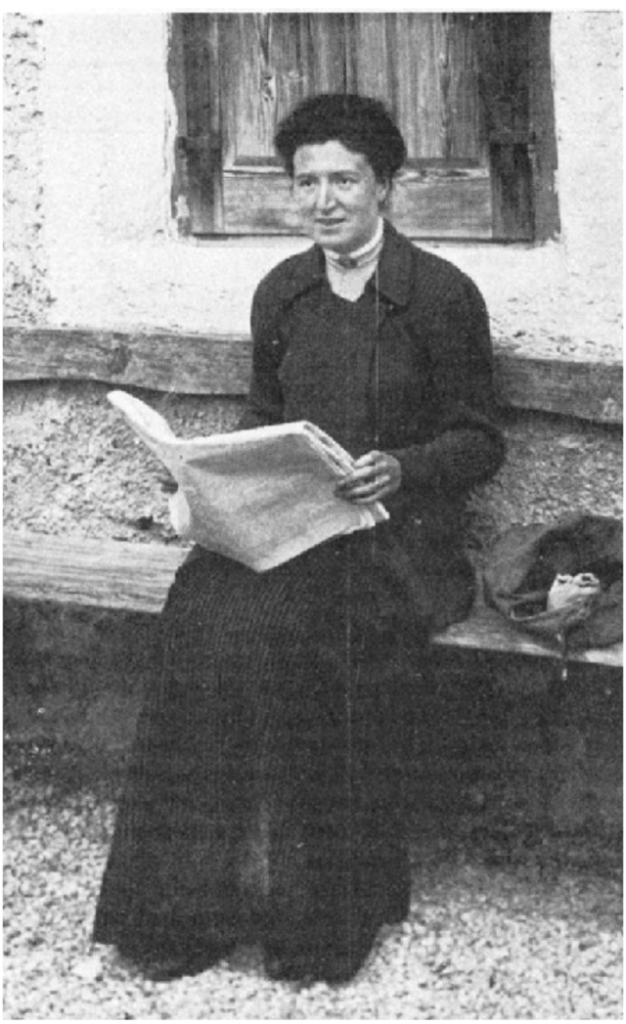
Edward Alexander Newell Arber (1870–1918), Public domain, via Wikimedia Commons

Historical Figures: Gregor Johann Mendel

Gregor Johann Mendel is a historical figure in ecology who is recognized as one of the founders of genetics. His discovery of heredity and how traits are passed on is still taught to this day. Mendel crossbred pea plants to express how genes are passed on from one generation to the next.

Mendel was born in 1822 in part of the Austrian Empire (now known as the Czech Republic). He grew up on the family farm, and studied theoretical philosophy and physics later on. This became a strain on the family finances as he pursued an education at 11 years old. He became a monk in order to afford an education, and was given the name Gregor (his birth name being Johann Mendel). Afterwards, he became a temporary high school teacher of physics, though he failed the teaching certification exam and could no longer do so. Mendel then went on to become a priest, and then continued his academic career as a student in Vienna. He notably worked under Christian Doppler, who found the Doppler effect of wave frequency. Later on returning to the monastery and continuing to teach for over a decade. He became an abbot which effectively ended his scientific pursuits as he became too busy, though this was after he had presented his findings on the pea plants to the Natural History Society. Mendel passed away from chronic nephritis at 61 years old.

Mendel is of course well known for Mendelian inheritance, there were five major discoveries he had made. This was an important part of plant ecology as it explored the relationships plants had within a species.

Wikimedia Foundation. (2022, January 15). Gregor Mendel. Wikipedia. Retrieved February 26, 2022, from https://en.wikipedia.org/wiki/Gregor_Mendel

Weiling. (1991). Historical study: Johann Gregor Mendel 1822-1884. American Journal of Medical Genetics, 40(1), 1–25. https://doi.org/10.1002/ajmg.1320400103

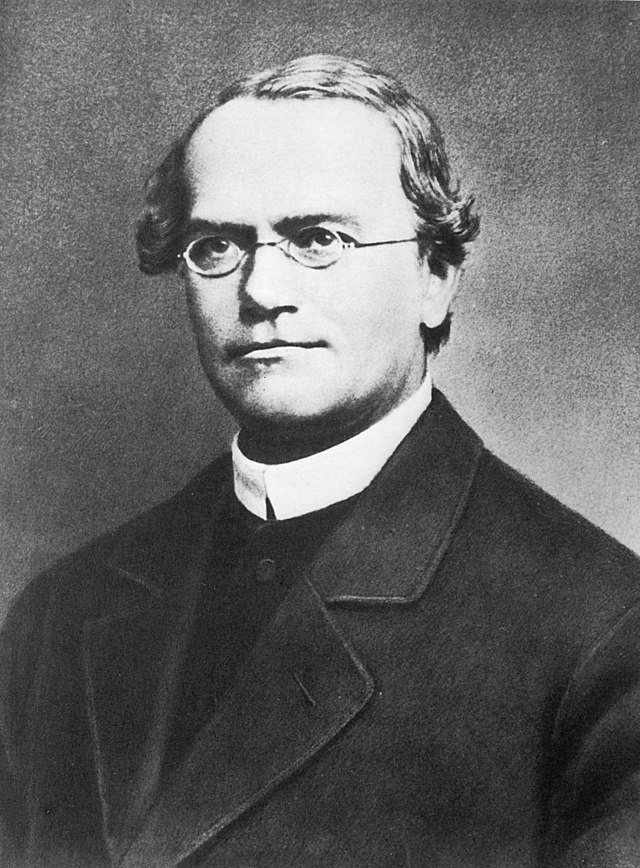
Unknown author, Unknown author, Public domain, via Wikimedia Commons

WALL-E and Ecology

The film “WALL-E” by Andre Stanton from Pixar Animation released in 2008 was an amazing story about the effects of human civilization on our planet. The story follows the titular character of WALL-E, a trash compacting robot whose role it is to clean the earth. After discovering plant life on earth has returned, WALL-E goes on an adventure with EVE, a robot sent from the human settlement in space, to tell humans of the now sustainable planet. Though other robots onboard the ship are attempting to stop the return to earth. The film’s issues highlight many modern day problems. The earth in the film has become a garbage-wasteland, in the real world we are continuously generating waste, with it taking many years to decompose. The character’s goal is the cultivation of the earth to be a hospitable planet again, which means wildlife preservation. Currently, there is a fast consumption of goods due to capitalism that has increased the waste disposal issue, as too many items end up in our landfills. This is reflected in the film, what had originally destroyed the planet was capitalism, and large monopolies that run the country. Though the film takes a more dystopian look at what the future holds. The environmentalism in the movie is what pushes human civilization forward as they had previously regressed due to capitalism. The takeaway of the film is to control consumer culture so as to not harm the environment, and exist in a more sustainable way.

Wikimedia Foundation. (2022, February 25). Wall-E. Wikipedia. Retrieved February 26, 2022, from https://en.wikipedia.org/wiki/WALL-E

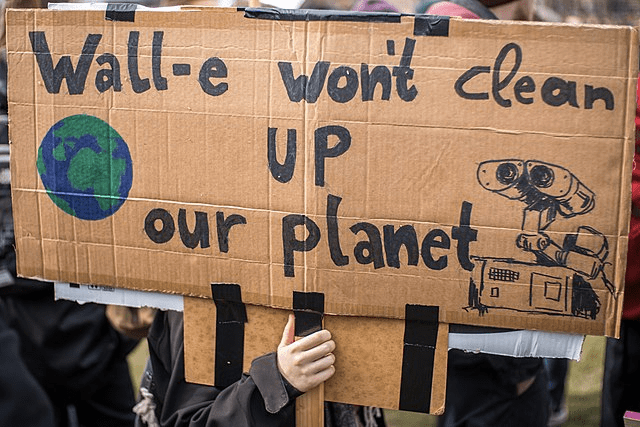
Protester holding a sign saying “Wall-e won’t clean up our planet.” Rally against climate change and environmental pollution. Ivan Radic, CC BY 2.0 via Wikimedia Commons

Design a site like this with WordPress.com
Get started