Urban Green Roofing

As an Applied Plant Ecology student, I figured I would take the opportunity to talk about an innovative new application for plants that I had some recent hands-on experience with.

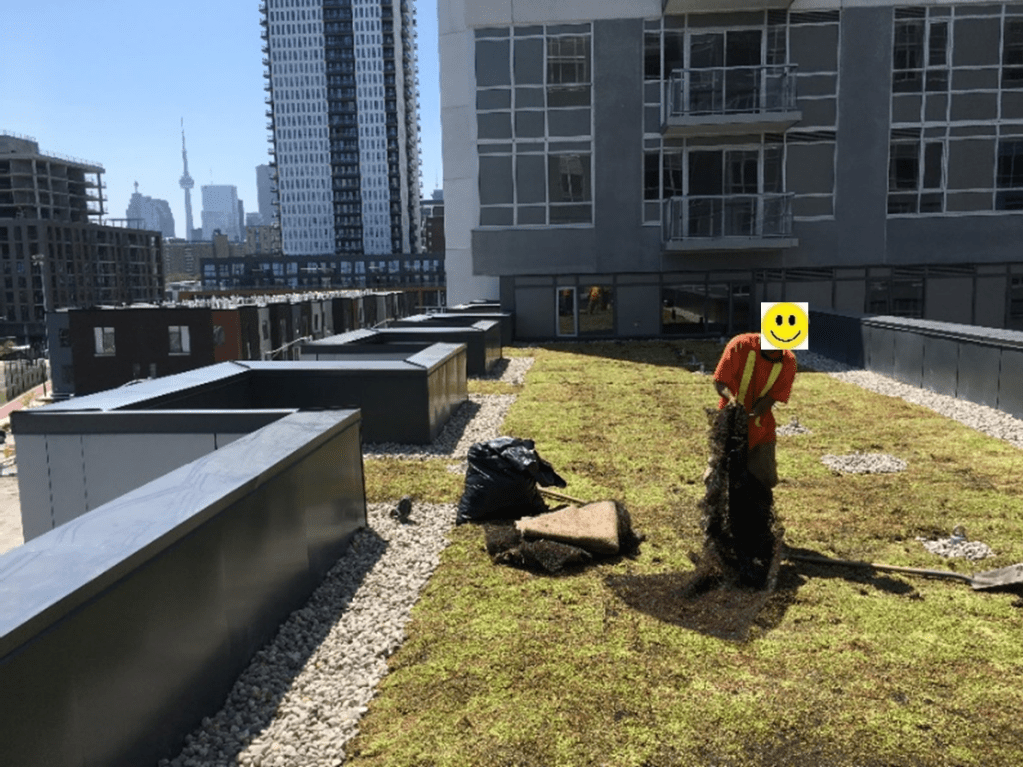
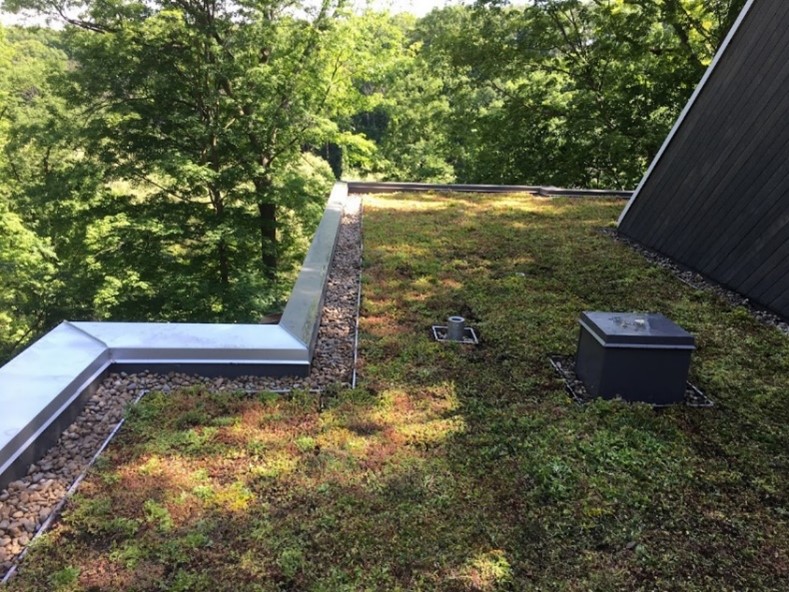
These photos were taken while I was installing green roofs in Toronto a couple summers ago. The many benefits of green roofs include providing energy savings to buildings via insulation, providing a habitat for insects, increasing inner city air quality, and helping to reduce the urban heat island effect.

One of the most common types of green roof, as shown in these photos, consist primarily of rolled out mats of succulent vegetation from the Sedum genus which are placed overtop of a high nutrient soil mix. These succulent plants are thick and fleshy, allowing them to retain water well even through dry temporal conditions. The plants are low maintenance and do not require more watering than what is provided by the regional precipitation. The rolls of succulents that we installed were deceivingly heavy, weighing around 100lbs depending on their saturation levels.

Usually, the edges of a green roof would consist of a variety of stones. These large diameter stones offer high drainage due to the large pore spaces that form between them. This drainage prevents excessive water retention and allows water to flow out of drainage holes installed on the building. This process prevents excessive weight and water volume that could potentially lead to roof leakages.

As of 2009, there is a green roof bylaw in Toronto. According to the City of Toronto, Green Roofs are required on:

  • New commercial, institutional and residential development with a minimum gross floor area of 2,000 m²
  • New additions to commercial, institutional and residential development where the new gross floor area added is greater than 2,000 m²
  • Industrial buildings greater than 2,000 m² gross floor area
https://www.toronto.ca/city-government/planning-development/official-plan-guidelines/green-roofs/green-roof-bylaw/

Come up with five basic multiple-choice questions about the novel Covid_19 disease and SARS-CoV-2 that test the Science Literacy of the public.

What does 19 stand for in COVID-19?

  1. First virus was and the disease was identified in 2019
  2. There are 19 variants
  3. There are 19 symptoms of this disease.
  4. None of above.

The “Corona” in Coronavirus stand for:

  1. Moon
  2. Star
  3. Crown
  4. Water

Which symptom isn’t common if you get infected by COVID-19?

  1. Fever
  2. Losing taste and smell
  3. Blurred vision
  4. Fatigue

Can SARS-CoV-2 variants be reliably detected by available diagnostic assays?

  1. Yes
  2. No
  3. May be
  4. Non or these

How is COVID-19 passed on?

  1. Through drops that come from mouth and nose when we cough or breath.
  2. By drinking unclean water
  3. By air
  4. All above these.

Answers:

  1. First virus was and the disease was identified in 2019 in China city Wuhan.
  2. Crown, Spike proteins on these viruses’ outer coating give them the appearance of a crown or halo.
  3. Blurred Vision
  4. Yes, thus so far, COVID is detectable with available diagnostic assays.
  5. Through drops that come from mouth and nose when we cough or breath

Choose a historical figure in ecology (they should be dead) and write about his life – this should be a usual suspect, as in a White guy (named Charles Elton, Darwin etc.)

Sir Arthur Tansley:

Sir Arthur George Tansley was one of the most well-known ecologists of the 20th century. He was the key to the discipline’s professionalization in the ecology field. He was born in 1871. He was awarded a knighthood in 1950. His passions led to the creation of a pathbreaking institution which is known as the world’s first ecological organization, “The British Ecological Society”. It was founded in 1913. Sir Author also helped in the creation of The Nature Conservancy, which was founded in 1949, and Sir Arthur was served as the first chairman. He also was served as the first president of The British Ecological Society. Tansley also acted as editor of BES’s Journal of Ecology from 1917 to 1938. Tansley also has a huge interest in the psychology field. He wrote a bestseller entitled “The new Psychology and its relation to life” which made him a household name in the psychoanalysis field. Tansley completed his magnum opus The British Island and their vegetation in 1938. After that, he continued to write for his audience. Sir Tansley is mostly described as a combination of idealist and materialist. Sir Tansley was the first person to use the most fundamental terminology term, the “Ecosystem” in 1935.

Tansley’s effort and work in the ecology field is unmatchable, he was the pioneer of modern ecology. He passed away in 1955.

write about one of the other two films that you considered nominating for the Applied Plant Ecology film festival, and explain why and how it relates to Applied Plant Ecology.

Movie name: Racing Extinction

Movies are a most powerful and watchable form of media, if uses correctly, they can have a huge impact on the public. Racing Extinction is of a kind movie, directed by the famous director “Louie Psihoyos”, and written by Mark Monroe. It documents the ongoing anthropogenic mass extinction of species on the planet.

The main plot of the movie is scientists predicted that by the end of the century, we will lose half of the biodiversity on the planet. Which will cause the sixth major mass extinction in planet earth’s history. This era is called as Age of Man because the evidence shows that humanity has sparked this catastrophic loss and we are the only ones who might stop that. This documentary features the example of overpopulation, anima agriculture, deforestation, and globalization will be the leading cause of 6th extinction. This movie also exposes the wildlife trafficking, illegal hunting of endangered species and highlights the black market for shark fin in China, which claims the lives of almost 2 million sharks every year. This movie highlight how human activities are changing the geochemistry structure of the planet. The movie acknowledges that large-scale geological changes are not simple problems to solve but it encourages people to find a way to help alleviate the problem.

Links Between Zoonotic Viruses, Biodiversity, and Habitat Loss

Amid the current human driven biodiversity crisis and the emergence of SARS‑CoV‑2 (the virus causing COVID-19), the connections between zoonotic viruses and habitat loss have been brought into the public spotlight. However, the linkage between the two issues has already been public knowledge and warned about by ecologists for years (Gibb et al., 2020).

Simply stated, zoonotic viruses are those that have evolved the ability to jump the species barrier, travelling from animals to humans. The emergence of zoonotic viruses is known to be influenced by the increased amount of contact made between humans and animals due to habitat loss. In fact, Dobson et al. (2020) showed that the risk of zoonotic virus transmission is increased for humans in contact with wildlife such as primates and bats; as well as domesticated animals including chickens, and pigs.

The risks for zoonotic disease transmission are compounded by the fact that humans are continuously expanding our environmental footprint. We are constantly destroying habitats to make room for agriculture, housing, and other industries. As such, we are consequently reducing the Earth’s biodiversity and increasing our physical contact with the wildlife that is being forcibly removed from their habitats.

As species die off, a void is left in ecosystems that is then filled by the species that are able to adapt and survive on the newly available resources. Unfortunately, as Tollefson (2020) states, the species filling the void, such as rats and bats, tend to also be the ones most likely hosting the zoonotic viruses.

Recent examples of zoonotic viruses include the avian and swine influenzas; variants of which have increased in recent years. This phenomenon is likely due to the increase in contact between humans and wildlife as our population continues to expand into new areas previously uninhabited by humans (Tollefson, 2020).

References

Dobson, A. P., Pimm, S. L., Hannah, L., Kaufman, L., Ahumada, J. A., Ando, A. W., … & Vale, M. M. (2020). Ecology and economics for pandemic prevention. Science, 369(6502), 379-381.

Gibb, R., Redding, D. W., Chin, K. Q., Donnelly, C. A., Blackburn, T. M., Newbold, T., & Jones, K. E. (2020). Zoonotic host diversity increases in human-dominated ecosystems. Nature, 584(7821), 398-402.

Tollefson, J. (2020). Why deforestation and extinctions make pandemics more likely. Nature, 584(7820), 175-177.

International United Nations conventions relating to climate change and vegetation or biodiversity. Find a document on the UN websites and write a short blog post about it, summarizing and explaining it.

A variety of living organisms, like animals, plants, fungi, and micro-organisms that make up our nature is called biodiversity. Different kinds of species are present on our planet and work together in an ecosystem to maintain balance and support life. But, in recent few decades due to climate change is becoming the biggest threat to our biodiversity.

In recent times United nation mentioned in one of the document articles that if we can control the global temperature not letting rise more than 1.5 0C we would be able to avoid the worst catastrophic event and could maintain the healthy biodiversity. UN mentioned that biodiversity can support efforts to reduce the negative effects of climate change. If we stop deforestation, it can remove the big chunk of carbon dioxide from the atmosphere. Moreover, it will also restore the habitats of a lot of different organisms. Mangroves can help to reduce the disastrous impact of climate change such as flooding and storm surges. UN is educating different communities around the globe and helping them with plating mangroves and fostering their natural regeneration to prevent the climate change effects and preserve biodiversity. The Monarch butterfly is best known around the world for an extraordinary migratory phenomenon. This species is vulnerable due to illegal logging, unregulated tourism, and increasingly damaging effects of climate change. Therefore, the UN has been educated and promoting initiatives to adapt to climate change and protect biodiversity in vulnerable areas. These little steps if we all follow, can have a huge impact and make this earth a better and safe place not only for humans but all the different species and organisms.

Link: https://www.un.org/en/climatechange/climate-solutions/biodiversity-and-nature-based-solutions

COVID-19 Science Literacy Test

Behold the ultimate COVID multiple choice test. Test your friends, test your grandma, test your university’s administration, test everyone… and vaccinate them too.

  1. How does COVID-19 spread?
    • Airborne respiratory droplets from the nose or mouth of a COVID infected person
    • Touching a COVID infected person
    • Ingestion of COVID infected food
    • Eating the yellow snow
  2. According to the CDC, where did COVID-19 most likely originate?
    • A Lab
    • An animal sold at a market
    • The Atlantic Ocean
    • A meteorite
  3. Which mask type works best at protecting you from COVID-19?
    • KN95
    • N95
    • Surgical Face Mask
    • Scarf
  4. What are the most common symptoms of COVID-19 according to the Public Health Agency of Canada?
    • Sore throat
    • Sneezing
    • Shortness of breath
    • All of the Above
  5. Which of the following is a Health Canada approved treatment for COVID-19?
    • Remdesiver (antiviral medication)
    • Ivermectin (antiparasitic horse dewormer)
    • 10 hours of Facebook (scrolling through misinformation)
    • Eating 1 AAA Duracell battery and 1 Tide Pod (Tide Pod must be Spring Meadow flavour)

https://www.canada.ca/en/public-health/services/diseases/2019-novel-coronavirus-infection/symptoms.html

https://www.canada.ca/en/health-canada/services/drugs-health-products/covid19-industry/drugs-vaccines-treatments/treatments.html#a1

https://www.cdc.gov/coronavirus/2019-ncov/science/about-epidemiology/identifying-source-outbreak.html

Explain the difference between peer-reviewed primary, secondary and tertiary literature and give a specific example of each kind that relates to applied plant ecology. Your examples should be specific documents.

Peer-reviewed primary literature: Original documents with first-hand information or empirical research study that was conducted by the author is called Peer-reviewed primary literature. Data from experiments is primary literature.

For example, Hypotheses, research questions, tests, and methods.

Biodiversity an introduction by Kevin J. Gaston, John I. Spicer is a good example of primary literature.

Link:https://books.google.ca/books?hl=en&lr=&id=0Bjp2o5CVnQC&oi=fnd&pg=PT6&dq=biodiversity&ots=Y1_a3RdjNz&sig=NrLgfGITO9-aQB81pgmZnlpdDGc&redir_esc=y#v=onepage&q=biodiversity&f=false

Peer-reviewed secondary literature:  Document that is based on other sources or sources that evaluate or draw conclusions from a primary source is called Peer-reviewed secondary literature. Secondary literature most is based on primary research sources.

For example, Literature review, Review articles.

Biodiversity loss and its impact on humanity is a good example of secondary literature.

Link: https://www.nature.com/articles/nature11148?report=reader

Peer-reviewed tertiary literature: Documents that are sourced in the index, establish, or compile other sources is called Peer-reviewed tertiary literature. Tertiary sources mostly summarize the research about secondary sources.

For example Dictionaries, Wikipedia, and Encyclopedias.

Plant biodiversity and genetic resources matter is a good example of tertiary literature.

Link: https://www.mdpi.com/2223-7747/9/12/1706/htm#:~:text=Plant%20biodiversity%20encompasses%20the%20ecosystem,the%20genetic%20diversity%20within%20species.

Rachel Carson

Rachel Carson is known as the mother of environmentalism, she was an acclaimed author, marine biologist and spent years inspiring the world to care for nature. She was born in 1907 and grew up in Pennsylvania. From a young age she held a passion for the natural world as she explored her family’s 64-acre property surrounded by forests and wetlands (Lear, 1998).

Throughout her career she faced gender-based discrimination from men towards her ability as a scientist as well as her credibility as a scientific author. Carson published five books in her lifetime and among those, her most notable release was in 1962, titled Silent Spring. This novel was Carson’s call for society to question its reckless domination of the natural world by illustrating the detrimental effects of chemical pesticide use. Upon the novel’s release, Carson effectively went to war with the male dominated American chemical industry. She faced extreme criticisms from the science community, many of which referred to and were based upon her gender.

Despite these hardships, she not only inspired generations of scientists, but she proved to the scientific world of the 1960’s that women scientists can also initiate calls for societal change. As a result of her many efforts and years of work Rachel Carson had successfully kickstarted the environmentalist movement, in 1970 the American Environmental Protection Agency was created (Environment Canada formed soon after in 1971) and in 1972 the pesticide DDT was a banned substance in the USA.

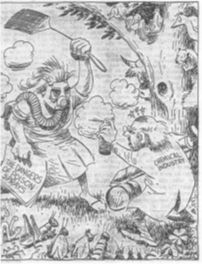
Backyard Battle by Franck Miller of The Des Moines Register (Hazlett, 2004).

References

Hazlett, M. “‘Woman vs. Man vs. Bugs’: Gender and Popular Ecology in Early Reactions to Silent Spring.” Environmental History (2004): 701-729.

Lear, L. Rachel Carson: witness for nature. Macmillan, 1998.

Monkey Puzzle Tree Journal Review

The title of the journal I am discussing for this blog post is: “Physiological, biochemical, and anatomical responses of Araucaria araucana seedlings to controlled water restriction”.

Araucaria Araucana, also known as Monkey Puzzle tree, Monkey Tail tree or Chilean Pine, is an evergreen tree that is native to central, southern Chile and western Argentina. This tree is the national tree of Chile and resembles many tree species of ancient times; thus, is sometimes referred to as a fossil. Researchers wanted to study the physiological responses of Araucaria Araucana stems and leaves when under water restriction. They wanted to compare responses gathered to their control experiment where the Araucaria Araucana stems and leaves are under well-watered conditions. It is predicted that when under stress (dehydration), damage to the plants can occur (but it varies depending on the species and how much stress they are put under). By placing the plants under stress, it would stimulate the real-life environmental conditions of climate change. Results from the study show that severe stress placed upon the tree reduced water content in the leaves while also accumulating large amounts of free proline. The concentration of phenolic compounds was not affected but epicuticular wax extrusions did increase in the apical leaf stomata. Plants that were put under water stress had an increased stem wood density and decreased photosynthetic pigments in the leaf. The leaves of the Araucaria Araucana are usually thick and tough. Physically, they look scale-like and triangular with sharp edges and tips. On average, the leaves have a lifespan of up to 24 years. A surprising result showed that Araucaria Araucana have seedlings that activate physiological mechanisms that allow the plant to withstand short periods of droughts but not necessarily longer or more severe ones.

References:

Papú, S., Berli, F., Piccoli, P., Patón, D., Rodriguez, D. R. O., & Roig, F. A. (2021, May       12). Physiological, biochemical, and anatomical responses of Araucaria araucana seedlings to controlled water restriction. Plant Physiology and Biochemistry. Retrieved February 9, 2022, from https://www.sciencedirect.com/science/article/abs/pii/S0981942821002503

Design a site like this with WordPress.com
Get started