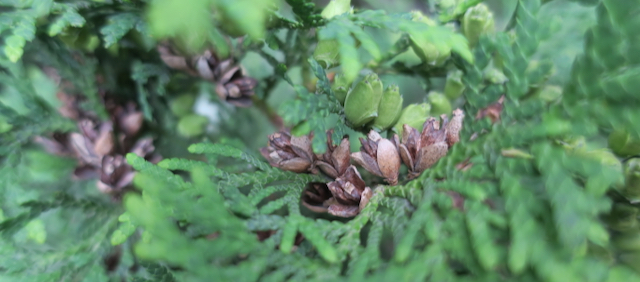
The monkey puzzle tree (Araucaria Araucana) is an endangered tree species that is found in the Andean regions of Argentina and Chile and are threatened with deforestation through logging and anthropogenic fires. The female trees produce cones that are pollinated via wind dispersal, that are then dispersed via gravity over short distances and animals over longer distances.
In 2016, Tell et al. published in the paper Large-scale impacts of multiple co-occurring invaders on monkey puzzle forest regeneration, native seed predators and their ecological interactions. This experiment included native seed eaters: Austral Parakeets (Enicognathus ferrugineus) and mice and introduced seed eaters, the latter of which includes wild and livestock mammals. There was a particular interest in learning the combined effects of the seed predators, ‘Are the combined effects equal to the sum of their parts?’ This study is unique in that it compares the independent effect of each exotic mammal and their combined impacts.
To measure the impact of the invasive species and the native species, 9 introduce mammals were targeted for the experiment, 5 of which were livestock, 4 were wild. They measured the impact before and after the livestock species were brought to graze the area and avoided sites where humans would use the seeds for their own consumption. Evidence of each animals seed predation was used to record their impact which was tied to the number of seeds that remained and the number of seedlings that grew under each female tree. They finally tracked the movements of Austral Parakeets while they were carrying a cone to measure their impact on seed dispersal.
Austral parakeets and the exotic mammals visited nearly the same number of trees, around 85%, while the mice visited only around 45% of the 516 trees, which is still higher than any individual exotic mammal. The results concluded that the seed and seedling number was negatively impacted at the site of each monkey puzzle tree when exotic species visited them and positively impacted when Austral Parakeets visited them, mice had no clear impact. The impact of the grazing path was found to be increase the number of seeds and seedling before the grazing and lower it after compared to monkey puzzle trees that were not on the grazing path at all. Through Trampling and seed predation, trees that were visited by more than 5 exotic mammals had almost seeds uneaten and no seedlings growing. The Austral Parakeet was found to have moved seeds a larger distance than the tree could disperse them in more than of the 770 observations made, often during which they dropped seeds.
The regeneration of monkey puzzle tree forests is in jeopardy. The impact of exotic mammals on the ability of the tree to disperse and produce seedlings is hindered by overconsumption. The Austral Parakeet’s success relies on the abundance of monkey puzzle tree seeds and without proper care, the loss of monkey puzzle tree forests can have upstream effects that will decimate the ecosystem.
References
Tella, J. L., Lambertucci, S. A., Speziale, K. L., & Hiraldo, F. (2016). Large-scale impacts of multiple co-occurring invaders on monkey puzzle forest regeneration, native seed predators and their ecological interactions. Global Ecology and Conservation, 6, 1–15. https://doi.org/10.1016/j.gecco.2016.01.001
 Applied Plant Ecology Winter 2020