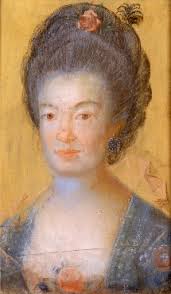
Elisabeth was born in 1743 in Sweden. While her education history is not entirely known, her along with many of the children of Linnaeus were heavily involved with her father’s teachings, and would regularly interact with other students of Linnaeus, possibly being tutored from home.
Elisabeth was a female botanist in 1700s, which as one might imagine was rare considering how scientific studies at the time were some male-centric. Her most notable work as a botanist is her discovery of the “flickering” that occurs in the Indian Cress, which is to this day still called the Elisabeth Linnaeus Phenomenon.

The Indian Cress is a fast growing perennial plant that originates from South America, now more commonly found throughout the world. The Indian Cress is known for its bright orange colouring and broad leaves. My mom actually has grown many orange plants similar to this in her gardens before, though I can’t confirm if it was the same one, however its distinct colouring takes me back.
At the age of 19, Elisabeth discovered a flickering effect while observing some Indian Cress. This flickering effect was commonly seen by Elisabeth closer to evening or night. At the time Elisabeth would observe the effects, and she would go on to publish papers on the topic, and over time many other botanists and scientists would come to study the topic as well, leading to the phenomenon being named in her honor. Throughout history the flickering would soon be thought of as an electrical discharge of sorts, however we now recognize the flickering to be a simple optical trick played by our own eyes due to the distinct orange flowers and dark green leaves. In some ways this is almost disappointing to know that there is no electrical discharge, as it almost takes away from the discovery, but on the other hand seeing how our eyes play tricks on us like that is fascinating as well.
References:
1. Platz, Kühn, C., Schiess, S., Schreiner, M., Kemper, M., Pivovarova, O., Pfeiffer, A. F. H., & Rohn, S. (2016). Bioavailability and metabolism of benzyl glucosinolate in humans consuming Indian cress (Tropaeolum majus L.). Molecular Nutrition & Food Research, 60(3), 652–660. https://doi.org/10.1002/mnfr.201500633
 Applied Plant Ecology Winter 2020