To determine if something is alive, there are 7 main requirements that must be met. In this case, do viruses meet the 7 criteria? First criterion is all about maintaining homeostasis; living systems are required to maintain a stable balance (e.g., internal temperature). Cells are capable of doing this; however, viruses are not made up of cells but rather ‘virion’ (virus particle). Because viruses are not cells, they do not posses organelles, nuclei, cytoplasm, etc., this results in it’s inability to create or change their internal environment, a stable balance on its own.
The second criterion requires living things to have a minimal level of organization. Viruses certainly pass this criterion as their structure is made up of a capsid (protective protein shell – some viruses have a double membrane called lipid bilayer) that encapsulates the nucleic acids (genes). The third criterion all living things are expected to meet, is the ability pass on their genetic material. This is a bit tricky since viruses can replicate and, in a way, pass their genetic information. Viruses manipulate a host cell to produce more virions; it takes a short time to create multiple virions if there is a big supply of hosts. The process can be summarized in a virus entering a living cell and using their cellular components to copy genetic information and build new capsids. Next criterion requires living systems to be able to grow. In other words, use energy and nutrients to increase in size or complexity. Viruses replicate by using a host cell, indicating that virions are created a developed state where their size nor structure complexity changes throughout its existence. Thus, virus do not meet this requirement.
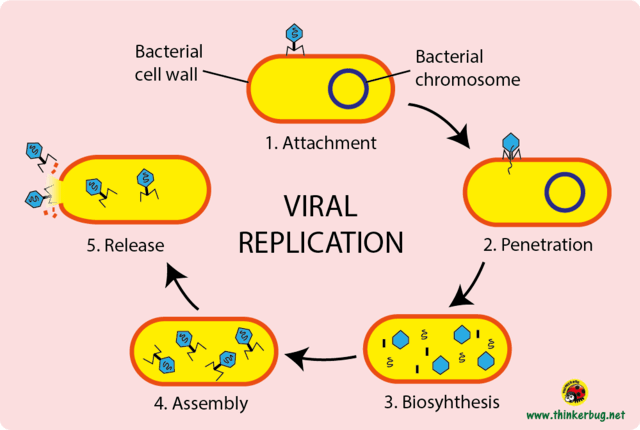
The next criterion consists in the ability of living things to use energy either by creating it or using from an outsider source. In this case, viruses manipulate the host cell to use its energy to replicate virion units. Moreover, living things shall respond to stimuli. There has been little research in this area and thus it is unknown. Viruses do not respond to light, sound, or touch the way living systems do. Thus, it is unknown if viruses respond to stimuli. Finally, the last criterion a living thing shall meet, is its ability to adapt to its environment. Viruses do pass this criterion as they have the ability to mutate quite quickly due to their frequent mistakes in their replication processes. The surviving virions (survived drugs and vaccines against it) are able to replicate as long as there are more living host cells.
There is a lot of debate in the scientific community regarding the living state of viruses. I suggest that one of the best ways to share this information is to show a table with the criteria viruses meet and do not meet to the public.
Khan Academy. (n.d.). Are viruses dead or alive? (article) | cells. Khan Academy. Retrieved March 8, 2022, from https://www.khanacademy.org/test-prep/mcat/cells/viruses/a/are-viruses-dead-or-alive#:~:text=So%20were%20they%20ever%20alive,androids%20than%20real%20living%20organisms.
 Applied Plant Ecology Winter 2020