
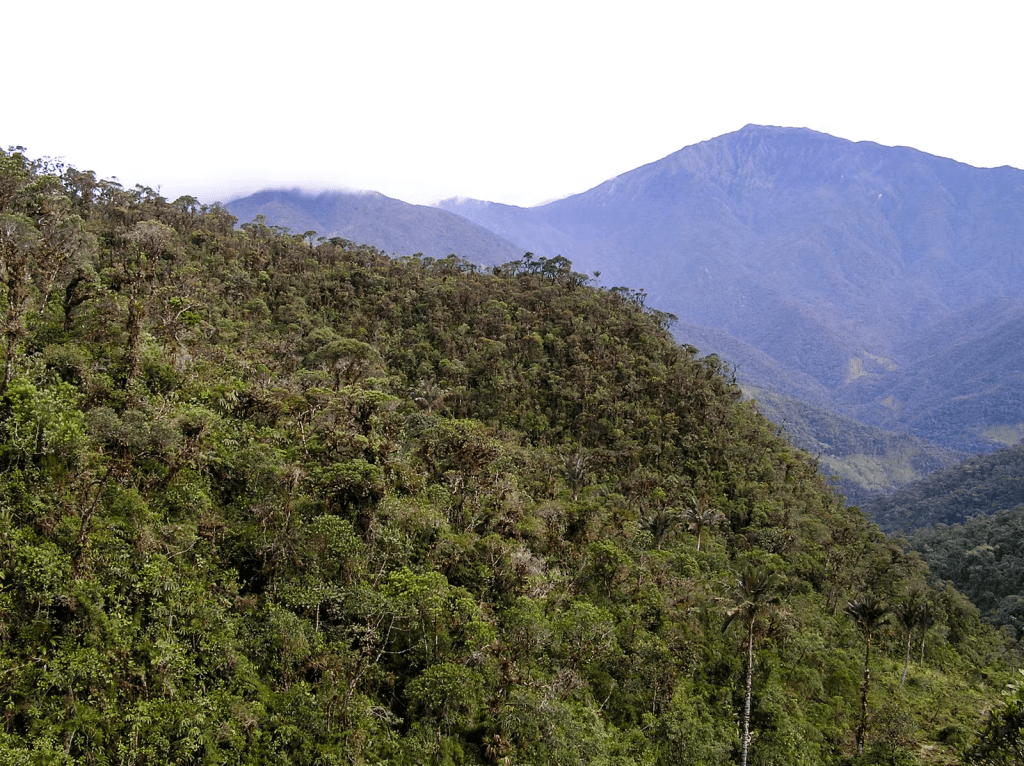
(https://www.oneearth.org/ecoregions/northwest-andean-montane-forests/)
Synopsis
Extinction is irreversible, but we can restore ecosystem functions, processes, and services by restoring habitats, ecological processes, and ecosystem services. There is an agreement that conservation planning should make the best use of both species and environmental data. Environmental data are important because they can help us correct biases and fill gaps in species knowledge. The North Central Rockies Forest and Northern Short Grassland ecoregions of North America are very distinct to our eyes, but species perceive them as one single biome. It is also difficult to trust land types for unknown species. The Northwestern Andean Montane Forests ecoregion is an example of how it is very difficult to use land types as conservation targets, as it is very important to consider the specific assemblages of different land types. The journal highlights that species data should take precedence over environmental data, with environmental information being used to expand the value of species data. In order to protect biodiversity, we need to represent not only ecological patterns, but also biological processes such as predation, biogeochemical processes, population dynamics, and disturbance dynamics. Species data can inform the spatial requirements for biodiversity persistence. We can set targets for the processes by looking at species’ ecological requirements, such as species’ endemism. The surrogacy value of land types or ED in representing species diversity is frequently assumed but rarely tested. Studies that indicate that land types are adequate surrogates for species in reserve planning are actually analyses of associations between land types and species assemblages, not surrogacy tests. This journal highlights two serious difficulties facing species-based approaches: the limitations of existing sampling and the cost of extending sampling. The variability of abundance across species ranges might mean that even low sampling might provide useful information. Any concerns about the cost of increasing sampling coverage only add to the value of the data and to the value of conservation planning and is worth it overall. Although the main challenges to biodiversity conservation are in the implementation of conservation plans, we must not lose sight of the need to compile more and better species data.
I agree that the most urgent target should be minimizing the rate of species extinction. Species data provide the best basis for setting targets for biodiversity conservation planning. Species data are not equivalent to conservation results but are a precondition for conservation because without species data we cannot understand the relationships between the components of biodiversity.
Citation
Brooks, T., Fonseca, G. A., & Rodrigues, A. S. (2004). Species, Data, and Conservation Planning. Conservation Biology, 18(6), 1682-1688.
 Applied Plant Ecology Winter 2020