(https://library.onu.edu/c.php?g=357753&p=3802458)
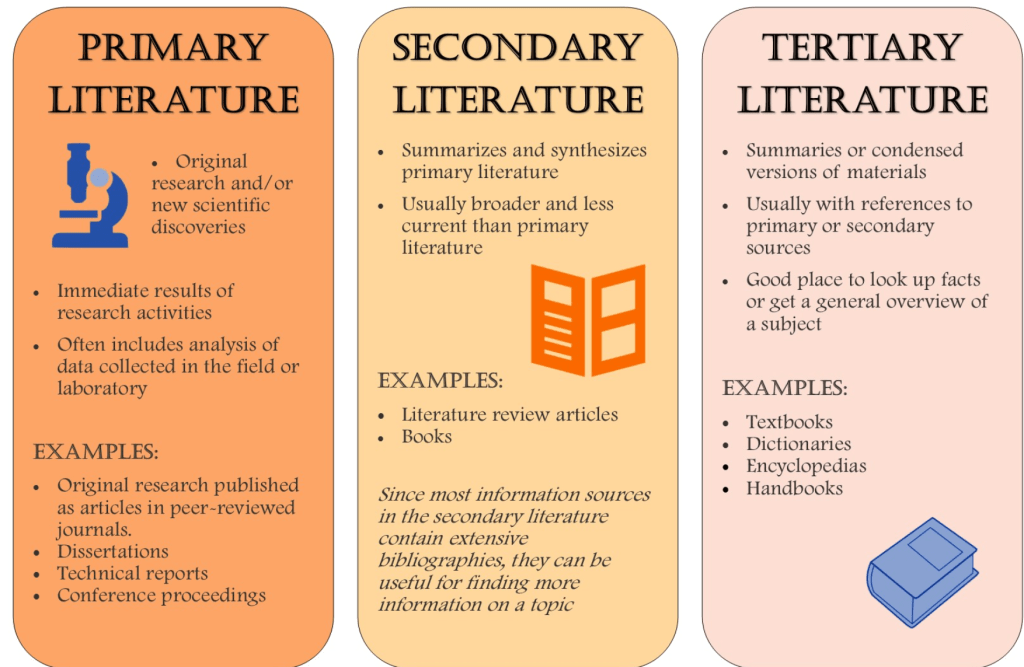
The distinction between primary, secondary, and tertiary sources is based on how far the information source is developed from the original event or occurrence. Is it firsthand information? Is this a second-hand translation? Is it possible to get a third-hand synthesis and overview of what’s known?
Primary sources are developed as closely as possible to the original event or phenomena. A main source is, for example, a photograph or video of an event. A main source is data from an experiment, while secondary sources are one step distant from that. Secondary sources are secondary sources that are based on or concerning primary sources. Secondary sources, for example, are articles and books in which authors interpret data from another research team’s experiment or archival film of an event; tertiary sources are a step further away. Secondary sources are summarised or synthesized in tertiary sources. Textbooks and reference books, for example, are tertiary sources.
Examples of each:
Primary source: Gustafsson, C., & Norkko, A. (2016). Not all plants are the same: Exploring metabolism and nitrogen fluxes in a benthic community composed of different aquatic plant species. Limnology and Oceanography, 61(5), 1787–1799. https://www.jstor.org/stable/26628520
Secondary source: Lewis, W. H., & Elvin-Lewis, M. P. (1995). Medicinal Plants as Sources of New Therapeutics. Annals of the Missouri Botanical Garden, 82(1), 16–24. https://doi.org/10.2307/2399976
Tertiary source: Lessing, P. (1989). EARLY GEOLOGICAL MAPS OF WEST VIRGINIA. Earth Sciences History, 8(1), 14–35. http://www.jstor.org/stable/24137144
Resource used to find sources: https://guides.jstor.org/ecob
 Applied Plant Ecology Winter 2020