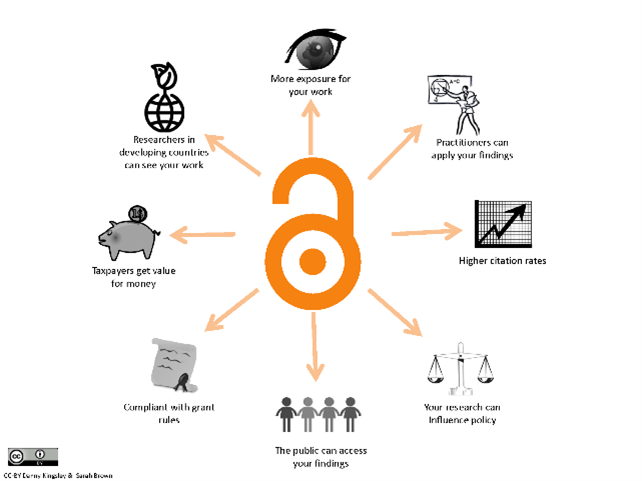
In my last year of my undergraduate studies, I had found that most of my classes required readings of all sorts, however, mostly scientific articles. It is a known fact that reading and analyzing primary literature improves scientific literacy and other skills such as critical thinking abilities. However, a lot of scientific articles and literatures are often difficult to obtain access to however there is a beautifully accomplished way by databases such as open access which is when a publishing model of some sort for scholarly communication that makes research information available to readers at no cost, as opposed to the traditional subscription model in which readers have access to scholarly information by paying a subscription. One of the most important advantages of open access is that it increases the visibility and reuse of academic research results.
Metadata is known as the data providing information about one or more aspects of the data, almost like a hub where you can pull all sorts of information. This can be very important and resourceful when you want to write on a certain topic and want to be able to pull various data on the topic. It can also be used to summarize basic information about data which is even more beneficial because at that point you know you do not need to sit through and read pages and pages of an article only to find out it is not what best fits your research.
Lastly to tie in another element, a creative commons license is usually issued by the copyright owner to allow anyone, such as you and me, to use and work with these literature work in any manner that may be consistent with that license. Some authors may allow only non-commercial uses or whatever license form that will protect their work but also provide the information to the public. There is flexibility in choosing what license type an author may supposedly get to choose which is established by the four licenses types CC offers.
An article I recently came across that was open access was called, “Uses and misuses of meta-analysis in plant ecology” by Julia Koricheva and her co-author Jessica Gurevitch. The author examines the growing number of published meta-analyses in plant ecology over the last two decades. They speak about the many cases of imprecise and inaccurate usage of the term ‘meta-analyses’ in plant ecology and regarding the confusion of using this incorrect application of statistical technique and such. It is a very interesting article and is open access as well so do make use of it if it applies to you!
Koricheva, J. and Gurevitch, J. (2014), Uses and misuses of meta-analysis in plant ecology. J Ecol, 102: 828-844. https://doi.org/10.1111/1365-2745.12224
 Applied Plant Ecology Winter 2020