
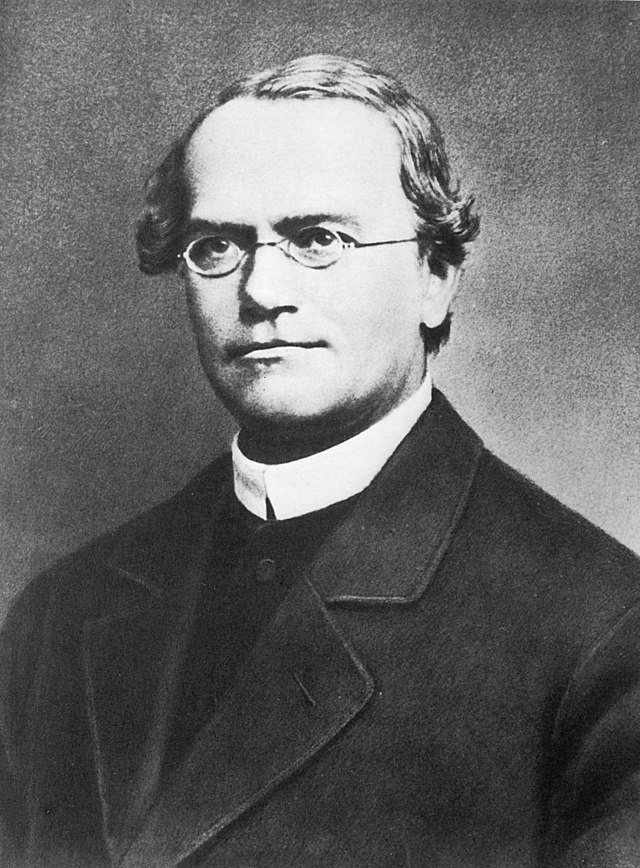
Gregor Johann Mendel is a historical figure in ecology who is recognized as one of the founders of genetics. His discovery of heredity and how traits are passed on is still taught to this day. Mendel crossbred pea plants to express how genes are passed on from one generation to the next.
Mendel was born in 1822 in part of the Austrian Empire (now known as the Czech Republic). He grew up on the family farm, and studied theoretical philosophy and physics later on. This became a strain on the family finances as he pursued an education at 11 years old. He became a monk in order to afford an education, and was given the name Gregor (his birth name being Johann Mendel). Afterwards, he became a temporary high school teacher of physics, though he failed the teaching certification exam and could no longer do so. Mendel then went on to become a priest, and then continued his academic career as a student in Vienna. He notably worked under Christian Doppler, who found the Doppler effect of wave frequency. Later on returning to the monastery and continuing to teach for over a decade. He became an abbot which effectively ended his scientific pursuits as he became too busy, though this was after he had presented his findings on the pea plants to the Natural History Society. Mendel passed away from chronic nephritis at 61 years old.
Mendel is of course well known for Mendelian inheritance, there were five major discoveries he had made. This was an important part of plant ecology as it explored the relationships plants had within a species.
Wikimedia Foundation. (2022, January 15). Gregor Mendel. Wikipedia. Retrieved February 26, 2022, from https://en.wikipedia.org/wiki/Gregor_Mendel
Weiling. (1991). Historical study: Johann Gregor Mendel 1822-1884. American Journal of Medical Genetics, 40(1), 1–25. https://doi.org/10.1002/ajmg.1320400103
 Applied Plant Ecology Winter 2020