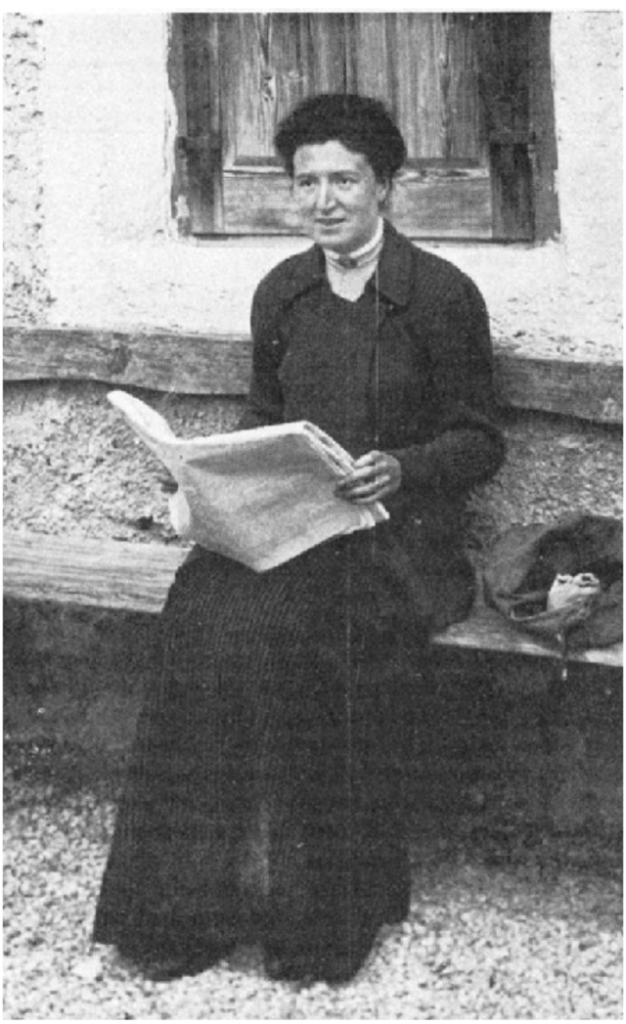
A woman I would like to shine the spotlight on is Agnes Roberston Arber, a British plant morphologist and anatomist, historian of botany and philosopher of biology. She was born in 1879 in London, England, and was intrigued by botany at a young age. She had published her first research piece in the school’s magazine, and won a scholarship for her knowledge in botany. Arber received her bachelors at University College and continued her studies at Cambridge for Natural Sciences.
She excelled in her studies, receiving first class results, prizes and medals. She then went on to work with Ethel Sargant, her mentor since she was 15, though she left after a year to obtain her Doctorate of Science at University College. While working with Sargent, Arber was a research assistant studying seedling structures. During this time she published her first paper titled “Notes on the anatomy of Macrozamia heteromera”.
Later in life she studied in the Balfour Laboratory for Women. She was awarded by the Newnham College the Research Fellowship and published her first book “Herbals, their origin and evolution”. In 1921 she became the president of the botany section of the British Association for the Advancement of Science, though she left soon after due to the sexist members of the association who did not like having two back-to-back female presidents. Arber was also awarded the gold medal of the Linnean society of London, a society whose focus is to study and teach natural history, evolution and taxonomy. After the laboratory closed she continued her research in her house, till Arber passed away in 1960. Arber’s focus was on plant’s evolution, specifically focusing on morphology. It is important to recognize female scientists because women like Arber paved the way for future young female scientists so that they can have a seat at the table, and keep it.
Wikimedia Foundation. (2022, February 22). Agnes Arber. Wikipedia. Retrieved February 26, 2022, from https://en.wikipedia.org/wiki/Agnes_Arber
 Applied Plant Ecology Winter 2020