When I saw that the Wikipedia Edit-a-Thon assignment was a part of the course syllabus for Applied Plant Ecology, I was confused. Throughout my academic career, I had been constantly taught that Wikipedia is an unreliable source. However, Dr. Bazely taught me otherwise. As she stated in her three-partedWikipedia Edit-a-Thon Chronicles blog post, she had discovered that pages for those areas of science where she has expertise in are actually very well fact-checked.
In 2013, Dr. Bazely introduced Wikipedia Edit-a-Thon to Ecology courses to teach students how to write and edit Wikipedia pages. In 2015, Dr. Bazely, alongside Steacie Librarian John Dupuis, launched the annual York University Ada Lovelace Day Wikipedia Edit-a-Thon to increase the recognition of women in the fields of science, technology, engineering, and mathematics through the addition of more Wikipedia entries. The Twitter hashtag for this is #WomenSciWP.
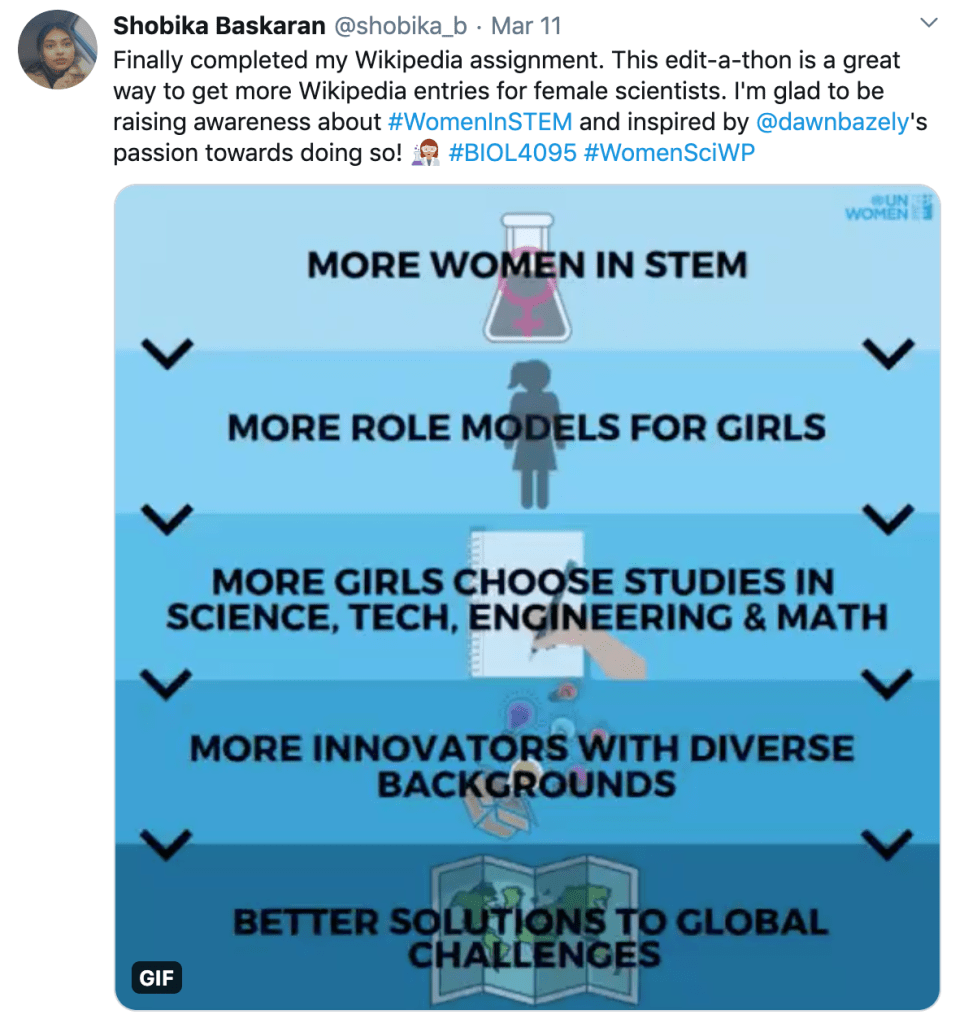
For the Wikipedia Edit-a-Thon assignment, I created a Wikipedia account under the pen name Plant Power 4095. I had to choose pages that were related to the student lecture topics of the course and edit, improve, and expand its content. Throughout my experience doing so, I learned:
• How to differentiate between primary, secondary, and tertiary sources. In fact, I even wrote a blog about it: https://wordpress.com/view/biology4095.science.blog!
• I can’t cite Wikipedia in my research essays and lab reports because it’s a tertiary source of information, and both the primary and secondary sources that it uses should be cited instead.
One of many things the training module additionally taught me is that:
• There are a few different types of free licenses you can use on Wikipedia. Wikimedia Commons defaults to a CC BY-SA license. This means that anyone can use, copy, or share media or modify it and share it as a new work as long as the person using it provides credit to the original author and notes the license and releases any modifications of the work under the same license.
 Applied Plant Ecology Winter 2020