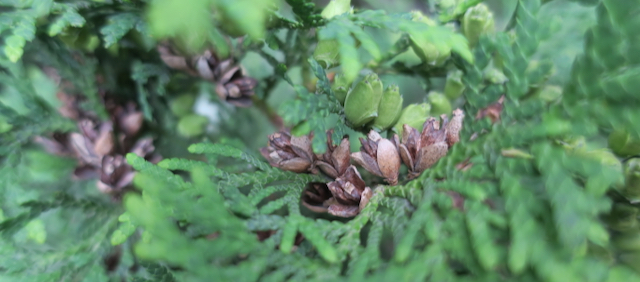

Araucaria araucana, also known as The Monkey Puzzle Tree, is an unusual looking evergreen conifer native to Chile (national tree) and Argentina. It has gained this strange name due to the fact that a monkey would be unable to climb it. This tree is characterized by its strange leaves and distinctive trunk with branches that originate from the trunk in whorls. It is believed that the ancestors of this tree existed at the time of the dinosaurs and composed some of the larger forests. The Monkey Puzzle Tree grows very slowly and has a growth period which lasts hundreds of years and is also thought to live up to a thousand years. Although it is native to Chile and Argentina, this tree has been introduced to many places where it grows as an ornamental plant.

The mature Araucaria araucana can reach up to 150 feet in height with a trunk diameter of 7 feet. (Just from these measurements, I could only imagine how large this tree must be!) Furthermore, the leaves of this tree overlap and are said to resemble reptile scales. This tree is dioecious meaning that they are either male or female. The male cones are known as pollen cones and the female cones are known as seed cones. Wind-pollination is the type of pollination which occurs between these trees as through the wind the transfer of pollen from the male cones to the female cones occur. The seeds of this tree are large, edible and delicious.

Araucaria araucana is endangered as the number of trees are reduced due to deforestation caused by logging and burning. These activities enforce the clearing of the trees on land and this tree is also harvested for its wood. Although it is illegal to cut down the Monkey Puzzle Tree in its native habitat they continue to be cut down illegally. As mentioned previously, because these trees grow very slowly, it is more difficult for them to recover from any population stresses and that is why the conservation of these trees should be considered. Attempts to save this tree are being done within Chile as well as in Scotland and there are a few conservation projects in progress. The Royal Botanic Edinburgh even imported thousands of Monkey Puzzle seeds to save the genetic diversity of this species and are also growing hundreds of trees in a greenhouse.

It is believed that UK gardeners can assist with the potential threats this species is enduring. The first monkey puzzle tree was introduced to Britain in 1795 by Scottish botanist Archibald Menzies. Furthermore, these trees remained rare in Britain until the 19th century until William Lobb began to collect seeds and prepared a nursery where he sold the seedlings. These seedling were sold to the elite and were only observed in the gardens of areas for the upper middle classes. During the 1920’s the Araucaria araucana were to be found grown as a statement of prosperity, in the small gardens of suburban Britain. They were later then forgotten in World War II. It was after this that these trees began to become ingrained in the British history and in the landscape of the UK. Because of the long history this tree has had in the UK, they can make significant conservation efforts for this plant.
https://owlcation.com/stem/The-Monkey-Puzzle-Tree-An-Ancient-and-Endangered-Plant
https://www.theguardian.com/lifeandstyle/gardening-blog/2015/may/07/monkey-puzzles-araucaria
 Applied Plant Ecology Winter 2020