As we all know, global warming is a global issue that we all must be concerned about. As such, the United Nations has developed a panel called the Intergovernmental
Panel on Climate Change (IPCC). The IPCC is an international organization consisting of scientists from around the world who review the latest science in order to deliver information about climate change to decision makers. The organization consists of three main groups who have three main areas of focus:
Working Group I: physical science
Working Group II: impacts, adaptation, & vulnerability
Working Group III: mitigation
Every few years, each group puts out an assessment report detailing the latest news and developments in their respective area of climate change to give policymakers a general insight on how climate change is both affecting us and being tackled globally. The IPCC also sometimes releases special reports which detaila specific topic of climate change, such as the 2018 special report that looked at the impacts of global warming of 1.5 ºC.
While the special report details the impacts on both natural and human systems, the section about natural systems is quite eye opening. While there are way to many results to list in one blog post, some notable impacts of global warming to 1.5°C (which we are currently at) on Terrestrial and Wetland Ecosystems include:
-6% of insects, 8% of plants and 4% of vertebrates are expected to lose over 50% of their geographic range.
-High latitude ecosystems (tundra and boreal forest) are expected to recede north as permafrost thaws and woody shrubs encroach on the lands.
-Similarly, many desert terrains in the medeterranian will expand outwards as drylands become drier
-Due to warming waters and ocean chemistry, ocean diversity will drastically become reduced as coldwater species move north and tropical species and sessile organisms die out (aproximately 70–90% of coral reefs will become extinct even if global warming stays at 1.5°C).
In additon, there are many effects on plants, particarly in agriculture, what should be concerning. Temperature changes will cause water security to decline in many regions, making agriculture more difficult or costly to maintain. Climate change will also negatively affect many staple crops we rely on such as wheat and rice by reducing yields and nutritional quality, as well as luxury crops such as coffee and chocolate. This means that food security will be a concern for those who rely on their agriculture to live, and will also increase costs for basic products that we use every day (increases in coffee bean price may mean your daily Tim Horton’s coffee might not become affordable anymore).
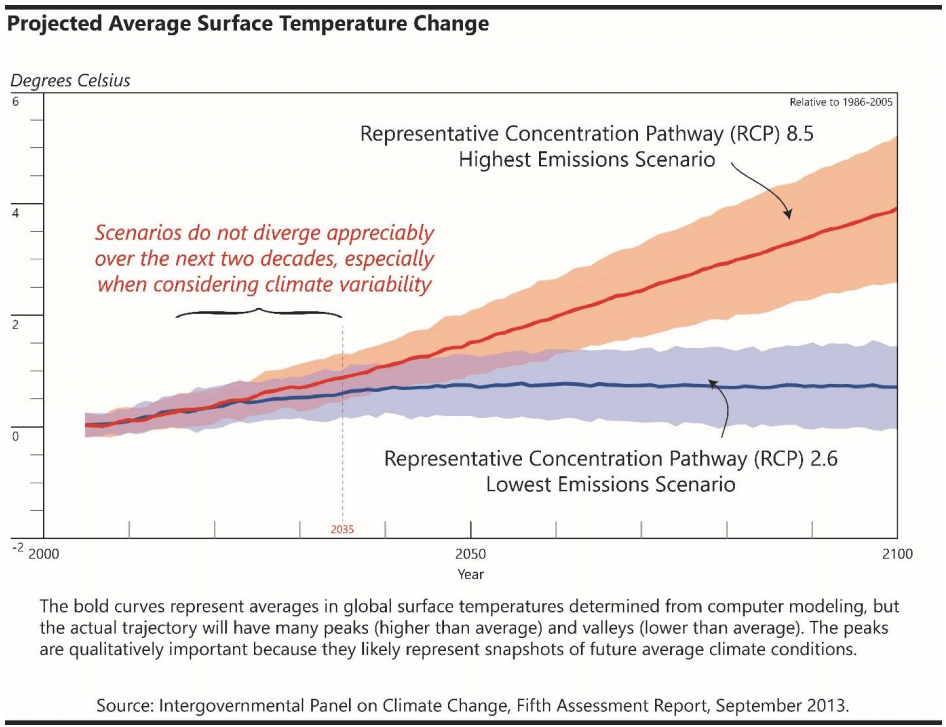
By National Intelligence Council [of the United States] – Extracted from File:Implications_for_US_National_Security_of_Anticipated_Climate_Change.pdf, Public Domain, https://commons.wikimedia.org/w/index.php?curid=73511874
The effects of climate change that the IPCC has found are particularly concerning as these impacts are happening at current rates, meaning that if Earth went carbon neutral today (we produce as much carbon as the earth can remove in a year) and maintained the current temperature increase of 1.5°C, these are the effects we can expect to see in the next few decades. This report just goes to show us how important reducing emissions are and why we should all strive to do our part.
 Applied Plant Ecology Winter 2020