In the last 10 years Quinoa (Chenopodium quinoa Willd) has been put forward as part of the solution in the challenge of global food security. The United Nations has been working through the Food and Agriculture Organization to spread Quinoa worldwide, for what 2013 was declared “International Year of Quinoa”, and the crop has been labeled a “Super Food” for its remarkable nutritional value (Gamboa et al., 2017).
The UN has been very active in recent years to show us why Quinoa is an important crop worldwide because of its potential to make a significant impact on the global food shortage crisis, and capacity to help us fight poverty, starvation, hunger and malnutrition. Moreover, as climate change rapidly degrades the farming conditions throughout the world, a crop that resists these conditions is becoming vital. A profile review of the plant is provided in their website, highlighting how this plant is notably adaptable to a wide range of conditions and highly stress resistant (FAO database).
Quinoa, originally from the Andean region, is a pseudocereal which provides all nine essential amino acids plus flavonoids, phytoestrogens, amylopectin, amylose and lithium (Ruiz et al., 2014). A chemical defense for the seeds protects it from pests, predators, and diseases. Hence, the plant requires minimal protection. One of the key aspects to highlight about this crop are the mechanisms that react to salinity levels as an essential instrument of defense to optimize water use efficiency (Shabala et al., 2012). You can all imagine how important this turns to be in places where droughts are long-lasting and increasingly happening.
This incredibly adaptable plant adjusts its growth to the environmental conditions, has a highly efficient survival mechanism, and thanks to its adaptations throughout the Andean macrozones has evolved to suite in five different ecotypes; Valleys, Highlands, Yungas, Salt flats, and Coastal or Sea Level (Murphy et al., 2015). To the world, this means we can grow Quinoa almost anywhere!
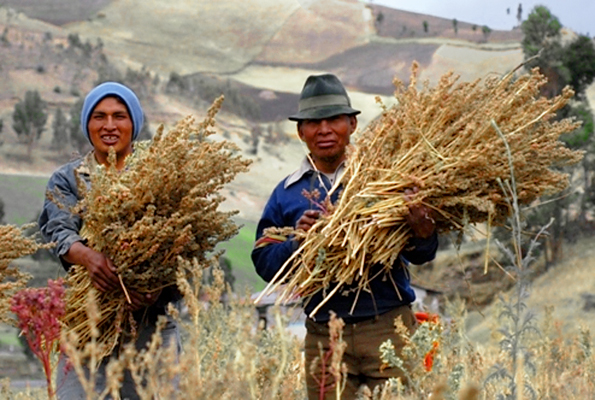
For Andean cultures that include Mapuches, Incas, Quechuas, Aymaras, and others it was sacred and a dietary staple (Valencia et al., 2010), but the Spanish discouraged and destroyed the cultivation of this crop, reducing its biodiversity. The species survived only thanks to indigenous small-scale growers in Peru, Bolivia, and Chile (Bazile et al., 2014).
References:
Bazile D, Martinez E, Fuentes F. 2014. Diversity of Quinoa in a Biogeographical Island: A Review of Constraints and Potential from Arid to Temperate Regions of Chile. NotulaeBotanicaeHortiAgrobotanici Cluj-Napoca. 42(2).
Ch14. Fao.org. 2018 [accessed 2018 Aug 20]. http://www.fao.org/docrep/t0646e/T0646E0e.htm
Gamboa, Cindybell, Monica Schuster, Eddie Schrevens and Miet Maertens. 2017. The quinoa boom and the welfare of smallholder producers in the Andes.
Ruiz K, Biondi S, Oses R, Acuña-Rodríguez I, Antognoni F, Martinez-Mosqueira E, Coulibaly A, Canahua-Murillo A, Pinto M, Zurita-Silva A et al. 2014. Agronomy for Sustainable Development. 34th ed. Institut National de la Recherche Agronomique (INRA). p. 349–359.
Shabala L, Mackay A, Tian Y, Jacobsen S, Zhou D, Shabala S. 2012. Oxidative stress protection and stomatal patterning as components of salinity tolerance mechanism in quinoa (Chenopodium quinoa). PhysiologiaPlantarum. 146(1):26-38.
Valencia B, Urrego D, Silman M, Bush M. 2010. From ice age to modern: a record of landscape change in an Andean cloud forest. Journal of Biogeography;37(9):1637-1647.
Murphy K, Matanguihan J. 2015. Quinoa: Sustainable Production, Variety Improvement, and Nutritive Value in. John Wiley & Sons.
 Applied Plant Ecology Winter 2020