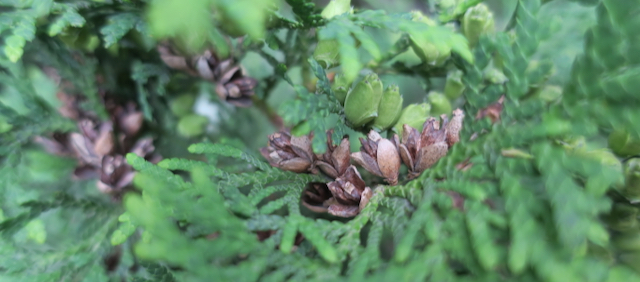
This article looks at the effect of plants in an ecosystem specifically how the loss of the loss of plant diversity affect an ecosystem. In this paper, the plants are observed in an ecosystem looking at nutrient uptake. It was speculated that higher plant biodiversity may pose a competition among the themselves and result in difficulty in the long run.
The paper uses mathematical models to understand and explain the relationships among the abiotic factors (soil) and the biotic factors in ecosystems. It was deemed that a correlation of resources i.e nutrient uptake and the species richness existed. A positive correlation is present, the paper tries to explain this result by bringing to two explanations possible one of them being the area occupied between the plant species i.e. how close are the plants to each other.
The other explanation is associated with the sampling effect “in which the average resource-use intensity increases with diversity because high-diversity plots have a higher probability of containing the most competitive species from the species pool.” (Loreau, 1998)
The paper is saying that the more plant diversity means different levels of nutrient availability and by doing so the soil may become depleted over time as the soil can not sustain that intense pressures. The plant in close proximities to the other will be directly competing for resources i.e water, nutrients, sunlight. This will lead to one being more dominant and the other to slowly die off.
Paper – Biodiversity and ecosystem functioning: A mechanistic model, Micheal Loreau PNAS May 12, 1998 95 (10) 5632-5636; https://doi.org/10.1073/pnas.95.10.5632 Communicated by Harold Alfred Mooney, Stanford University, Stanford, CA (received for review November 19, 1997)
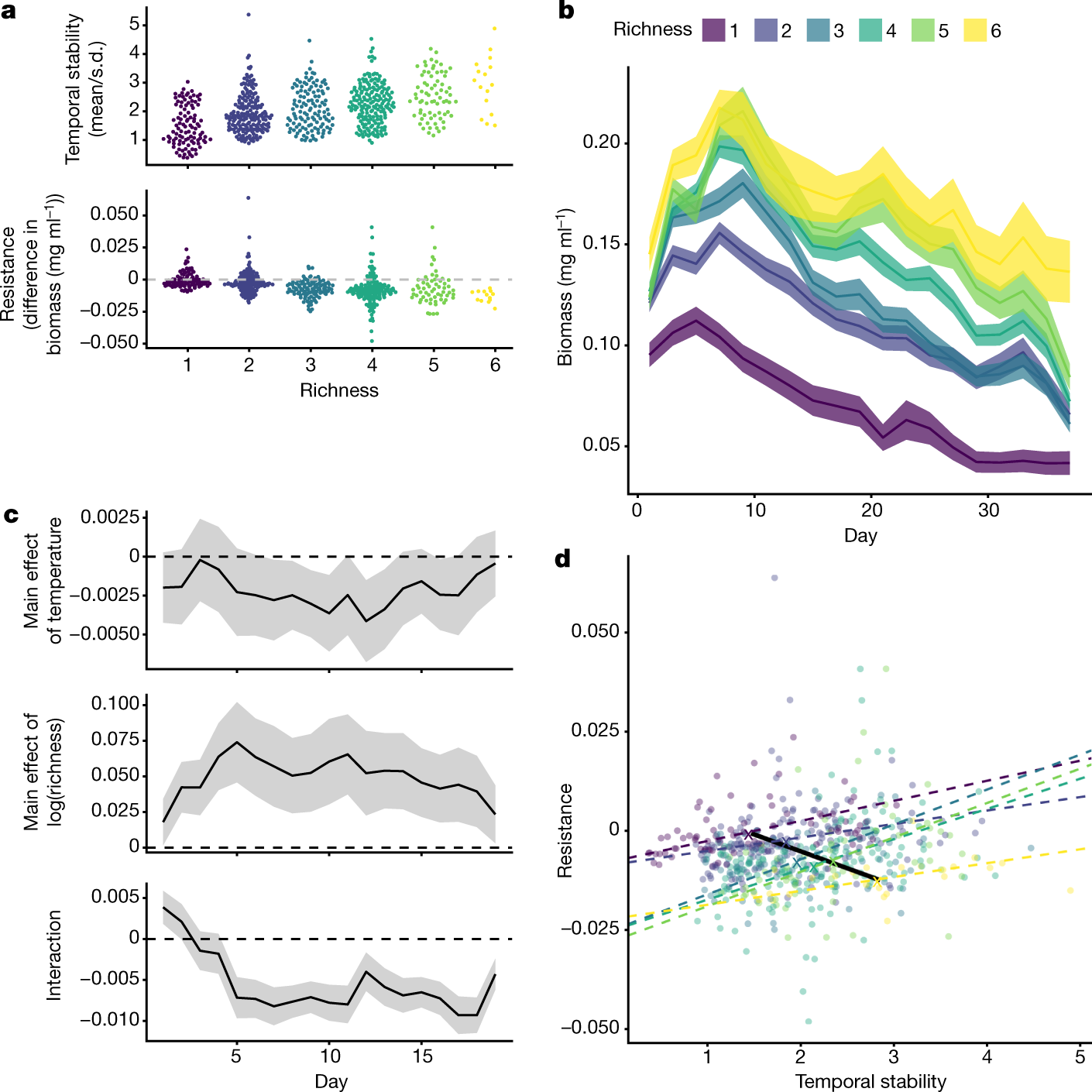
image derived from: https://www.nature.com/articles/s41586-018-0627-8
 Applied Plant Ecology Winter 2020