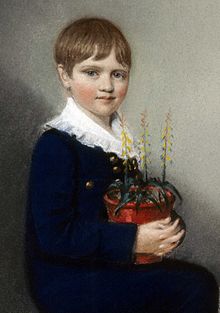
Charles Darwin was born on February 12, 1809 in the Darwin family home. He was of English descent, and had five siblings. His father, Robert Darwin, was a respected financier and doctor, and was married to Charles’s mother, Susannah Darwin. Both of his grandfathers, Josiah Wedgwood and Erasmus Darwin, were abolitionists. Overall, he came from a wealthy and well-respected family. He was baptised in 1809 into the Anglican faith, at Saint Chad’s Church. However, he often attended a Unitarian chapel with his mother and five other siblings until his mother passed away in July of 1817. After Susannah Darwin’s passing, Charles Darwin attended an Anglican school in Shrewsbury with his brother, Erasmus Darwin.
https://www.biographyonline.net/scientists/charles-darwin.html
Charles Darwin worked with his father during the summer of 1825, and acted as an apprentice doctor. In October of that same year, he attended the University of Edinburgh Medical School. However, he neglected his studies and eventually lost interest in medicine. He then started to learn taxidermy from John Edmonstone, and joined a natural history group in his second year of university. He quickly lost interest in this field as well, which irritated his father. Robert Darwin then sent him to Cambridge college to earn a Bachelor of Arts. With his Bachelor of Arts, he was expected to become a parson in the Anglican faith.
https://www.britannica.com/biography/Charles-Darwin
Darwin stayed at Cambridge University until the year of 1831, but preferred outdoor activities to studying. However, he read a book entitled Preliminary Discourse on the Study of Natural Philosophy by John Herschel. This book mainly focused on understanding natural philosophy, which really interested Darwin. He then decided to travel to Tenerife to familiarize himself with the natural history of the tropics. To prepare for this trip, he enrolled into a geology course taught by Adam Sedgwick, who saw Darwin’s potential. Sedgwick wrote a letter that recommended Darwin as a naturalist for the HMS Beagle expedition. This expedition was to span the duration of two years, and was heading to South America. Darwin immediately expressed interest in this new role, and his father reluctantly funded the expedition.
Despite suffering from seasickness, Darwin made very interesting observations on board the BHS Beagle. A significant discovery took place on the Galapagos Islands. He noted that among different islands, the finch species had slight differences. This ultimately led him to develop his different evolutionary theories, specifically that of natural selection. He defined natural selection as “the principle by which each slight variation of a trait, if useful, is preserved.” He ultimately noted that natural selection was a driving force behind evolution. Although Darwin was not original with the theory of natural selection, his time on board the BMS Beagle shaped him into the naturalist he is known to be today. Many of his contributions to academia stemmed from his time on board the BMS Beagle, and science as we know it was forever changed by his work and contributions to ecology, geology, naturalism and botany. Darwin’s legacy will forever live on through these contributions.
Works Cited
Desmond, A. J. (2020, February 8). Charles Darwin. Retrieved from https://www.britannica.com/biography/Charles-Darwin
Pettinger, T. (2012, September 4). Charles Darwin Biography |. Retrieved from https://www.biographyonline.net/scientists/charles-darwin.html
 Applied Plant Ecology Winter 2020