In honor of black history month, I want to write one of my blog post about an inspirational black women who has “grinned” her way to the top of her field despite the invisible chains that attempted to limit her from achieving all possibilities. The amazing black women I am choosing to celebrate is, Wangari Maathai.
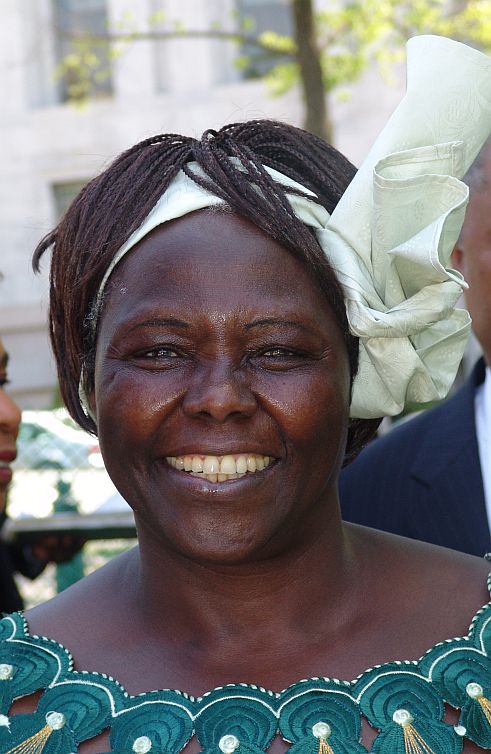
This incredible woman has accomplished much in her life; she was a social, environmental and political activist who dedicated her life to better the environmental state of her country while also helping women gain income and replenish depleting resources needed for a prosperous livelihood. She was an African women who accomplished many important things, paving the way for other black women. Allowing them to gain a sense of agency to do the unthinkable, despite the obstacles that comes with having dark skin and being a women.
Wangari Maathai, was born on April 1st, 1940 in Nyeri Kenya where she attended school, which was not common for girls at the time. After completing her high school education, she won a scholarship in 1960 that afforded her the opportunity to attend college in the U.S. Maathai went to Mount St. Scholastica College in Atchison, Kansas where she obtained her Bachelor of Biology degree in 1964. After this successful achievement, she went on to gain her masters in biological science at the University of Pittsburgh.
It is important to remember that she was completing her education during the time of the Civil Rights Movement, where racial discrimination was at an all-time high. It was a time where African Americans, fought for equality in “White America.” Maathai pursuing her education challenged the systematic notion that blacks were incapable of learning and thought to be scientifically inferior to their white counterparts in terms of their ability to learn and be educated.
However, despite this, she didn’t stop there, as she choose to continue her studies by pursuing her doctorate at the University of Nairobi; successfully gaining her Ph. D. in 1971 making her the first women scholar to gain a doctorate from east and central Africa.
She was active on the National Council of Women of Kenya where she introduced the idea of community tree-based planting in order to fight poverty and encouraging environmental conservation in Kenya. Due to her initiative there was a planting of over thirty million trees. In 1977 she launched the Green Belt Movement to tackle two important issues affecting Kenya, deforestation and women’s rights. Helping women, restore their primary source of fuel for cooking, securing income and stopping soil erosion.
During some of her activism she was physically beaten by police and classified as a “mad women” by Kenyan President, Daniel arap Moi for making her voice heard, as she acted against deforestation. Attempting to stop forest clearings for the purposes of commercial plantations that would bring about a loss of biodiversity.
In 2004, she was recognized for her astonishing work and was awarded the Nobel Peace Prize for her “contribution to sustainable development, democracy and peace,” and went down in history as the first African women to win a Nobel prize. My hero.
References
Gail M. Presbey (2013) Women’s empowerment: the insights of Wangari Maathai, Journal of Global Ethics, 9:3, 277-292, DOI: 10.1080/17449626.2013.856640
The Green Belt Movement. (2020). Bibliography: Wangari Maathai. Retrieved from https://www.greenbeltmovement.org/wangari-maathai/biography
 Applied Plant Ecology Winter 2020