In 1996, an ecologist, Dr. Jean Langenheim began a project named, “women ecologists” by sending letters to various women who were studying and practicing in the field of ecology in the United States of America.
“In 1988 I hoped that there would be no further need to discuss the contributions of women ecologists because we would be recognized just as ecologists. … Although women have become increasingly prominent as ecologists, it still seems timely and useful to consider the progress women ecologists have made in overcoming both personal and societal obstacles, particularly with regard to research contributions.”
—Jean H. Langenheim, 1996, Annual Review of Ecology and Systematicshttps://esa.org/history/women-in-ecology-then-and-now/
Jean was able to break new ground for women in science and she conducted field research on five continents, and crossed the disciplinary boundaries of botany, geology, and chemistry. She began her career when the numbers of women in science were discredited and limited – however that did not stop her from becoming the first woman to serve as president of the Association for Tropical Biology and the International Society of Chemical Ecology (which she founded), as well as the second woman president of the Ecological Society of America and the Society of Economic Botany.
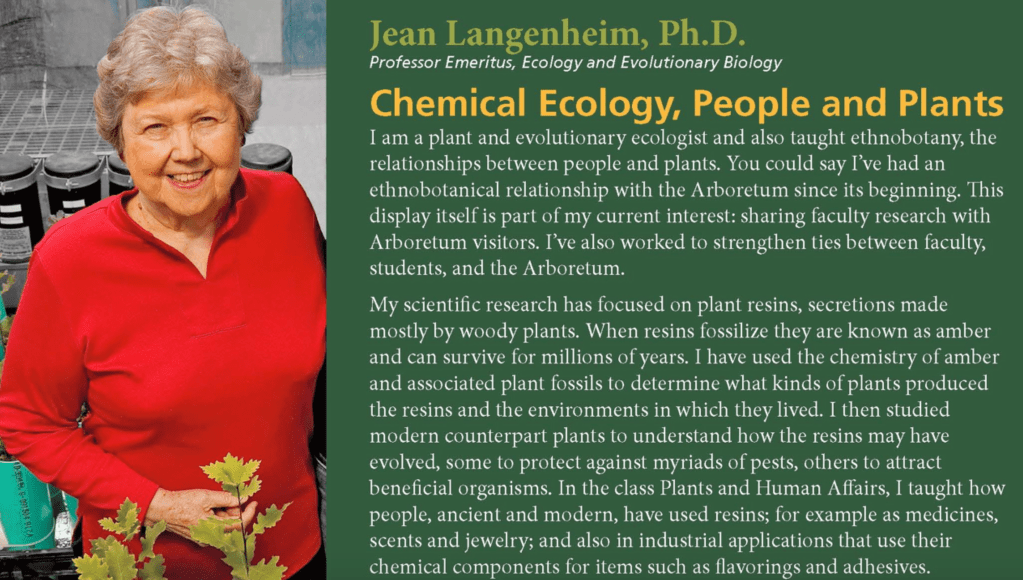
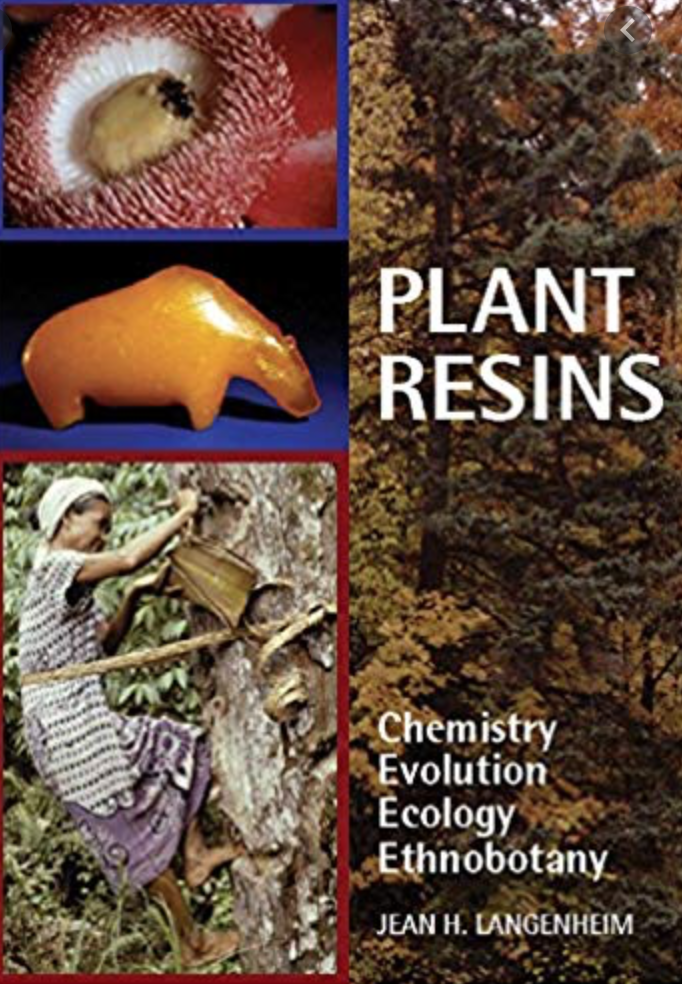
For her research she was able to travel throughout the world ranging from tropical lands to arctic and alpine environments. She became widely recognized for her use of innovative chemical techniques in order to evaluate the plant origins of amber (fossilized resin) which allowed her to publish a book, Plant Resins (Timber press).
Jean studied with William Skinner Cooper, a leading plant ecologist and geobotanist, finishing her Ph.D. in 1953, a time when there were few women field scientists. Jean later published a reminiscence, “W. S. Cooper as I Knew Him: Teacher, Mentor, and Friend” [Bulletin of the Ecological Society of America 96 (2015): 184-208], in which she commented that Cooper’s efforts to give women advanced training in ecology and help them overcome hurdles had not been generally recognized. It was departmental policy at the time to allow women to do only master’s degrees, with the idea that they would become teachers.
In 1966 Jean returned to the University of California as Assistant Professor at the newly founded campus of UC-Santa Cruz, where she taught additional graduate courses that offered new ideas and perspectives in chemical and tropical ecology, including ecological history concepts.
In addition to examining the history of ecology over her long career, her biography helps us to understand the changes in the status of women in STEM over many decades, changes that Jean herself helped to bring about. Jean has written about women in ecology, “The Early History and Progress of Women Ecologists: Emphasis on Research Contributions” [Annual Review of Ecological Systems 27 (1996): 1-53], which displays remarkable women in STEM who have added to the field of ecological research.
 Applied Plant Ecology Winter 2020
