
A steady climate is important in maintaining success for life and environments on Earth over time. As the Earth gets warmer, species become displaced because of floods, volatile weather or simply moving away in search of better environments. Climate suddenly changing can mean bad results to organisms used to living a certain way. As temperatures warm, plants that are not used to this climate shift to places that are more favourable. When plant species migrate to new locations, competition and crowding will occur, which would eventually lead to extinction.
Climate change is one of the main factors of plant migration. In the paper I chose, the researchers used modelling to predict how plant communities respond to different factors (i.e. temperature change) after a specific time. This is especially helpful when the challenge is on a large-scale and proves difficult to do experimentally. Modelling creates future scenarios which scientists can use to figure out how to fix these environmental problems. This tool lets you take a complicated system like plant migration and simplify it to better understand its issues and how to fix it.
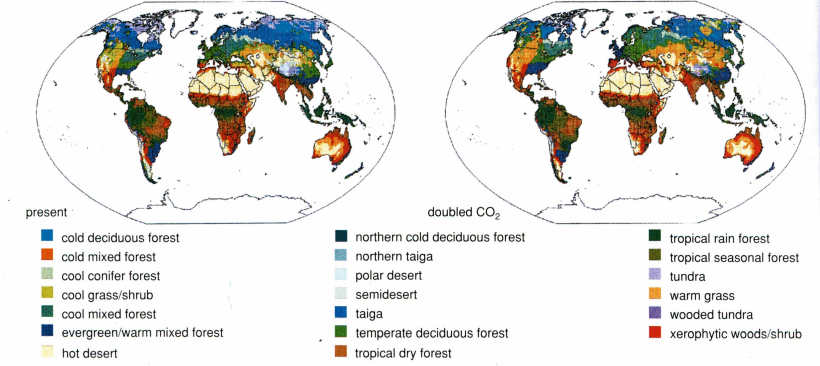
In the model the researchers created, they discovered a difference in vegetation location after carbon dioxide is doubled. In the doubled CO2 model, biomes like the taiga and the northern taiga have seemed to decrease around Russia. Also, areas in Australia and western Canada show an increase of warm grass biomes. This loss and gain of plants are due to the amount of carbon dioxide in the environment, which has negative effects on plant life.
I settled on this paper because I wanted to learn more about plant migration. Plants that migrate because of changing temperatures due to external factors like climate change can cause long-lasting damage to their original ecosystem and to themselves by moving. Plants provide support and resources to other organisms, and in turn, they should be protected from human and natural destructions. Climate change can be reduced, and greenhouse gases repressed with a mass reduction of emissions and useless energy. This way, plants will not have to migrate to other places when environmental conditions get too extreme.
Reference
Pitelka LF. 1997. Plant Migration Workshop Group. Plant migration and climate change. Am Sci 85:464–73
 Applied Plant Ecology Winter 2020