Tansley’s 1917 paper brought into prominence an ecological problem of considerable interest and importance, namely the relation of competition between species, particularly closely related species, to their soil preferences. In order to investigate this phenomenon, two species, Galium saxatile and Galium sylvestre, in competition were grown on different types of soil. G. saxatile is ubiquitous on on light siliceous soils and G. sylvestre appears to be confined to limestone hills and pastures.
Results
1. Calcerous soil: the seedlings of G. sylvestre grew quite normally, but those of G. saxatile show marked chlorosis very shortly after germination, and growth is very slow for many weeks. The terms “chlorosis” and “chlorotic” are used to designate the yellow or yellowish brown colouring of the leaves of the seedling.
2. Garden loam: not a type of soil on which either species usually occurs in nature, therefore, the original experiment failed due to lack of germination.
Autumn 1912: G. saxatile was sown and established itself during the next season (1913).
June 1914: a healthy tuft of G. sylvestre grown on the same type of soil was planted in the middle of the mat and established itself during the summer.
July 1915: this plant was holding its own quite successfully in the midst of the mat of G. saxatile which had in the meantime spread over the whole box.
During 1916: the G. sylvestre steadily spread, overshadowing the G. saxatile, whose growth became less vigorous.
In 1917: this process continued and by September G. saxatile had completely disappeared and the box was almost entirely occupied by a mat of G. sylvestre derived from the tuft planted in 1914.
3. Peat: germination of both species was slow and the plants remained small and did not flower during the first year. However, during the second year, growth was considerably more vigorous and some plants of both species flowered. G. saxatile spread rapidly during the third summer, forming a continuous mat over considerable areas of the soil, in which isolated shoots of G. sylvestre maintained themselves quite vigorously. The growth of G. saxatile in the peat boxes was not so rapid and luxuriant as that of G. sylvestre in the boxes containing calcareous soil, and even in 1915 the peat was by no means completely covered. In the autumn of 1917 all three of the peat boxes were completely covered (except for some patches occupied by Molinia) with G. saxatile, among which a few quite healthy plants of G. sylvestre were still maintaining themselves.
4. Natural sandy loam: both germinated and grew well, G. saxatile somewhat
more vigorously than G. sylvestre. TheK former became dominant, but the
latter maintained itself as isolated plants among the mat of G. saxatile so long
as the cultures were kept (three years).
Roots vs. Shoots
Shoots: competition appears to work through the direct suppression of the shoots of one species by those of the other as a result of the more vigorous growth of the species which is growing on its “preferred” soil. Shoot competition acting in this way appears to be adequate as, the cause of the suppression of one species by the other.
Roots: no evidence of root competition was found, though the case of the plant of G. saxatile which flourished on the corner of the box of calcareous soil, where its shoot escaped the competition of the shoots of the dominant G. sylvestre, is, to an extent, evidence against the effectiveness of root as opposed to shoot competition.
What’s missing though?
- Abstract
- Hypothesis
- Statistics
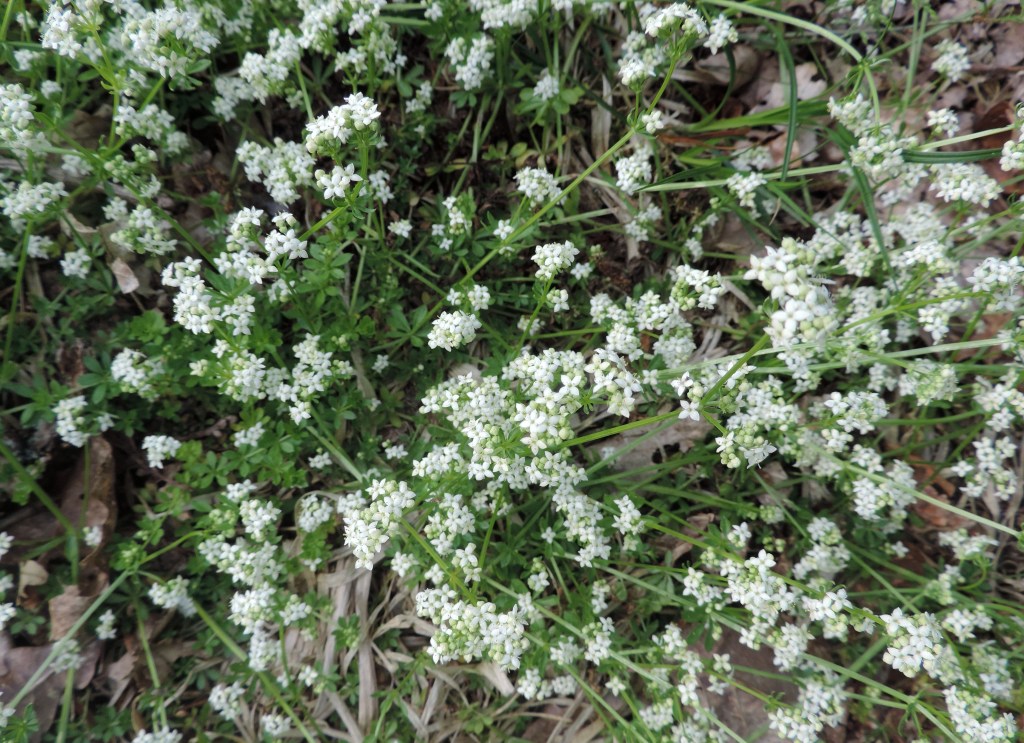
- Considering that the study largely discusses two species of plants, there should really be a photograph of each of them.
Reference
Tansley, A. G. “On Competition Between Galium Saxatile L. (G. Hercynicum Weig.) and Galium Sylvestre Poll. (G. Asperum Schreb.) On Different Types of Soil.” Journal of Ecology, vol. 5, no. 3/4, 1917, pp. 173–179. JSTOR, http://www.jstor.org/stable/2255655. Accessed 28 Feb. 2020.
 Applied Plant Ecology Winter 2020