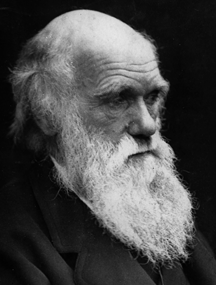
Charles Robert Darwin was born in 1809 in Shrewsbury, England and was a British naturalist known for his theory of evolution and his deep understanding of the process of natural selection. Darwin was born into a family of scientists, in which he was the second youngest of six kids and a child of wealth and privilege. Having high hopes that Darwin would follow his footsteps and become a doctor, his father had him enroll at the University of Edinburgh Medical School, however, Darwin was uninterested and the sight of blood supposedly made him queasy. His father then had him enroll at Christ’s College in Cambridge to achieve a Bachelor of Arts degree to become a parson. Though Darwin graduated in 1831 with a Bachelor of Arts degree, he was far more interested in studying natural history.
He became a close friend and follower of botany professor John Stevens Henslow at Christ’s College, who had encouraged him to aboard the HMS Beagle. The HMS Beagle launched its voyage around the world on December 27th, 1831 and was considered an opportunity of a lifetime for an aspiring naturalist. While it was initially planned to last for two years, it was extended to five. Darwin collected a wide range of natural specimens, including birds, plants, and fossils. The Pacific Islands and Galapagos Archipelago in South America were of particular interest to Darwin. Years later, Darwin compiled all of his research into his famous book, On The Origin of Species.
Following a lifetime dedicated to research, Darwin passed away in his family home, Down House, in London, England on April 19th, 1882. He was buried in Westminster Abbey. As he once stated, and to wrap up this blog on an inspirational note, “a man who dares to waste one hour of time has not discovered the value of life.”
Reference
“Charles Darwin.” Biography.com, A&E Networks Television, 28 Aug. 2019, http://www.biography.com/scientist/charles-darwin.
 Applied Plant Ecology Winter 2020