What the 2019 Report on Climate Change says about Vegetation Loss
The IPCC (Intergovernmental Panel on Climate Change) an intergovernmental panel of the United Nations published a short report last year. This Summary for Policy Makers also holds integral information on the impacts of climate change on vegetation worldwide.
An increase in photosynthetically active plant biomass is referred to as vegetation greening which a decrease is referred to as vegetation browning. This is because when viewed from satellites certain areas appear to be becoming more green or brown over time.
Over the last 30 years, vegetation greening has been occurring in parts of Asia, Europe, South America, Central North America, and southeast Australia due to extended growing seasons, increased nitrogen deposition, increased CO2 fertilization, and intensive land management practices. On the other hand, vegetation browning has been occurring in parts of northern Eurasia, parts of North America, Central Asia and the Congo Basin due to water stress. Generally, more vegetation greening has occurred over vegetation browning.
While this might seem to be favorable, after all, “more plants are better, right?” there are hidden consequences for shifting of the greening and browning patches on Earth. The biggest implication comes from the overall albedo effect (more snow cover = more reflectance = higher albedo = cooling of Earth’s surface temperatures). Which increasing vegetation greening in the polar regions, more snow cover will be replaced by vegetation cover. This will reduce the amount of energy that hits the ground to be reflected back. Decreased reflectivity means lowering the local albedo, which in turn, contributes to the heating (warming) of the Earth.
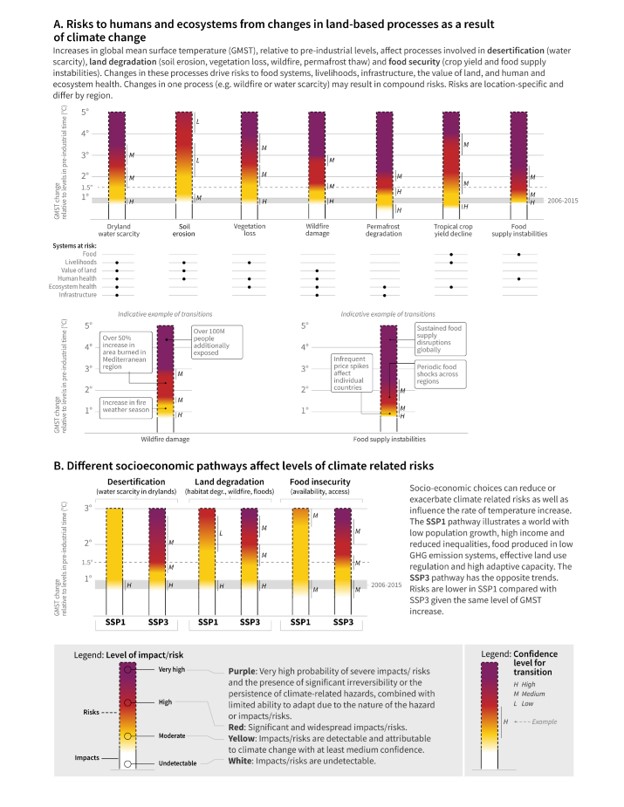
As can be seen in this figure, vegetation loss directly impacts livelihoods, human health, and ecosystem health. This figure also goes on to show the level of impact of climate change (increasing temperatures) on vegetation loss. Cascading risks, such as water scarcity, soil erosion, crop yield declines will exacerbate the loss of biodiversity and vegetation worldwide. While the risk from vegetation loss will be very high at 3°C of global warming, effects will be felt at just 1.5°C of global warming. This will occur in part due to the risks from dryland water scarcity, wildfire damage, and permafrost degradation being high at 1.5°C. An increase in disturbances (flood, drought, fire, pest outbreaks, or future poor management) will lead to loss of accumulated carbon in vegetation.
Restoring natural vegetation and planting trees on degraded land may aid in sequestering carbon in the top and subsoils. However, afforestation, reforestation, agroforestry, soil carbon management on mineral soils, or carbon storage in harvested wood products will not store this carbon indefinitely. Conservation agriculture practices must focus on maintaining carbon stocks carefully because if this is lost then it will take a long time for it to recover.
References:
Intergovernmental Panel on Climate Change. (2019). IPCC Special Report on Climate Change, Desertification, Land Degradation, Sustainable Land Management, Food Security, and Greenhouse gas fluxes in Terrestrial Ecosystems: Summary for Policymakers, 2019. Retrieved from https://www.ipcc.ch/site/assets/uploads/2019/08/4.-SPM_Approved_Microsite_FINAL.pdf
“Overview.” National Academies of Sciences, Engineering, and Medicine. (2019). Understanding Northern Latitude Vegetation Greening and Browning: Proceedings of a Workshop. Washington, DC: The National Academies Press. doi: 10.17226/25423.
 Applied Plant Ecology Winter 2020