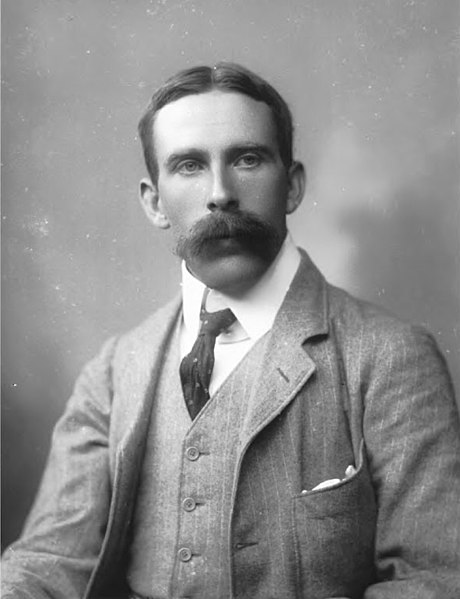
Arthur Tansley published a paper in the Journal of Plant Ecology in 1917 titled “On Competition Between Galium Saxatile L. (G. Hercynicum Weig.) And Galium Sylvestre Poll. (G. Asperum Schreb.) On Different Types of Soils”. The original method was to plant the seeds of the two species together in different types of soils. The four types of soils used were (1) calcareous garden soil, (2) a non-calcareous and a reddish-yellow garden “loam”, (3) a strong acid peat, as well as a (4) natural sandy loam (Tansley, 1917).
Article: https://www.jstor.org/stable/2255655?seq=3#metadata_info_tab_contents
Tansley, A. G. (1917). On competition between Galium saxatile L.(G. hercynicum Weig.) and Galium sylvestre Poll.(G. asperum Schreb.) on different types of soil. The Journal of Ecology, 173-179.
RESULTS
Behaviours of the Plants on Different Soils
1. Calcareous Soil
G.sylvestre grew normally but G.saxatile showed chlorosis after germination and grew extremely slow for many weeks and both plants ended up dying
2. Non-Calcareous Soil
Naturally neither of the two species grow in this type of soil due to lack of germination. However, during 1916, the G.sylvestre grew steadily, overshadowing the G.saxatile whose growth became less vigorous. Eventually, G.saxatile completely disappeared and the mat was completely covered with G.sylvestre.
3. Acid Peat
Germination of both plant species were very slow and the plants remained small and no flowering was seen in the first year. During the second year there were some flowering of both G.sylvestre and G.saxatile. In the third summer, G.saxatile spread rapidly while a few healthy plants of G.sylvestre still remained.
4. Natural Sandy Loam
Both germinated a grew well, but G.saxatile more rapidly than G.sylvestre.
Competition: Between Shoots or Roots?
Tansley argued that competition appeared to work through direct suppression of the shoots of one species by the other due to the growth of one of the species growing on its preferred soil. He also argued that there was no root competition.
BUT…..WHAT’S MISSING AND WHY?
A lot of research papers now include abstracts, introduction, materials and methods, and results which most importantly use STATISTICS to analyze their data. So when comparing research papers now and the 1917 paper from Tansley we can conclude that one thing that is mainly missing is STATISTICS. Why you may ask? Well…. It’s simply because statistics was not full invented by 1917 when Tansley published this paper. As you can see, we have come a long way in terms of scientific reports and data analysis over the past century…. and there is definitely a lot more to come!!!
 Applied Plant Ecology Winter 2020
