Pattison et al, conducted research on the Growth, biomass allocation and photosynthesis of invasive and native Hawaiian rainforest species, in the year of 1998 (the year I was born!).
This primary research article is based on a study done on the growth, biomass allocation, and photosynthetic characteristics of seedlings of five invasive non-indigenous and four native species grown under varying light frequencies to help explain the successive growth of invasive plant species in Hawaiian rainforests.
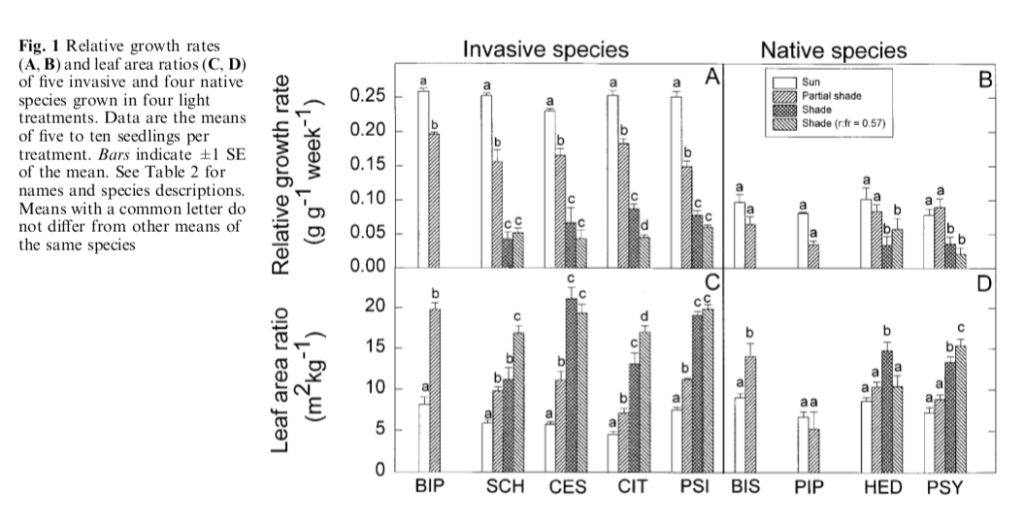
“Relative growth rates of invasive species grown in sun and partial shade were significantly higher than those for native plant species, averaging 0.25 and 0.17 g, native averaged 0.09 and 0.06 g, and the relative growth rate (RGR) of invasive species under the shade treatment were 40% higher than that of native species”
(Pattison et al. 1998)
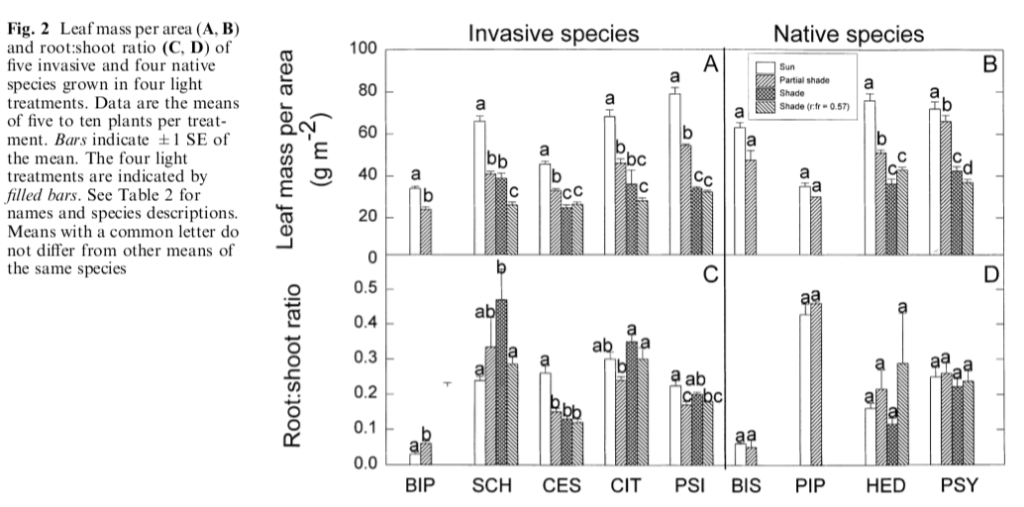
However, observations yielded found that there were no differences between native plants and invasive plants in terms of biomass allocation to shoots and roots or in leaf mass per area across light environments. The light-saturated photosynthetic rates were higher for invasive species than for native species under all tested light treatments.
Invasive species assimilate more CO2 at a lower respiratory cost than native species suggesting that invasive species may have higher growth rates than native due to higher photosynthetic rates. Currently there are more than 4600 non-native plant species in the Hawaiian islands, of which are 800 spreading and reproducing independently of human action.
Invasive species prevent seedling establishment of native species by occupying “safe sites” and by outcompeting native seedlings for limiting resources (survival of the fittest!!).
“It is said that invasive species are deemed successful due to their phenotypic plasticity”
Williams et al. 1995
A possible ultimate explanation for the differences between invasive and native species is that native species in Hawaii, a group of islands with low species diversity and disharmonic flora, have undergone less selective pressure to compete for light resources than invasive species. Arguments have arisen against evoking the idea that competition for resources is stronger on mainland than on island ecosystem. The results of this study suggest that invasive species in Hawaii may have higher growth rates than native species as a consequence of higher photosynthetic capacities of plants growing under sun and partial shade, lower dark respiration rates under all light treatments, and higher LARs for plants growing under shade conditions. The removal of elements that create disturbances in these Hawaiian ecosystems is likely to reduce the spread of invasive species. The Herbivore pressure and susceptibility to pathogens may affect potential growth rates in field conditions.
 Applied Plant Ecology Winter 2020